I’m sure many of you have already seen Steven Speilberg’s acclaimed “Lincoln.” I am eager to see it myself. My favorite part of American history is from the Civil War to the present, mainly because it is captured in photographs.
Abraham Lincoln is a most compelling and thoughtful man. Lori, in her post, describes how his tendency towards depression from his melancholy nature created the man of character we so admire.
For much of my life I too was deposed towards melancholy fueled by an artist’s temperament. It took me many years to figure out the cause (and therapy, much of it useless) and now having that knowledge, I can say that my life is much calmer. The roller coaster ride has smoothed out into floating downstream.
Here’s a teaser to Lori’s post with a link to the rest. And let me know if you’ve seen “Lincoln” and what you think of it. Can’t wait to go myself!
You probably already know a quite a bit about Lincoln, but one aspect of his story may not be familiar to you. In particular, I want to tell you about a gift that Lincoln possessed, the gift of melancholy. Melancholy—which is related to what we would call depression—was both a blessing and a curse to Lincoln. I think the story of how he bore that affliction, and of how it deepened his character and faith, holds some lessons for us today.
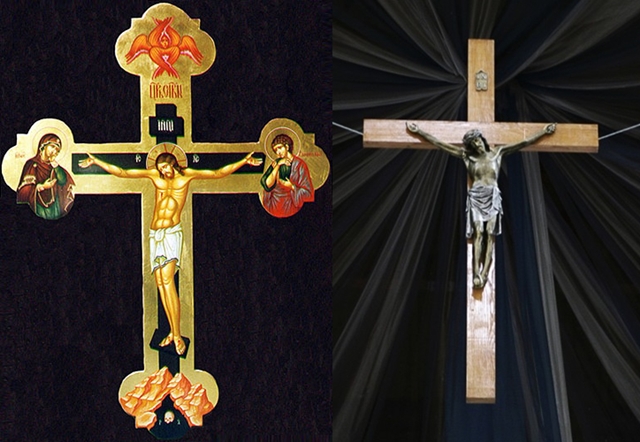
My husband represents the East as a deacon in the Eastern Catholic Melkite Church. The Eastern Catholic Churches celebrate the Byzantine liturgy with its many beautiful and meaningful rituals. Their sanctuaries are full of beautiful icons with gold backgrounds; they appear at times translucent, permitting the eye and the imagination to travel beyond this world to heavenly heights.
It’s the Orthodox tradition: experiential, sacramental, mystical, rich and deep.
I represent the West as a Roman Catholic. My home parish is a mini cathedral with carved pillars supporting graceful Corinthian arches. Light-filled and colorful, the stained glass windows tell stories of the Gospels through the rosary mysteries. Paintings of the stations of the cross line the walls, inviting one to prayer. And the golden tabernacle, holding the true presence of Christ in the host, is positioned in the place of honor at the front of the church, behind the altar.
I come from the Roman tradition, also sacramental, rich and deep, but based more on reason perhaps than experience.
I love living in an East-West household, receiving the benefits of Eastern thinking, augmenting, and softening perhaps my Western way of thought.
My husband and I share many lively discussions about our faith.
His conversion to the Eastern Catholic Church was one of the greatest gifts to our marriage.
I enjoy learning about his approach to faith and can do so readily through a website known as Ancient Faith Radio. One can listen 24/7 to beautiful Byzantine chant and learn from the many podcasts espousing Orthodox teaching.
My favorite is “Search the Scriptures,” hosted by Dr. Jeannie Constantinou, presenting “interesting and accessible bible study for busy people.” Dr. Jeannie, thanks to her vast education in a variety of settings, combines a passionate love for the Bible and Orthodox spirituality with her love of ancient history. She makes the pages and people of the Bible truly come alive.
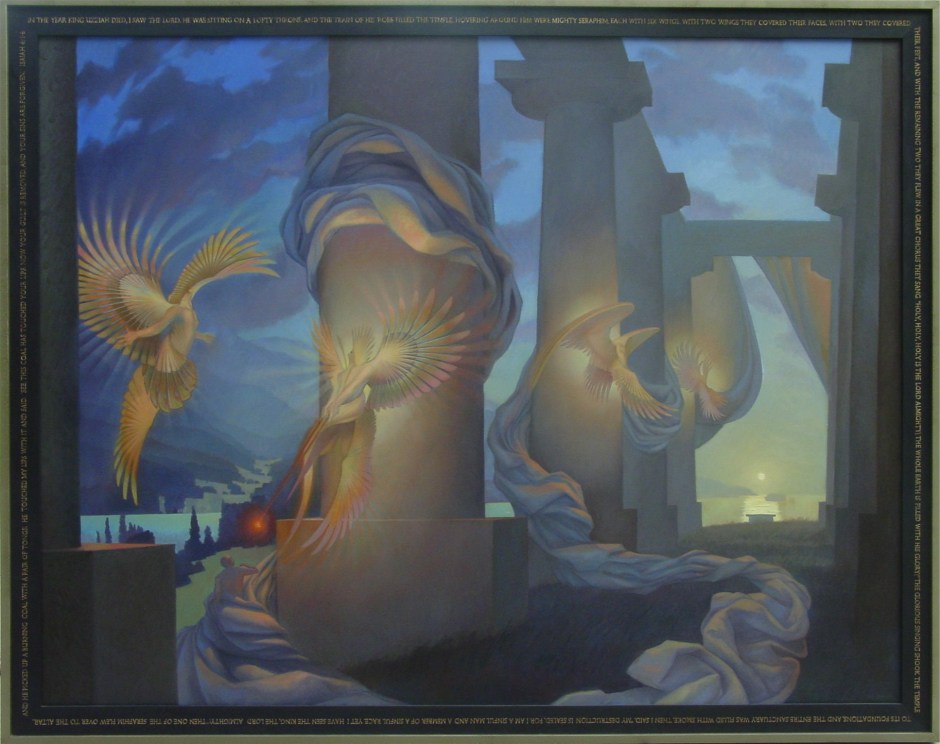
Today she taught about Isaiah, chapter 6 which describes the prophet’s vision of heaven
It reminded me of why mystery is such a wonderful and freeing concept.
The first three verses of chapter 6 read as follows (New King James version):
In the year that King Uzziah died, I saw the Lord sitting on a throne, high and lifted up, and the train of His robe filled the temple. Above it stood seraphim; each one had six wings: with two he covered his face, with two he covered his feet, and with two he flew. 3 And one cried to another and said:
“Holy, holy, holy is the Lord of hosts; The whole earth is full of His glory!”
Dr. Jeannie went on to explain, citing her favorite Church Father St. John Chrysostom (aka, “The Golden Mouth), the impossibility of describing the nature and essence of God. As God is formless, there is no way to physically describe Him. Why even the seraphim are formless!
So how can Isaiah write this description of heaven?
Isaiah needed a way to convey the truth of what he saw in his vision: the utter majesty and glory of God. Even though seraphim are not known to have form, the traditional image is of an angel with wings (and in this case, six). By having the seraphim covering his face and feet with his wings, Isaiah is demonstrating how the being could not look upon the countenance of God, for His glory was too much for him. St. John Chrysostom goes on to explain the meaning of the feet being covered as well as the face, as a means of demonstrating the seraphim’s knowledge that he was a lowly creature in the sight of such magnificence.
Dr. Jeannie cited other parts of the Bible, including the Genesis creation story as similar examples of writers using human examples to describe the indescribable so as to convey important theological and spiritual truths.
Looking at the Bible that way, backed up by rich ancient history she provides, surely does make the pages and people come alive.
But the reason why I so enjoy hearing the Bible taught in this way, through the lens of Orthodoxy, is that it reminds me of the utter mystery of God.
Rather than trying to explain difficult concepts such as the Holy Trinity or the essence of God, how much more enjoyable, fruitful and freeing it is to just release the need to understand and go with the flow of the mystery, allowing it to sweep me along.
This, of course, requires a Guide (the Holy Spirit), thus I need to remain in prayer to continue the journey safely.
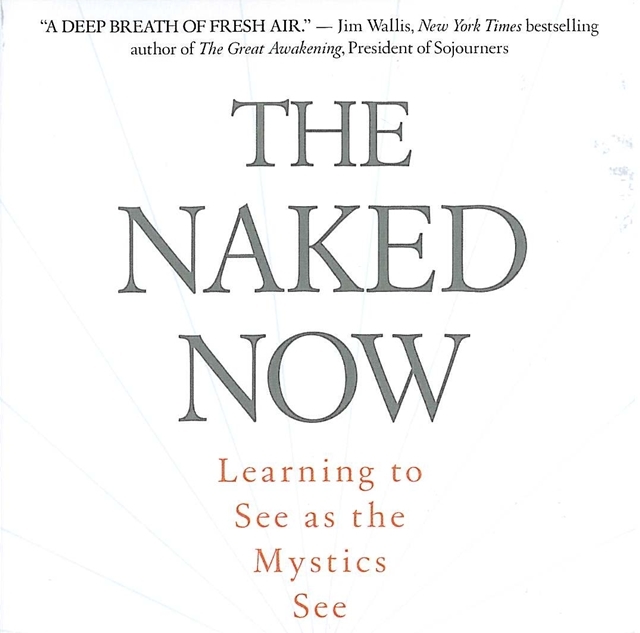
The book I cited in my last post, The Naked Now, presents a simple and profound way to remain in prayer at all times and it fits in perfectly with the indescribable magnificence of God.
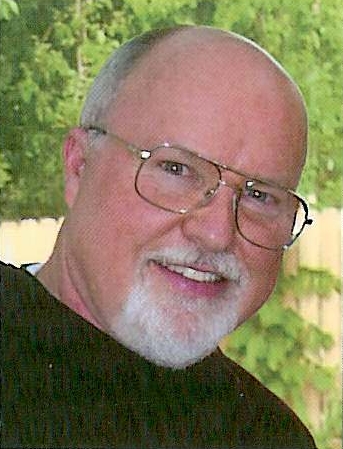
Author Richard Rohr
Richard Rohr, in talking about the name of God, said that word Yahweh (in Hebrew, YHVH) “was considered a literally unspeakable word … From God’s side the divine identity was kept mysterious and unavailable to the mind; when Moses asked for the divinity’s name, he got only the phrase that translates something to this effect: “I AM WHO AM … This is my name forever, this is my title for all generations.” (Exodus 3:14-15) (page 25, The Naked Now by Richard Rohr).
Rohr says the word was not spoken; no, it was breathed. The first and last thing we do each day, and at the beginning and end of life. The thing that we must do to live.
We breathe, thus speaking the unspeakable, over and over again.
Breathing and mystery … wonderful things to lose myself in today …
Today I started reading a book entitled The Naked Now by Richard Rohr. I originally planned on reading it because a group I belong to, the Commission of Women of the Diocese of Worcester, chose this book as the one they wished to study this year. A dear friend of mine, a deacon in the Catholic Church, had also highly recommended it.
Rohr aims to teach the reader to see as the mystics see.
I have long resisted the notion of being a mystic though this same friend insisted that I be open to the idea. The pragmatist in me, the one who is unimpressed with splashy theatrics and celebrity, would have nothing to do with it. I saw no connection between my earthly life and supposed “heavenly visions.” I mistakenly connected mysticism with crying statues; I wanted nothing to do with it.
However, the creative in me, now being regularly exercised with reading and study, began to speak up and say,
“Hold on a minute. Maybe there is more to this than meets the eye.”
And my inner self, also exercised daily with prayer and reflection, objected too.
The Naked Now is now affirming something I’ve been experiencing ever since I started all this exercising: this newfound ability to “read between the lines,” and it is growing exponentially.
Rohr spells out three ways to view the world through a simple example: how three people view a sunset. One simply enjoys the beauty, nothing more. A second enjoys the beauty and understands the science behind a sunset, giving him extra insight.
The third not only appreciates the beauty and perhaps the science, but also “tastes” the experience. His vision enables him to transcend the physical experience to something mystical.
Rohr calls this seeing with the “third eye.” And I knew exactly what he meant.
I experienced that kind of vision all summer long in my lunchtime walks through the woods, past streams and alongside the lake at Wellesley College. Some of these experiences were quite intense, most especially my kayak trip on Lake Waban.
And I had noticed this vision even before the summer.
Reading the Bible had always been a difficult and dry experience. I simply could not understand what it was trying to tell me. However, last year I began to experience a strange sensation while reading: my mind and my heart would be literally flooded with ideas and insights. It was thrilling and a little scary. It was like God was chattering at me!
I don’t remember when I began acquiring this “third eye” but I am guessing it is connected to a few newer habits in my life: challenging reading, journaling and blogging, and set times for prayer. (This blog is a result of those new habits.)
I allowed myself to be carried in the flow of God’s will, just like my kayak floats down river. I went with the flow and without realizing it, accepted an invitation from God to go deeper with my faith.
I didn’t really know what was happening but had a sense that it was better to just “go with it” rather than to question.
And now, I have a book that will explain what’s been happening.
And the best part is, you can experience this too.
Everyone is called to be a mystic. It’s what Jesus intended. It was not just for those saints we see commemorated in statues and prayer cards.
Jesus means for each of us to experience this “third eye,” a direct result of a close, intimate relationship with Him.
The closer we get, the better we see.
And that’s when life really starts to take off. Surrounded by and immersed fully in this Divine love, we can experience what Henri Nouwen wrote in that post I highlighted the other day, “It is in the heart of God that we can come to the full realisation of the unity of all that is, created and uncreated.”
I belong to a wonderful group of women from the Diocese of Worcester, Massachusetts known as the Commission for Women of the Diocese of Worcester. Established in 1989 by Bishop Timothy J. Harrington, the following mission statement of the commission explains its goals:
“The Commission for Women shall serve as an advisory board to the resident bishop of Worcester in regard to women’s issues. It shall function as a liaison between women in the diocese and the resident bishop, raising and promoting awareness of the evolving role of women in the church and society. The commission shall strive to bond together the women of the diocese through spiritual, educational and social programs.”
I help out with the blog and wanted to invite you to join our Virtual Book Club. We are studying The Cup of Our Life by Joyce Rupp. It is a wonderful spiritual guide with an array of exercises involving a written reflection by Joyce, quiet prayer time, and prompts for journaling.
Joyce Rupp recently presented a retreat day for women with subject being “The Art of Self Compassion.” It was a truly blessed day and you can read all about it here.
Because of the enormous success of this day, we are following up with this study of The Cup of Our Life (I will be writing the blog posts). Our hope is to create online discussion as we reflect upon the spiritual wisdom offered in this book.
This blog is supposed to be about making connections.. Lately it’s felt more like a hodgepodge, just a collection of unrelated posts. This blog is certainly challenging me to live out what I preach: living life in a single flow.
It ain’t easy!
This weekend however, it suddenly got a lot easier. I was blessed to attend two extraordinary events which practically shouted “Connections! Connections!” to me. The pen couldn’t move fast enough across the page of my notebook to capture all I was hearing so I could share it with you.
I will begin with this past Sunday night.
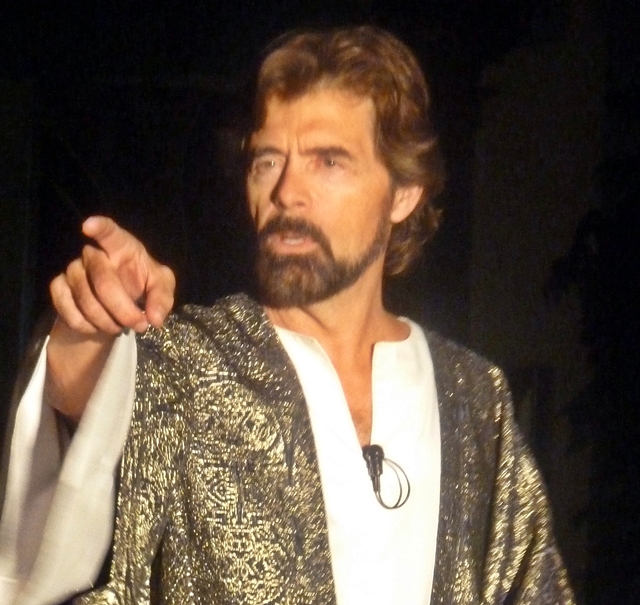
I teach CCD to high school students and needless to say, it is a challenge. Instead of our normal class last night, the students were treated to a one-man play about the Gospel of St. Luke. It was written and performed by Frank Runyeon.
Frank is a successful actor in television and movies. His bio reads, “He starred for seven years as Steve Andropoulos on As the World Turns opposite Meg Ryan, a storyline that garnered the second highest ratings in the history of daytime television. He next appeared for four years as Father Michael Donnelly on the Emmy award-winning Santa Barbara, and as tycoon Simon Romero on General Hospital, opposite Emma Samms. Frank has also guest-starred in recurring roles on L.A. LAW as talk-show host Brooks Tapman, on Falcon Crest as chess genius Jovan Dmytryk, on Melrose Place as Father Tom, and on All My Children as Forrest Williams.”
But Frank would rather be associated with the art closest to his heart: spreading the Good News of Jesus Christ through his vibrant performance of the Gospels.
He debuted his latest one-man play, “Luke, Stories on the Road” at the parish to which I belong, St. Luke the Evangelist in Westborough, MA.
Ah, the first connection!
I came with low expectations. I’m not a big movie-goer nor have I seen a lot of live plays. I had had a fight with my husband, was blown-out from a weekend of endless activity and just wanted to crawl under the covers.
So it took a bit of time to warm up.
About a half hour into the performance I felt a sudden urge to whip out my notebook and write. Frank spoke and I’d write. His performance became riveting.
The camera soon followed. As a former girl scout, I am always prepared!
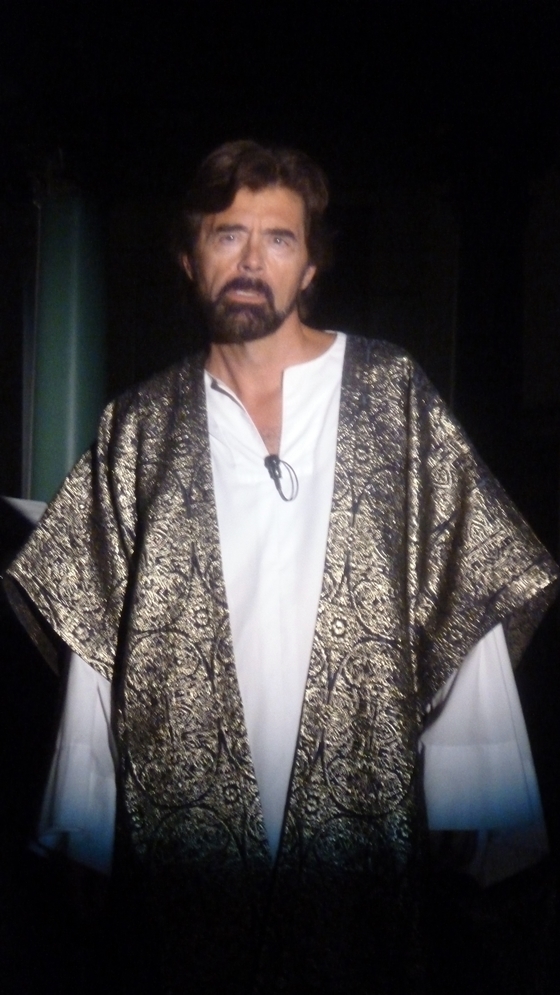
Dressed in a simple robe, Frank wove stories from the Old and New Testament, focusing first on the story of King David and his disastrous affair with Bathsheba and moving into the stories of Jesus as recorded by Luke the Evangelist.
In each story, he shared a similar and striking insight: the stories, in many cases, had open endings.
The reason? WE are the ending to the story.
How can that be? These stories are thousands of years old. But inspired by the Spirit of the Living God, their truths are as pertinent today as they have ever been.
And Frank made the scriptures come alive with his talented way of weaving a tale.
Past and present – another connection.
Frank made an important association between the story of King David and Bathsheba (2 Samuel 11; 2 Samuel 12) and the parable of The Rich Man and Lazarus found in Luke 16:19-31.
In the story of King David, Bathsheba found she was pregnant after their affair. To cover up their relationship, David arranged to have her dutiful warrior husband killed in battle (2 Samuel 11). Nathan the prophet was sent by the Lord to point out David’s sin (2 Samuel 12) and he did it through a heart-wrenching tale of a rich man robbing a poor man of his only lamb who had been a member of the family so that he could roast it for his friends.
David was incensed. Who was that man? He should be punished!
It was then that Nathan turned the story around on David, using it to accuse him before God of his sin.
Frank put out the palm of his hand: the story was a mirror clearly showing David’s guilt.
David listened, made the connection and repented of his sin.
The Rich Man and Lazarus Meister des Codex Aureus Epternacensis (source: Wikipedia)
The rich man did the same with poor Lazarus, committing evil against him by not offering him food or comfort as the poor man suffered outside the door of his home.
When both died, Lazarus, in the bosom of Abraham became the mirror to the rich man in agony in Hades. The rich man listened but too late: he must suffer the consequences.
The rich man had Moses and the Prophets, but he didn’t listen.
He failed to make the connection.
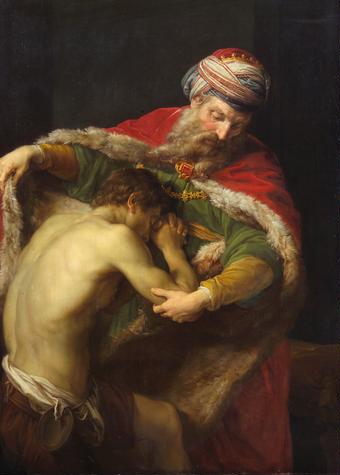
Frank shared many such stories from the Gospel of St. Luke, the most powerful being The Prodigal Son (Luke 15:11-32) and The Publican and the Tax Collector (Luke 18:9-14).
In both cases we are most definitely the end of the story. And it’s not the character that you would imagine.
Frank beautifully conveyed the deep emotion in the story of Prodigal Son, showing the arrogance, ignorance and finally, redemption of the younger son, the deep, generous love of the father, and the bitter resentment of the older son.
The so-called “good” son.
The Return of the Prodigal Son (1773) by Pompeo Batoni
The father and the younger son reconciled. The older son, faithful in service to his father, complained, feeling entitled to better treatment.
And as Frank pointed out, the ending with the “good” son was open-ended.
The “good” son is us. We have to create our own ending.
The same was true with the Publican and the Tax Collector. Both praying in the temple, the Publican pontificating before God about how much he tithed and how much better a person he was than the wretched Tax Collector.
The Tax Collector, knowing he was an outcast in Jewish society, never raised his eyes to God but begged forgiveness.
He was justified. The “good” Publican was not.
And the mirror shines back on us – are we that Publican?
Do we consider ourselves as the “good guys?”
Frank Runyeon, through his vibrant, deeply emotional performance, demonstrated the deep connection of the Living Word of God to our daily lives. We at St. Luke’s were fortunate to have him tell these stories, opening our ears and eyes, helping us to listen and make those connections.
Bring Frank to your church
Frank is available for bookings throughout the country with “Luke: Stories from the Road” and other biblical one-man plays, all written by him. Visit his website at frankrunyeon.com.
On occasion while driving I will listen to the Ancient Faith Radio app on my iPhone. My husband, an Eastern Catholic and deacon in the Melkite Church introduced me to this treasure. Tuning in I can listen to glorious Byzantine chant sprinkled with prayers and sayings.
One set of prayers frequently used is known as Prayers by the Lake by St. Nikolai Velimirovitch, a modern day Orthodox saint.
Today’s prayer ended this way:
O my illustrious King and my God, to You alone I bow down and pray. Flood into me, as a raging stream into thirsty sand. Just flood me with Yourself, life-giving Water; then grass will easily grow in the sand and white lambs will graze in the grass. (Prayers by the Lake, XIX)
The Holy Rover is one of my favorite spiritual blogs; in part, it inspired this blog with regards to spiritual writings. Blogger Lori Erickson presents spirituality in a way that makes me hunger for more. I will be featuring teases from some of her posts with links back to the full post, and I hope you will enjoy them as I do.
To Work is to Pray
The Trappist monks at New York’s Abbey of the Genesee bake bread to help support their community. (Abbey of the Genesee photo)
On a recent trip to upstate New York, my family and I visited the Abbey of the Genesee, a Trappist monastery overlooking the green, rolling countryside south of Rochester. In its gift store, loaves of bread made by the monks were prominently displayed. “Monks selling bread?” my son asked. “Why do they do that?”
One answer, of course, is that monks, like everybody else, need to make a living. Religious houses often operate businesses, from cheese making and dog training to raising chickens. In my home state of Iowa, Our Lady of the Mississippi Abbey sells delicious caramel candies while New Melleray Abbey makes finely crafted wooden caskets.
These enterprises do much more than bring in income, however: they are also a way to craft souls …
In our modern culture we have so many options that many times we can’t choose one over the other.
We can have 500 hundred channels of cable TV and still have nothing to watch on the television.
We treat life like sampling a Chinese pu pu platter: we want to be able to try everything.
College students many times have 2, 3 or 4 majors … different degrees so they can have a lot of job options.
Too many choices! And we want to have it all.
Today we have two examples in the scriptures of just the opposite.
The fact is that spiritually and honestly for the best things in our lives we do need to make choices that exclude other things.
Joshua in our first reading tells the people that they could choose to worship the God of their ancestors, the God that they were used to, or they could choose to worship the God of this new land, the God that will be unfamiliar to them. Joshua leads the people to choose to serve the Lord, the one God of Israel. They made their choice.
A choice between goods will always be a difficult choice
and it always excludes something else.
The same thing happens with Jesus in our Gospel, This is the 5th week in a row that we hear “I am the bread of life”.
Stop saying that!
What they said was, “This is too hard. This teaching is too hard; we cannot accept it!”
Jesus made it clear a choice had to be made: “Choose to believe that I am the Son of God that came down from heaven. And the way that you believe in me is that you will eat my body and drink my blood.”
This saying is too weird. This teaching is too hard.
The healing, the teachings were nice, the reaching out was nice and inspired them, but now he has gone too far.
What is sad about this scripture is that some of his disciples turned away and no longer follow him. They went back to their former lives.
Choices!
I wonder what in our day will make us choose like that. What could Jesus say to us that will make us say, “This is getting too hard, I do not know if I can do it!”
Some of us struggle with some of the teachings of the church.
I have and I do. There are a few things that I can think of that cause me to say, “This is hard, who can accept it?”
For some of us it is hard to accept that God is forgetful.
He forgives us and unlike humans, he forgets. God holds no bitterness, no resentments, and no anger against you.
It is hard to accept that God is blind and he is indeed blind.
He does not see the negative or the broken in us, only the positive and the possibility of healing and fullness of life.
It is hard to accept that God is stubborn and he is indeed stubborn
He will not give up on us, ever. There is nothing we can do to make him love us any more than he does. And there is nothing we can do to make him stop loving us. He will pursue our hearts, for decades if he has to, until he gets us to fall in love with him and let him in.
I think what the gospel is inviting us to say is what Peter says, what Peter representing all the apostles said to Jesus:
“Lord, to whom shall we go, you have the words of everlasting life.”
“We are convinced that you are the holy one of God.” Notice that Peter does not say, “Okay! I got it, I understand it all, and I am right on board with you.” I am sure Peter and the disciples were as freaked out as everyone else.
But Peter’s answers reflect faith and faith sometimes needs to step out.
There are things that we do not believe, things that we do not completely understand. Maybe there are things we do not agree with. We say, “This is a hard saying,” but where else will we go?
“You have the words of everlasting life.”
We had to make a choice by coming here. There are a lot of things that we could be doing but we made a choice to come here.
At some point in our life we are forced to make a choice between one thing and another.
The choices we make now will affect us later on. We will need to let go of things in order to get what is really important. To me the choice is to be present as much as I can in my life. To see the beauty in everything, to find God in everything, even in our struggles, shortcomings and sins, and to remain open and aware that nobody has all the answers.
For me it is about letting go of all my junk, letting go of my prejudice, my control, my securities and the false belief that I have to know it all and have all the answers.
So, maybe we do struggle, I know I struggle. Sometimes I do not get it. And yet to whom shall we go?
The associate pastor at my parish of St. Luke the Evangelist, Fr. Edwin Gomez, gives wonderful homilies. From time to time I’d like to share them with you. This is his homily from Sunday, August 19, 2012, the 20th Sunday in Ordinary Time on the liturgical calendar.
Fr. Edwin reminds us of something we often forget. He begins with a story …
An 80-year-old couple was having a problem remembering things; they decided to start writing things down and make notes to help each other remember.
One night while watching TV, the old man got up from his chair and his wife asks, “Where are you going?”
He replies, “To the kitchen.”
She asks, “Will you get me a bowl of ice cream?”
He replies, “Sure.”
She then asks him, “Don’t you think you should write it down so you can remember it?”
He says, “No, I can remember that.”
She then says, “Well, I also would like some strawberries on top. You had better write that down ‘cause I know you’ll forget that.”
He says, “I can remember that, you want a bowl of ice cream with strawberries.”
She replies, “Well, I also would like whip cream on top. I know you will forget that so you better write it down.”
With irritation in his voice, he says, “I don’t need to write that down, I can remember that.”
He then went into the kitchen. After about 20 minutes he returns from the kitchen and hands her a plate of bacon and eggs. She stares at the plate for a moment and says, “You forgot my toast.”
Forgetful and Very Wise at the same time. Ha!
“Brothers and sisters: watch carefully how you live, not as foolish persons but as wise” (Ephesians 5:15) To be wise is the invitation. And today I am going to share with you my greatest discovery…I have found the way to become really wise.
Ready?
In order to be wise you have to be forgetful as God is forgetful. You have to imitate God’s forgetfulness.
Surprised? Let me explain.
Think about His mercy. He forgives you and unlike humans, He forgets.
He holds no bitterness, no resentments, no anger against you for anything you have done in the past.
The past is history, the future is a mystery, so live in the present with no fear of recrimination or punishment.
You cannot be wise unless you have been in some kind of interpersonal, interactive relationship with God. Only will you know that God is compassionate, that He will let you start over again, every day fresh and new.
Good News: God forgives anyone who is willing to be forgiven. Willingness is the key here … that is the only requirement to becoming wise.
And this is the bread from heaven. (“I am the living bread that came down from heaven…” Gospel of John, 5:51)
This is what we need to learn to eat. To eat the life of God.
And if you do not have a life with God, an hour in church on Sunday is probably not going to make up for you. If you are not living with your merciful and “forgetful” friend all week, an hour during the weekend does not create a friendship.
That friendship has to be pursued and nurtured morning, afternoon and night as with every true friend that you have.
And then, you learn how to imitate God’s love and how to be wise, because you know what God is like. God is El Amigo, is a companion, is someone who loves you more than you love yourself, who forgives you more easily than you even know how to forgive yourself.
Today is a new day, a day in your journey to meet the friend, to meet the “forgetful” God. The only way to become wise is to imitate God, the One who loves you just the way you are, the One who is forgetful and forgiving about your past and loves you.
“A wise man once sat before an audience and cracked a joke … all of them laughed like crazy. After a moment he cracked the same joke again, and fewer people laughed … he cracked the same joke once again and no one laughed. Then he smiled and said ‘If you can’t laugh at the same joke again and again, then why do you keep crying over the same thing over and over again?’”
Forget the past and move on.
“Loving God, help us to imitate you … help us to forgive and forget as You forgive and forget. Amen.”


















 Click to Tweet & Share
 Be as One
