In the ancient world, the journey up a mountain often symbolized “enlightenment” or “seeing” things in a “new” or different way from previously. In this Sunday’s gospel, Jesus takes his students (disciples) up a very high mountain. (Mark 9:2-10)
There they see Jesus in a completely different “light.” He is “transfigured” before their eyes. They begin to understand this rabbi from Nazareth as much more than just a very wise teacher. He is the one who reveals our ultimate destiny and that world beyond what our eyes can see.
Lent is a season inviting us to “see” things in a new and different way; perhaps in ways we’ve never contemplated before.
How do envision your life? Do you see it as a series of goals to reach and tasks to fulfill daily? Could you look at it in a different way: an amazing pilgrimage revealing at different stages and seasons different gifts and insights?
How do you look at your death? Do you view it with dread as the cruel ending to our brief stay here on earth? Or, could you gaze upon it as a horizon beyond which is beauty and love beyond imagining?
How do you see the Church? As a centuries-old organization trying to maintain commandments and rituals? What would it be like think of the Church as a community of apprentices, striving to learn, struggling to love as Jesus taught? What would it be like to regard each apprentice as unconditionally loved, thoroughly loved…even when he or she messes up big-time, no matter whether the apprentice is young or old, a hair- dresser, an executive or a bishop?
How would things change for you, if you asked for the grace to see things in a new light? Are you open to taking a “hike” up the mountain to new insight?
The journey (each day) might become infinitely richer and beautiful.
One detail can make all the difference. A slip of the knife, a screw in the wrong place can spell danger and disaster.
However, surgery performed well and products built precisely to specs can and do enhance and save lives.
A mother know the importance of details . . .
. . . remembering each child’s birthday year after year with a specially planned party . . . or creating the perfect Halloween costume . . . cooking up that favorite dish to perfection just because . . . saving all those little masterpieces made and then given to her with such love.
Later the grown children will find these artifacts and be reminded of how cherished they are.
I remember my mother changing the sheets on our beds faithfully once a week. My bed felt so inviting to sleep in as I turned back the covers and climbed between the crisp, cool sheets. The smell, the feel . . . these little details remain to this day a tangible reminder of my mother’s love for me.
Yes, details do indeed matter. In our lives out in the world, and in the world inside of ourselves.
How we live our interior spiritual lives matters a great deal, right down to the last detail.
I have taken on as my Lenten journey the study of St. Bernadette Soubirious. This journey was inspired by a Facebook post back on February 11 by Father James Martin, SJ. In honor of the Feast of Our Lady of Lourdes he recommended the viewing of “The Song of Bernadette,” a critically acclaimed 1943 movie starring Jennifer Jones. He wrote, “The film, based on the book by Franz Werfel actually corresponds very closely to the real-life story of St. Bernadette Soubirous, with only a few exceptions.” You can find the movie on YouTube – just search for “The Song of Bernadette.”
Moved by the film
I have always enjoyed this film and so happily watched it again over the course of three nights (the film is over two hours in length). I surprised at how moved I was as I watched, crying whenever Bernadette saw “The Lady” and crying too over the poverty of her home life and the humiliations she faced over and over again.
Attraction to the life of Bernadette
I wished to know more about Bernadette as I was particularly drawn to her interior life and how she bore with what she suffered. I had an old book, written in the 1950’s by Abbé Francis Trochu who had written many spiritual biographies.
Details, details …
As I read, I see how the smallest of details meant a great deal to Bernadette. She was always very particular in the way she told her story of the apparitions; it was important to her that she report as accurately as possible so as to honor The Lady’s wishes. Her consistent telling of the story was a crucial part of the process whereby Church determined the authenticity of the apparitions.
This attention to detail carried over into her religious life as Sister Marie-Bernard;
she practiced a life of fidelity.
I was struck in particular by this passage; it’s a little long but without reading it all, you cannot feel the power of the point that was made:
Postulants or novices were often sent to the infirmary, chiefly for cleaning the wards, and thus came under the more or less direct control of Sister Marie-Bernard. She managed these young people with understanding and tact, but she also found means of helping their religious training in her own individual way. There was, for example, the story of the copper knobs that went the rounds of the noviceship several times. Sister Marie-Bernard had been in office for only a short while, as the incident occurred in 1868.
I was still a postulant [related Sister Justine in her old age], and I had been given a job in the infirmary. Well, one day when we were giving the place a thorough cleaning, I had spent the whole morning dusting, rubbing and polishing. Then the bell rang and I was getting ready to leave when Bernadette said: ‘The work is not finished. There’s still this and that, but you haven’t time now. It will do some other day.’ Then I foolishly said with a certain satisfaction: ‘I’ve rubbed the copper knobs with polishing powder.’ This referred to the knobs on the iron bedsteads. Bernadette replied: ‘Yes, they are shining brightly. You’ve polished them well and thoroughly. You have taken great pains with this work because it catches the eye.’
She delivered me this reprimand so nicely that I wasn’t hurt, but I felt the little pinprick to my vanity all the same and I carried the lesson away with me, saying to myself: ‘You understand? You have taken great pains over the knobs because they show, but the work that doesn’t show, the work that remains hidden and which God alone sees, did you do that so carefully?’ I have always remembered those copper knobs.
pages 293-294, Saint Bernadette Soubirous by Francis Trochu; bold is my emphasis
I felt that “pinprick to my vanity” too.
How faithful was I to those little tasks that no one sees? How much fidelity do I apply to what I do, especially if I don’t want to do it? And, does it really matter?
If I profess to love God, it matters a great deal.
How can I claim to love him if I care more about what others think of what I do rather than what he thinks?
How shallow it is, really, to perform tasks only so that I can earn a compliment from my boss or a “thank you” from my family. Shouldn’t it be just enough to do the task well, without currying favor?
God sees all. Isn’t his favor enough for me?
Just how much am I willing to do in secret for my Beloved?
Am I even willing to do good in secret even though it might be misunderstood,
even criticized by people I care for?
I don’t have answers yet to these questions but it gives me much to ponder this Lent.
You never know what you can learn from a movie. Or a book. God uses every opportunity to teach us. I look forward to learning more from Saint Bernadette Soubirous.
I would appreciate hearing from you if you have pondered these questions. Are the details important to you?
This Sunday’s gospel (Mark 1:12-15) states that Jesus went into the desert for 40 days and was tempted by Satan. After being tempted Jesus boldly embraced his mission.
Temptation is the experience of attraction to something or someone that’s not good for us.
Everyone is tempted. No exceptions, not even Jesus.
No one should be ashamed of their temptations. Temptations are as much a part of life as are breathing and sleeping.
Temptations always force us to make a choice:
“Will I give in? Will I resist? What will I do?” Over time, our choices define who we are and the quality of our relationships. Our choices create many of the situations we find ourselves in.
Lent is a 40 day journey that invites us to think hard about our temptations in life.
Everyone has an area of life where the temptation feels especially fierce. We all have an area in life where we experience ourselves as weak and where “things can get crazy,” if we let them. So, how are you tempted? Is it connected with anger? Envy? Control? Sex? Alcohol? Food? Spending?
The gospel tells us that while Jesus was tempted, “that angels ministered to him.”
Who are your “angels” who help you avoid giving in to your weakness?
Who are those companions and friends who push you to be your better self? Who is helping you right now to avoid a road you know you don’t want to go down? (Because you’ve been down that path before and you don’t like what you become.)
People in Alcoholics Anonymous have companions called “sponsors” that help keep them sober. They are “angels” in that they minister in the face of temptations.
The Christian Community (the Church) is meant to be a community of “angels,” both seen and unseen, that empowers us to resist bad choices and embrace good choices; choices that foster healthy relationships; choices that makes us more aware of God and of our purpose in life.
If we would consult ‘our angels” a little bit more often this week, Lent will get off to a very good start!
copyright 2015 Steven Michael LaBaire
Artwork: photo of Father LeBaire by Susan Bailey; “The Temptation” by Angela Marie Henriette, Flickr Creative Commons; “Swanswell Pool_Debating Society_Swanswell Pool Coventry_Apr11” by Ian, Flickr Creative Commons
Those of us who grew up in the pre-Vatican II church and for sometime after saw Lent as dour and depressing, maybe even … creepy. I know as a child I was always put off by the purple shrouds covering the statues in the church. In my childish mind, it’s as if they were dead.
And who can forget being smeared with ashes on Ash Wednesday as the priest intoned, “Remember you are dust, and to dust, you shall return.”
Lent used to be all about repentance but with a negative twist.
To many, it merely felt like piling on the guilt for past transgressions. In actuality, repentance really means coming back home where we belong, to be filled with holiness so that we can then share it with those around us.
Isaiah 58:5 from today’s lectionary (Feb. 20)
describes the negative approach to perfection:
Is this the manner of fasting I wish,
of keeping a day of penance:
That a man bow his head like a reed
and lie in sackcloth and ashes?
This, rather, is the fasting that I wish:
releasing those bound unjustly,
untying the thongs of the yoke;
Setting free the oppressed,
breaking every yoke;
Sharing your bread with the hungry,
sheltering the oppressed and the homeless;
Clothing the naked when you see them,
and not turning your back on your own.
Then your light shall break forth like the dawn,
and your wound shall quickly be healed;
Your vindication shall go before you,
and the glory of the LORD shall be your rear guard.
Then you shall call, and the LORD will answer,
you shall cry for help, and he will say: Here I am! (verses 6-9a)
So, shouldn’t Lent be more about saying “yes” rather than saying “no?”
While I have been rethinking words such as “discipline” and “obedience,” seeing them more now as life-giving “yes” words (see previous post), I hadn’t done that yet with Lent. Until, I chatted with one of you.
In our chat, the reader said she looked forward to Lent as her “favorite time of the year,” adding that Lent is “an opportunity to work closely with the Lord to make change in myself .”
That made me stop short. I couldn’t enter into Lent now with that same dread I carried since my childhood. Couldn’t I too look at Lent as “an opportunity?”
We may fast from foods or back away from activities that have consumed us
(like the boob tube and the internet) but isn’t fasting really about creating space for something better?
Creating that space requires discipline. Yet filling that space with something holy can turn out to be far more satisfying in the end.
On the ride home last night I decided to sing to God to begin filling that space.
I wanted to sing songs where I knew all the words; this made me think of the St. Louis Jesuits.
Anyone involved in liturgical music from the 1970’s and 80’s will know the music of the St. Louis Jesuits. Their folk-style, scripture-based songs created a revolution in liturgical music (a revolution that was not embraced by everyone). But I embraced it. And when I found playlists on YouTube of all of their music, I broke into song joyfully.
If you have a smart phone (and a robust data plan), you too can sing along with the St. Louis Jesuits all the way home.
Singing the scriptures drew me into a deep place of prayer.
I shed tears singing “Be Not Afraid” as I thought of the Christians in the Middle East being martyred and driven from their homes.
I meditated on the wonder of God as I sang along with “O Beauty Ever Ancient.”
I smiled and sang out with joy upon hearing “Sing to the Mountains.”
And then I thought, I have to share this opportunity with all of you.
Come and enter into prayer by singing the scriptures. There is nothing like music to move the soul, to tap into those things you wish to bring to God in prayer.
If you can, try singing with the St. Louis Jesuits the next time you have a long ride in the car. Here is a complete list of all the playlists on YouTube.
A word of warning: YouTube inserts an ad after every two songs played, just so you know. But the experience of singing the prayers of your heart make that interruption tolerable.
Lent can indeed be a time of celebration.
A time of joining with God and being filled to the brim with his Spirit so that you too will feel a compulsion to share.
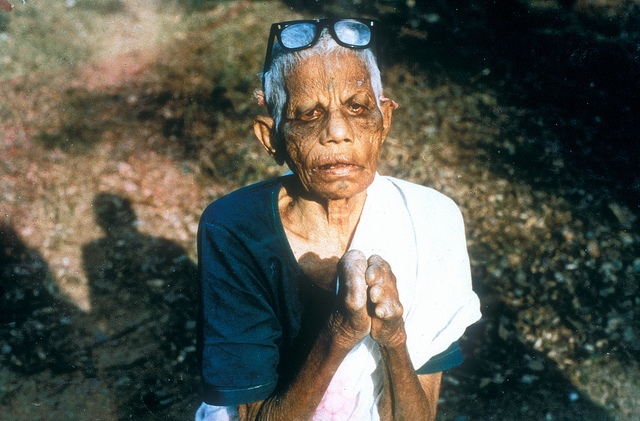
Leprosy is a disease that affects nerves. Most people think about leprosy as a horrible skin disorder. But that’s only part of the story. Leprosy tragically affects the nerves of the body, especially in the hands and feet. Leprosy stops people from “feeling.” So for example, someone with leprosy might not “feel” the red hot pot on a stove. Their bare hands would be terribly burned. Because there’s no feeling. Leprosy creates numbness.
Leprosy can also be a “spiritual” affliction, something under the skin. Some call it “leprosy of the heart.”
It’s an overall, generalized “numbness” that deadens our feelings and reactions to life.
Because we’re so busy and distracted we can become “numb” to what’s really going on with our kids or spouse.
Because we “overdose” on headline news and stories of terrible things happening all over the world, we can be “numb” to the pain of the co-worker sitting a few feet away.
Because we’re surrounded so much noise and distraction, we can be “numb” to our own feelings and emotions. (One day, someone tells us how angry we get over the smallest thing. Or, that we’re no longer fun to be around. Or, that we’re so “negative.” Then we wonder, “How long have I been like this? How long have I been “numb” to what I’ve become?)
Part of healing involves assessing our own personal leprosy or numbness. It might mean asking some hard questions of ourselves. It might mean making some daily lifestyle changes. It might mean changing our circle of friends if they are people who seem content with their “numbness.”
(Let’s remember that lots of folks actually pursue “numbness” through alcohol, workaholism and drugs, so… we may need to make some new friends!)
Above all, the path to healing requires asking God for the grace needed to live a fuller, more abundant life: Day by day, hour by hour, situation by situation. Healing is rarely self-induced. It requires openness to a power that is bigger and higher than ourselves.
If you can at least allow yourself to “feel” the need within yourself, you’ve taken the first step toward healing. Pray for the “nerve” to go further.
What comes to mind when you hear the word “discipline?”
Punishment? Do you think of those times as a child when you were disciplined by your parents for doing something wrong?
Dull, repetitive actions such as practicing a musical instrument or working out to keep in shape? Perhaps even prayer, like reciting the rosary, feels like such a discipline, an endless repetition of Our Fathers and Hail Marys.
The scriptures say, “… for whom the Lord loves, he disciplines;” But it also says, “At the time, all discipline seems a cause not for joy but for pain, yet later it brings the peaceful fruit of righteousness to those who are trained by it.” Hebrews 12: 6, 11
The latter half of verse eleven is the key. Discipline acts as a teacher. Sometimes it needs to be administered by a parent or from God himself. However, as spiritual adults I believe we are asked to discipline ourselves. At first it may seem like punishment but with perseverance we can establish good habits that will aid us in our spiritual growth. After weeks of such discipline, we will wake up one day and experience that “peaceful fruit” of which the scriptures speak, making it all worthwhile.
I was resistant at first to applying discipline to my spiritual life. How can a discipline be heartfelt? I remember watching “The Nun’s Story” with Audrey Hepburn and noticing the way she chafed at the bell ringing for prayer. She hated the interruption and even openly complained to her superior that the bell disrupted important spiritual conversations with patients or interfered with her work as a surgical nurse.
Yet, in the end, I ended up establishing a regimen of prayer with that bell in mind. And like Hepburn’s Sister Luke, I too chafe sometimes at the interruption of that bell. In the end, however, that discipline has proven to be my lifeline to God, showing that prayer runs far deeper than my fickle and fleeting emotions.
Lent offers a wonderful opportunity to establish a prayerful spiritual discipline. I would like to offer my regimen as an example.
I use technology to assist me in my daily prayer discipline:
Building reminders into Google calendar I set up my iPhone to chime like the bell of a monastery as my reminder to pray. The bell chimes at the top of each hour between 9am and 3pm. Each short prayer is devoted to a specific theme or intention:
9am—dedicating my day to God using the Prayer of Charles de Foucauld, prayed each day by Henri Nouwen. I have set aside this time to pray for myself.
10am—prayer for the unemployed
11am—daily readings from at the USCCB website accompanied by a short meditation from The Word Among Us website.
12 noon—praying the Angelus and offering petitions for clergy and consecrated lay persons.
1pm—praying for those in need of healing.
2pm—prayers for those who don’t know Jesus; also for Christian martyrs.
3pm—Chaplet of Divine Mercy.
Even though a busy work schedule can sometimes get in the way of meaningful prayer, the discipline always serves as a reminder that God is with me. At times I feel a surge of consolation in my prayer, a sweet and “peaceful fruit.”
As you establish and grow into your ritual, be prepared for dry times as the foundation is built. Habits established over time become ingrained and indispensible. It’s when they become second nature that true prayer begins.
copyright 2015 Susan W. Bailey
Art/Photography: Manastirea Neamtului – July 2008, Name – Cristian Bortes, Flickr Creative Commons;
This coming Sunday’s gospel describes Jesus as very busy, doing a lot of good. He’s bringing healing and relief to lives that are burdened.
In the middle of this whirlwind of activity, we’re told that he went to a quiet, deserted place and prayed.
Recently, I read some articles about how silence is good for the brain. According to these studies, our brains need a regular doses of silence. Silence not only allows our brains to “calm down,” silence, it would seem, is a seedbed for creativity and clear, more focused thinking. I’m not surprised by these findings. Virtually all the great spiritual writers describe regular doses of silence as essential to the diet of the spiritual life.
We live in the midst of the noisiest generation to ever inhabit the planet.
Some people spend their whole day, from the moment they wake up, distracted by the clutter of “ noise” around them. Often I hear people telling me that “peace and quiet” are a ” luxury,” they find difficult to find. More and more I find young people, raised on a diet of noisy gadgets and non-stop entertainment, uncomfortable with extended periods of silence. ( A parent was telling me how she was driving the neighbor’s kids in her car. She had no video or gadgets to “distract” them for the 45 minute ride. The kids “freaked out.” She described the ride as “hell.” So addicted to noise and being-entertained, they couldn’t tolerate simply talking or quiet for less than an hour.)
Sadly, even our churches have become noisy places …
… where in the name of “hospitality,” the drum of chatter robs our neighbor of even a modicum of peace. (Have you ever noticed people trying to pray before or after Mass in church and within a stone’s throw, people (including the priest) talking rather loudly? In 2015 it is sometimes impossible to find a quiet, prayerful environment even in church!)
Silence can get us in touch with the feelings and thoughts inside, that we often don’t pay enough attention to. Quiet calms the spirit. Silence can help us organize our thoughts without distraction. As a healer, Jesus knew this all so well. Do we know this?
Are we ignoring one of the best non-prescription remedies for body and soul by not clearing away some of the “noise clutter” of our day? Silence really can be “golden.”
Let’s pray for the grace to follow Christ to a peaceful place.
Copyright 2015 Steven M. LaBaire
Art/Photography: Father Stephen LaBaire — Susan Bailey, copyright 2015 Chaotic Noise Marching Band 3, Peter Lee, Flickr Creative Commons; Silence, Alberto Ortiz, Flickr Creative Commons
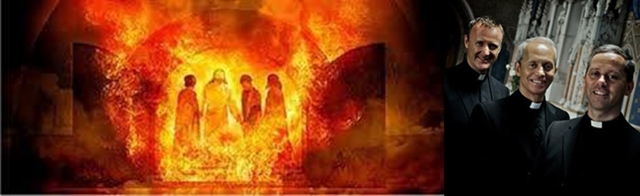
Recently I posted a “Thought for the Day” on my Facebook page about fear, citing the Book of Daniel and the story of Shadrach, Meshach and Abednego.
A consuming fire
The gist of the post was that fear, like fire, can consume if we try to run away from it. Shadrach, Meshach and Abednego allowed themselves to be thrown into the furnace; they recognized God with them (“looking like a Son of Man) and danced with joy amid the flames.
Now that is how to deal with fear!
Major fears and even lesser ones can consume us but only if we allow it. By calling out our fear and walking straight into the fire with God at our side, we can slowly conquer our fear.
Developing fear
I used to have no fear when I sang in public but losing my voice changed all that. Several times when I cantored at mass, my voice failed me in a big way. I never knew when my voice would “show up for work” and that made cantoring a terrifying experience.
That’s how I viewed the auditions recently held at the Hanover Theatre in Worcester for a chance to sing with the internationally acclaimed trio, The Priests.
The challenge
My voice still has its weak spots and the cold and dry conditions of mid- winter don’t help. The day of the audition I was not at my best and it was tremendously tempting to bail out. But along with committing to write an article for the Catholic Free Press about the auditions, I had already accepted God’s latest invitation to deal with my fear. There was no backing out now.
A win-win
When the moment came to sing, I decided to enjoy it even though my fear made my vibrato wobbly. I gazed at the theatre and thought yet again of my healing. With gratitude I realized I never could have sung for this audition a year ago.
In the end, I did not win the privilege of singing with The Priests, but I did win yet another round against fear.
Imagine yourself on the stage at the Hanover Theater. Gazing out over the empty seats and focusing on the sparkling chandelier, you begin singing your audition piece, all the while imagining those seats filled with people applauding your beautiful voice.
Winner Emily Suuberg; photo by Monica Mansfield
That dream is now being realized by Emily Suuberg of St. Mary’s in Shrewsbury, the winning vocalist chosen from a group of forty-one sopranos from various parishes in the Worcester Diocese. Suubert will be singing on stage at the Hanover on March 27 with The Priests, the internationally acclaimed trio from Northern Ireland. The concert is being presented by Francis Carroll, chairman of The Friends of St. John’s Food the Poor Program as a fundraiser for the program..
“I am beyond thrilled to be singing with The Priests!” said Suuberg. “It’s a bit surreal, actually – they’re international stars and I’m lucky enough to be sharing the stage with them. It’s hard to believe.” She credits her grandmother with finding out about the audition and encouraging her to try. Suuberg sang “Saper Vorreste” Verdi Opera for her audition piece.
The Priests, made up of Father Eugene O’Hagan and his brother, Father Martin O’Hagan, and Father David Delargy, have been incorporating local non-professional sopranos into their concerts for the last couple of years, giving the lucky vocalists a chance of a lifetime to display their talent. Suuberg will be singing “Amazing Grace” with The Priests plus 2-3 solo pieces.
A member of St. Mary’s nearly all her life Suuberg sang for the choir and with other young musicians while in high school. She studied privately with Jenn Turner beginning at age thirteen and continued with Faith Esham while attending Manhattanville College in Purchase, NY. Suuberg graduated in May of 2014.
Suuberg was not the only contestant encouraged by her grandmother to audition; Katie O’Neill from St. Luke the Evangelist in Westboro admitted that her grandmother too told her she “had to do it.” She sang “Let There Be Peace on Earth” for her audition piece.
Cantors and choir members from around the diocese flocked to the Hanover last Sunday for the auditions. Margaret Abboud from Christ the King in Worcester was there despite the fact she was expecting forty people at her home later in the afternoon for a Super Bowl party. “I love the idea of supporting the St. John’s Food for the Poor Program anyway I can,” she said.
The contestants
Julie BuAbbud from St. Mary of the Hills in Boylston was encouraged by her priest, Father Manny, to audition. She sang “Rose of Bethlehem.” And Katrina McNamara tried out because she hails from the hometown of the O’Hagan brothers. She sang a haunting Irish folk song, “Only Our Rivers Run Free.”
Three distinguished judges were on hand: Thomas Nerbonne, a music educator for the last twenty years at Wachusett Regional High School has adjudicated vocal soloists, vocal ensembles and choirs in all of the New England states and the Vienna International Music Center in Vienna, Austria. Siobhan Petrella studied Vocal Performance at Anna Maria College. She is classically trained in Opera under Malama Robbins, and a past member of the Salisbury Singers. She taught music in the Worcester Public Schools and in the music magnet program at Burncoat Middle School. Currently she is an Assistant Principal at Worcester Technical High School. David MacArthur is the Assistant Operations Manager at The Hanover Theatre. He obtained his B.A. in Entertainment Management. An avid music lover he assists in booking events and coordinating production needs that come through the venue.
Kallin Johnson, Music Director at Notre Dame Academy. Worcester, and Board Member, The Hanover Theatre for the Performing Arts, was the accompanist for the auditions. Melanie Donegan, director of the Actor’s Loft and another Board Member, coordinated the auditions.
The concert takes place on March 27th at the Hanover Theatre. Tickets range from $25-45 and are available online at the website http://thehanovertheatre.org/; you can also call the theatre at 877.571.SHOW (7469).
This Sunday’s gospel has Jesus going into a synagogue. People are gathered there. He speaks. Many who hear him speak say that he “speaks with authority.” His words are able to drive out “dark” oppressive forces that are wearing down the lives of people in the community.
What about us? What kinds of words do we use in the course of a day?
Have you ever thought or wondered what effect what we say
has on others and on ourselves?
Sometimes we all have to face challenges that require speaking hard truths that are difficult to speak and to hear.
But a constant “flow” of criticism, whining, put-downs, sarcasm, complaining and “poor me self-victimization”? Who wants to be around that? (I’ve been in those situations and with those personalities. I feel like I’ve been “dumped on” with negativity. Yuck!)
The word “authority” has its root in the Latin phrase, “to give life.” So when Jesus spoke, people experienced the things he said as “life-giving.” His words actually helped people grow. The felt that they were healed and helped by his words.
Some people monitor their “calorie intake.”
Sometimes it’s good to monitor our “word output.”
Do the things we say, even in difficult situations, help people to grow, to become better people? Or is too much of our “talk” punctuated by a negativity that tears people down, or simply does nothing to change the situation?
If we adopt a Christ-like “grammar” and speech patterns, we might erase some dark forces too. We might impart “ new life” to a situation, and, in the process, feel a heck of a lot better about ourselves (and life) at the end of the day…
Copyright 2015 Steven M. LaBaire
Art/Photography: Father Stephen LaBaire — Susan Bailey, copyright 2015 Blah Blah Blah, Name – Chris Piascik, Flickr Creative Commons;
This coming Sunday’s gospel is a story of fisherman making a career change. We hear that they “left behind their nets” to follow Jesus.
Some people think that being a fisherman in the time of Jesus meant being poor. Nothing could be further from the truth. Fishing was an extremely lucrative and well paying profession. Fishermen could enjoy a fairly good standard of living. Fishermen in the part of the world where Jesus lived had a job security and steady income that many others would envy.
Obviously, for these men, their well-paying jobs, and career security weren’t satisfying enough. We’re told that they were willing to leave it all behind and become “students” or “apprentices” of Jesus. (The word “disciple” means: student or apprentice.) These men were looking for something more in life. Apparently they found it in Jesus, because later on they were willing endure all kinds of suffering for the sake of what they discovered.
What about us? What about you?
Is what you’re doing in life right now satisfying to your soul?
Have you found what you need to live each day with serenity?
What would you be willing to “give up” and” let go of” in order to experience yourself more at peace with yourself?
Would the people you call “friends” support you in your decision? If not, do you need different “friends?”
Do you find something inside you, yearning and craving to make some changes in life?
Let’s pray this week for the strength to “leave behind the nets” that are preventing us from going where we need to go in life. How will we make 2015 different in a terrific way? Or, will it be more of same…same…same?

 I am pleased to present this guest post from Father Steven LaBaire, pastor of Holy Family Parish in Worcester, MA.

 Join Susan Bailey’s Email List (special surprises just for you!)












 Be as One