My name is Susan Bailey and I find the life of Louisa May Alcott endlessly fascinating. I come from New England (specifically Massachusetts) and my family has been here in one form or another since the 1630′s. I live fairly close to Concord, MA where Orchard House, the homestead of the Alcotts, is located, and visit often. Every few years or so I go on a reading ‘binge’ about Louisa and this time around was so good, I just had to start a blog about my passion. The binge, by the way, still goes on!
I’ve been happily married for over 30 years and my husband is a deacon in the Melkite Church (Eastern Catholic – I am Roman Catholic). We are proud parents of a grown son and daughter.
I’ve worked happily for the last 17 years at Rutledge Properties in Wellesley, MA, supporting the agents in the office.
And in my ‘other life,’ I’ve performed, written and recorded music exploring my Catholic faith. I have a website (www.susanbailey.net) where you can hear samples and find out more about this. I sing at various masses at my home parish of St. Luke the Evangelist in Westboro, MA.
Other interests include history (especially photographic), nature (especially bird watching), and I have the same ‘inordinate love of cats’ that Louisa had. :-)
I believe in God. And I can see evidence of His existence and care for humanity, told through the stories He has left for me to find.
The more I immerse myself in God, the more these stories come to life. I’d like to show you what I saw yesterday during my lunchtime walk.
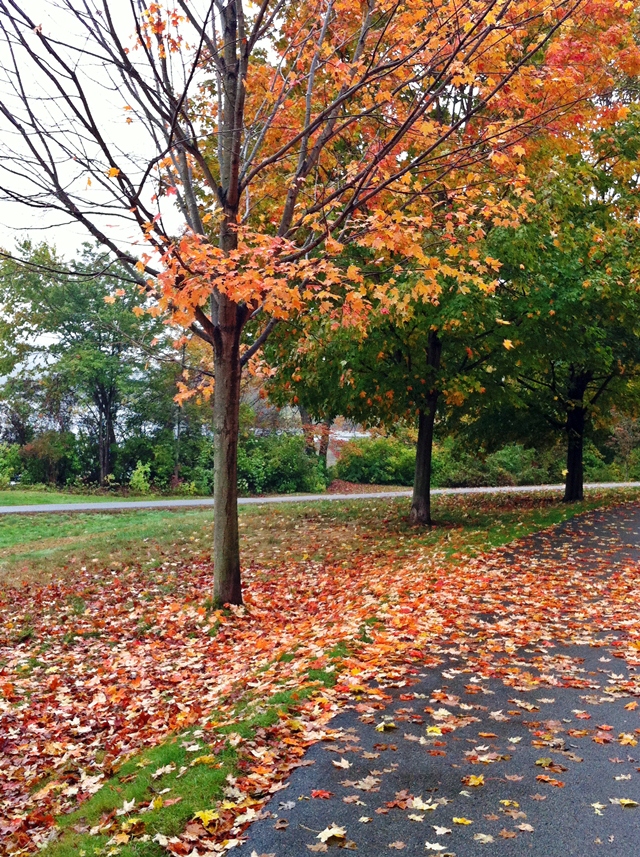
It’s October. Cool air and gray rainy days are becoming more frequent. Today a soft rain fell, covering the land in a shimmering mist.
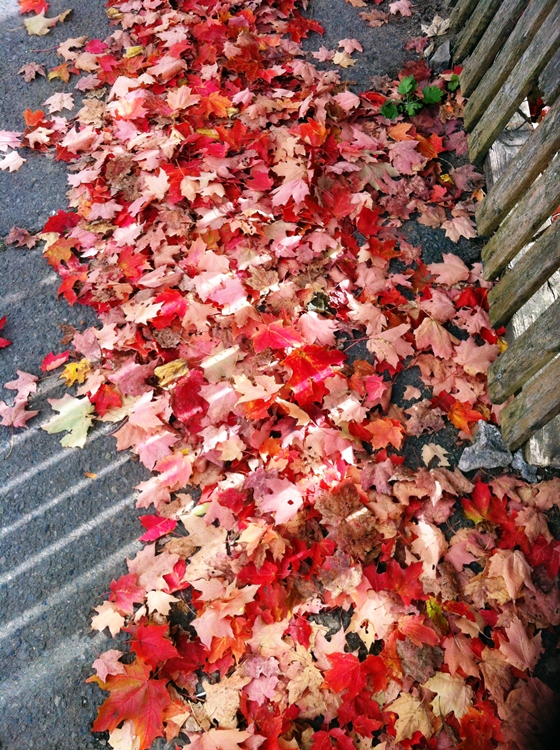
The leaves are peaking here in Massachusetts, turning vivid shades of red, orange and yellow. They flash their colors for all to see only to fall to the ground.
Off in the distance I saw a tree, its fallen leaves creating a colorful circle around the trunk.
I started to think: leaves derive their sustenance
from the tree. Once the leaves fall, they will shrivel
up and die.
God was telling me a story.
“I am the tree,” He says, “and each of you are leaves. If you remain connected to the tree, you will flourish. If you decide to fall away, you will die.”
Reflecting on that thought (not unlike John 15:5 when Jesus calls Himself the vine and we the branches), I began examining the leaves on the ground.
Some were still supple and beautifully adorned, just waiting to be admired. Others were brown and dry despite the mist.
And it occurred to me: we, like these leaves, may fall away from our Source of Life and flourish for a time but eventually, the color will fade and life will ebb away until we too are brown and dry.
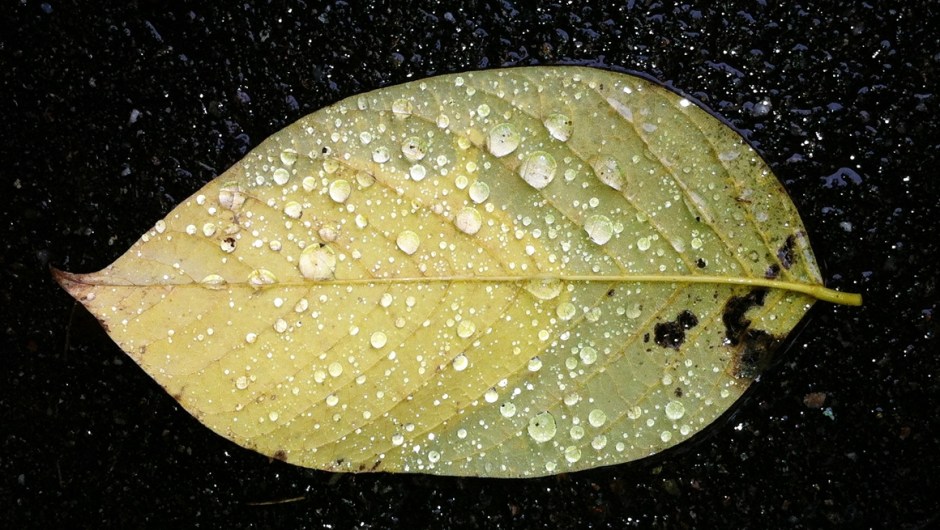
Even a leaf covered with raindrops cannot survive forever on its own. The drops will evaporate and the leaf will wither. It needs the tree to live.
Thus the story of the vital relationship between God and humanity, told through His creation.
And there is more to this story.
No healthy tree bears only one leaf. Healthy trees are covered with leaves providing the traveler with relief from the heat under shady branches.
God did not intend for us to be alone. Without each other, we also wither and die.
He means for us to be a community, just like He as a Trinitarian God, forms the perfect community of Father, Son and Holy Spirit.
A seamless circle of love, continuous and unbroken for all eternity. Perfect love, perfect harmony and we are invited to join.
And unlike leaves which are temporal, dressed in their best colors for a brief moment before fading and dying, we can become perfected as the image of God we were meant to be.
The dashboard contains various pictures and icons that I can gaze upon. God has gifted me with a long commute – two hours each day of time alone. Here I can pray, reflect and sing. And often I end up brainstorming as well. It’s not only a prayer space but a creative space.
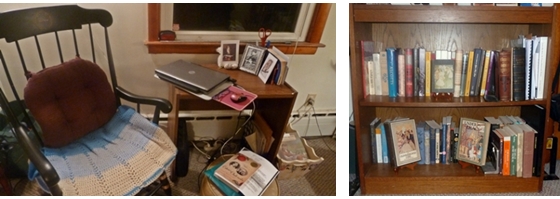
My writing corner is a sacred space.
On my small desk is a picture of my favorite author, Louisa May Alcott, plus 2 paintings by her younger sister May. Sitting at the desk and working from my laptop, I can see my bookcase dedicated to all things Alcott plus the birds at the feeder outside the large window. Lots of writing has been done in that space.
The entrance to our home is a sacred space.
Here my husband, a deacon in the Melkite church, has set up his icon corner. Each morning he faithfully prays the First Hour of the Office, also known as the Liturgy of the Hours. I marvel at how he prays the same prayers every morning and frequently experiences new insight. He’s been praying those same prayers for close to ten years.
Physical sacred spaces prompt the mind and heart to enter the spiritual sacred space in the soul.
I am pleased to offer a guest post by Lori Erickson of the Spiritual Travels blog on sacred spaces. Here’s a tease:
There seems to be something instinctual about the human desire to create sacred space. We set St. Francis amid our garden flowers and tuck the Virgin Mary under the shelter of an overturned bathtub. Many of us do even more inside our homes, creating private altars that seem to grow of their own accord on a shelf in our bedroom or on top of a dresser, spots that gradually accrue photographs, stones, sea shells, candles, holy water, and prayer cards. Each seemingly inconsequential item carries a deep weight of memory, prayer, or hope.
Today I had the good fortune to catch a wonderful program on PBS called “Bird Tales.” You can watch it on your computer or check your local PBS station for a schedule of showings.
In a series of stories, “Bird Tales” shows how your everyday birds connect with the world at large. Here’s a preview of the program:
You will meet Donald Kroodsma, a songbird expert who has devoted his life to not only recording bird songs but interpreting what the birds are communicating through their songs.
Birdsong expert Donald Kroodsma
He chronicles how a young bird grows from a baby’s babble to the full song of the adult. He talks about birds who have migrated from other parts of the world and demonstrate that by the extra sounds they include in their songs that are native to the countries they migrated from.
You will also meet a team of classroom teachers and instructors from the Smithsonian Institute in Washington, DC who expose school children to birds in their natural setting. They are shown where these birds migrate and follow up by connecting with school children in the migration-bound countries who see these same birds (through the process of bird banding).
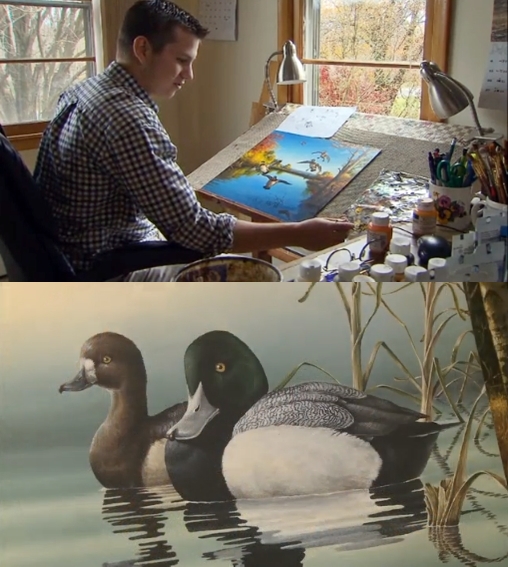
We are introduced to a young man of sixteen, Abraham Hunter, who has taught himself how to paint birds and landscapes strictly through perseverance and his keen powers of observation. Some of his paintings were chosen to be reproduced as stamps to raise awareness about wildlife.
There is much more to see in this wonderful program which you can view in its entirety online. I have included it here for your enjoyment.
Have birds made an impact on your life? Share your bird stories with us!
Extravagance in my neighbor’s yard (Lori Erickson photo)
“Nature is, above all, profligate. Don’t believe them when they tell you how economical and thrifty nature is, whose leaves return to the soil. Wouldn’t it be cheaper to leave them on the tree in the first place? This deciduous business alone is a radical scheme, the brainchild of a deranged manic-depressive with limitless capital. Extravagance! …”
So writes Annie Dillard in Pilgrim at Tinker Creek. I love that line about this deciduous business being a radical scheme, the brainchild of a manic-depressive with limitless capital. When I took a walk this morning, I stood beneath a neighbor’s maple in a shower of shimmering leaves, each one the product of a hundred sunny days, watching as they twirled and tumbled about me, drawn toward earth in a dance they will take just once. Extravagance indeed.
This blog is supposed to be about making connections.. Lately it’s felt more like a hodgepodge, just a collection of unrelated posts. This blog is certainly challenging me to live out what I preach: living life in a single flow.
It ain’t easy!
This weekend however, it suddenly got a lot easier. I was blessed to attend two extraordinary events which practically shouted “Connections! Connections!” to me. The pen couldn’t move fast enough across the page of my notebook to capture all I was hearing so I could share it with you.
I will begin with this past Sunday night.
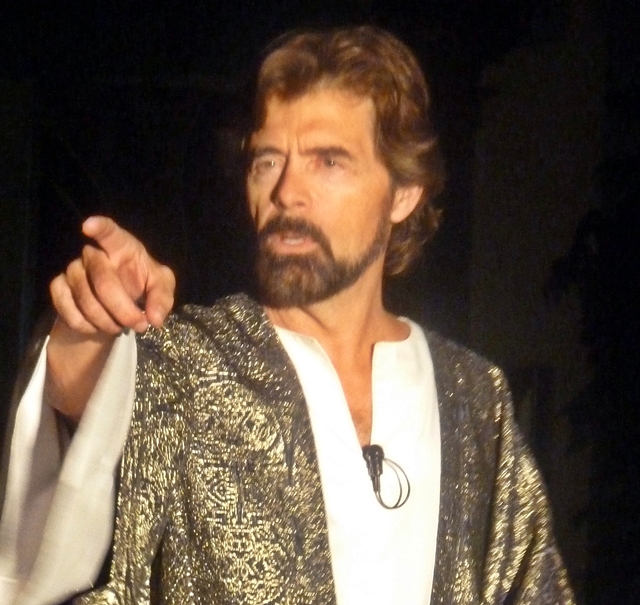
I teach CCD to high school students and needless to say, it is a challenge. Instead of our normal class last night, the students were treated to a one-man play about the Gospel of St. Luke. It was written and performed by Frank Runyeon.
Frank is a successful actor in television and movies. His bio reads, “He starred for seven years as Steve Andropoulos on As the World Turns opposite Meg Ryan, a storyline that garnered the second highest ratings in the history of daytime television. He next appeared for four years as Father Michael Donnelly on the Emmy award-winning Santa Barbara, and as tycoon Simon Romero on General Hospital, opposite Emma Samms. Frank has also guest-starred in recurring roles on L.A. LAW as talk-show host Brooks Tapman, on Falcon Crest as chess genius Jovan Dmytryk, on Melrose Place as Father Tom, and on All My Children as Forrest Williams.”
But Frank would rather be associated with the art closest to his heart: spreading the Good News of Jesus Christ through his vibrant performance of the Gospels.
He debuted his latest one-man play, “Luke, Stories on the Road” at the parish to which I belong, St. Luke the Evangelist in Westborough, MA.
Ah, the first connection!
I came with low expectations. I’m not a big movie-goer nor have I seen a lot of live plays. I had had a fight with my husband, was blown-out from a weekend of endless activity and just wanted to crawl under the covers.
So it took a bit of time to warm up.
About a half hour into the performance I felt a sudden urge to whip out my notebook and write. Frank spoke and I’d write. His performance became riveting.
The camera soon followed. As a former girl scout, I am always prepared!
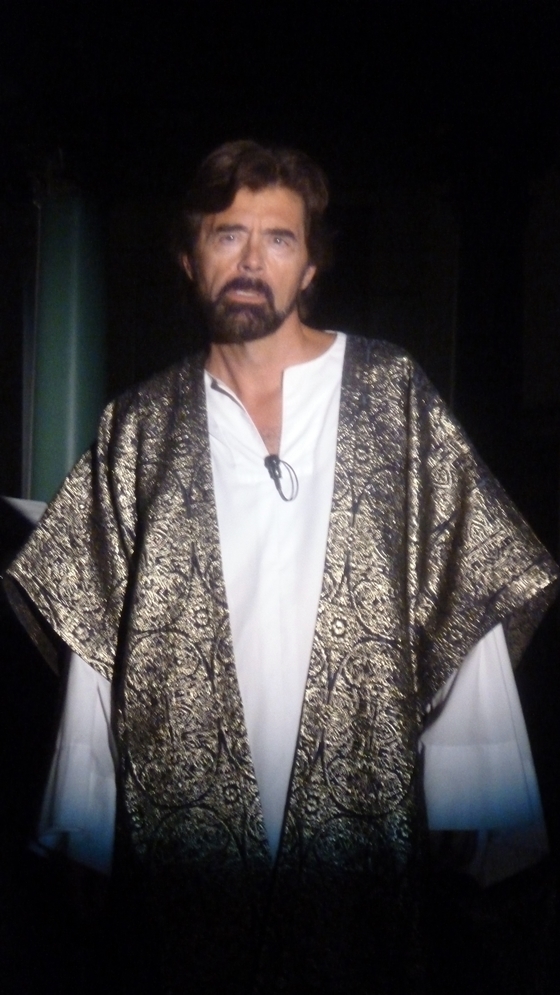
Dressed in a simple robe, Frank wove stories from the Old and New Testament, focusing first on the story of King David and his disastrous affair with Bathsheba and moving into the stories of Jesus as recorded by Luke the Evangelist.
In each story, he shared a similar and striking insight: the stories, in many cases, had open endings.
The reason? WE are the ending to the story.
How can that be? These stories are thousands of years old. But inspired by the Spirit of the Living God, their truths are as pertinent today as they have ever been.
And Frank made the scriptures come alive with his talented way of weaving a tale.
Past and present – another connection.
Frank made an important association between the story of King David and Bathsheba (2 Samuel 11; 2 Samuel 12) and the parable of The Rich Man and Lazarus found in Luke 16:19-31.
In the story of King David, Bathsheba found she was pregnant after their affair. To cover up their relationship, David arranged to have her dutiful warrior husband killed in battle (2 Samuel 11). Nathan the prophet was sent by the Lord to point out David’s sin (2 Samuel 12) and he did it through a heart-wrenching tale of a rich man robbing a poor man of his only lamb who had been a member of the family so that he could roast it for his friends.
David was incensed. Who was that man? He should be punished!
It was then that Nathan turned the story around on David, using it to accuse him before God of his sin.
Frank put out the palm of his hand: the story was a mirror clearly showing David’s guilt.
David listened, made the connection and repented of his sin.
The Rich Man and Lazarus Meister des Codex Aureus Epternacensis (source: Wikipedia)
The rich man did the same with poor Lazarus, committing evil against him by not offering him food or comfort as the poor man suffered outside the door of his home.
When both died, Lazarus, in the bosom of Abraham became the mirror to the rich man in agony in Hades. The rich man listened but too late: he must suffer the consequences.
The rich man had Moses and the Prophets, but he didn’t listen.
He failed to make the connection.
Frank shared many such stories from the Gospel of St. Luke, the most powerful being The Prodigal Son (Luke 15:11-32) and The Publican and the Tax Collector (Luke 18:9-14).
In both cases we are most definitely the end of the story. And it’s not the character that you would imagine.
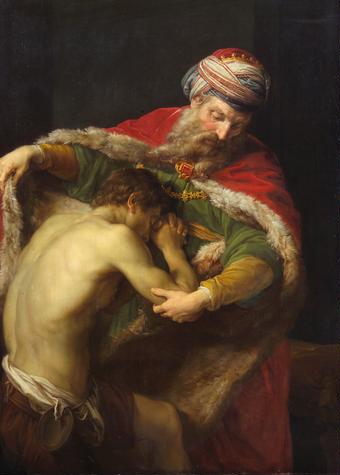
Frank beautifully conveyed the deep emotion in the story of Prodigal Son, showing the arrogance, ignorance and finally, redemption of the younger son, the deep, generous love of the father, and the bitter resentment of the older son.
The so-called “good” son.
The Return of the Prodigal Son (1773) by Pompeo Batoni
The father and the younger son reconciled. The older son, faithful in service to his father, complained, feeling entitled to better treatment.
And as Frank pointed out, the ending with the “good” son was open-ended.
The “good” son is us. We have to create our own ending.
The same was true with the Publican and the Tax Collector. Both praying in the temple, the Publican pontificating before God about how much he tithed and how much better a person he was than the wretched Tax Collector.
The Tax Collector, knowing he was an outcast in Jewish society, never raised his eyes to God but begged forgiveness.
He was justified. The “good” Publican was not.
And the mirror shines back on us – are we that Publican?
Do we consider ourselves as the “good guys?”
Frank Runyeon, through his vibrant, deeply emotional performance, demonstrated the deep connection of the Living Word of God to our daily lives. We at St. Luke’s were fortunate to have him tell these stories, opening our ears and eyes, helping us to listen and make those connections.
Bring Frank to your church
Frank is available for bookings throughout the country with “Luke: Stories from the Road” and other biblical one-man plays, all written by him. Visit his website at frankrunyeon.com.
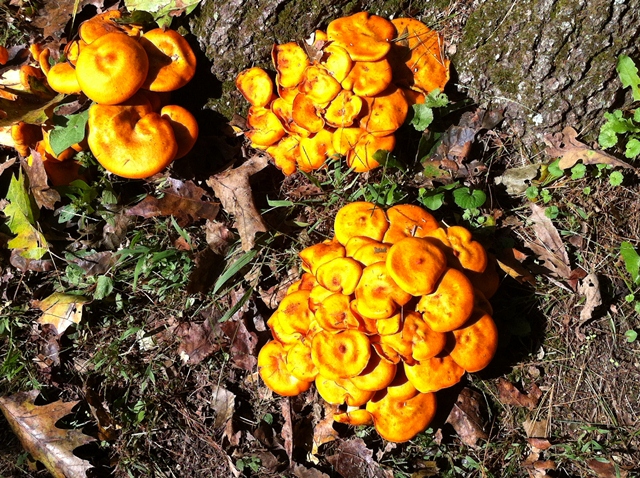
Autumn … one of the many reasons why I will never leave New England. While out on my lunchtime walk on the Brook Path in Wellesley, the color orange followed me everywhere.
It began with this:
This fungi really intrigued me, I don’t believe I’ve ever seen such a brilliant color of orange on a mushroom!
If you know what kind of mushroom this is, please comment and share your knowledge.
Emerging from the Brook Path, the red and orange leaves made their presence known:
It seems appropriate then to close this post with a short poem about this lovely time of year:
Autumn
Alexander Lawrence Posey
In the dreamy silence
Of the afternoon, a
Cloth of gold is woven
Over wood and prairie;
And the jaybird, newly
Fallen from the heaven,
Scatters cordial greeting,
And the air is filled with
Scarlet leaves, that, dropping
Rise again, as ever,
With a useless sigh for
Rest–and it is Autumn.
What signs of Autumn are you seeing in your world?
I loved this post that my husband sent me yesterday!
It is written by author Anne Strieber, well known for her thrillers An Invisible Woman and Little Town Lies.
She is married to Whitley Strieber, best known for his horror novels The Wolfen and The Hunger and for Communion, a non-fiction account of his perceived experiences with non-human entities.
In this post, Anne draws an analogy between hummingbirds who love to pick a fight, and people of the same ilk. It proves yet again how much we can learn by drawing upon and make connections.
John Donne in 1624 said it so well in his famous poem,
“No Man is an Island:”
No Man Is An Island
No man is an island,
Entire of itself.
Each is a piece of the continent,
A part of the main.
If a clod be washed away by the sea,
Europe is the less.
As well as if a promontory were.
As well as if a manor of thine own
Or of thine friend’s were.
Each man’s death diminishes me,
For I am involved in mankind.
Therefore, send not to know
For whom the bell tolls,
It tolls for thee.
He speaks of the need for human connectedness. Anne extends that connectedness to the entire natural world.
Here is a teaser from her post:
” … I’ll see a hummer [aka, hummingbird] land on our feeder, take a sip of sugar water, then immediately put his head up and look around, searching for a rival. I used to think this had something to do with guarding the food source, but now I’ve realized it’s because hummingbirds really ENJOY a good fight.
Soon two (or three) hummers are buzzing around, darting at each other, feinting and threatening, sometimes even telling each other off with that little “cht, cht” sound they make.
I’ve written before about why we humans are designed to make love, not war (even though we seem to be starting a new battle, somewhere, almost every day). But SOME people are more like hummingbirds–they relish a good fight and actively look for one … ”
Sometimes we need a place to jot down our thoughts and feelings.
We learn something new.
We screw up. Big time.
We receive a surprise blessing.
I wanted to establish this quiet space to share things as they happen to me with the hope that you will see yourself here too. Free free to comment and I will answer. Let’s talk and share.
In this journal I will be sharing insights I learn from scripture, experiences of prayer, encounters with people and with the world … whatever I run into that leads me to God.
I am hoping that in my sharing you will find something that resonates with your spiritual life.
We are never alone. God is with us and not just in church. He in our hearts and souls. He is in each one of us. And he is in the world around us.
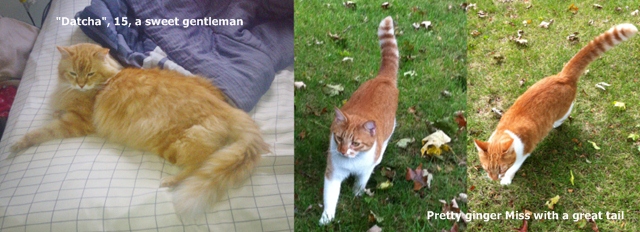
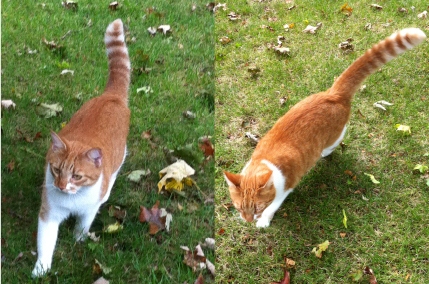
Today on my lunchtime walk, I met the most lovely little female ginger. Talkative and sweet, we spent time together on the grass communing. She moved constantly but I did manage to get a couple of pictures to share.
I needed that communing; the world is in turmoil right now and being the news junkie that I am, I keep listening, reading and paying attention. But it does get overwhelming.
A sweet cat along the journey offering hospitality can sure lift my spirits!
My son Stephen also has met a sweetie. Now settled in Brooklyn, NY, he made his first new friend in the form of Datcha, a fine and fluffy fifteen year-old gentleman. Temporarily living with Stephen and his 4 roommates, Datcha has chosen Stephen as his favorite and claimed his bed. He remarked that “It certainly makes it feel more like home to have a nice kitty here.”
Amen.
Datcha and the Ginger Miss reminded us both of another lovely fluffy ginger, Oscar, who use to luxuriate in the grass waiting for passers by to greet him, and I would as I walked from the parking lot to the office. His owner, a lovely women I once worked with, commented that Oscar was “waiting to be admired.” Indeed. Stephen and I both had the chance to do that.
Oscar is gone now but Oscar, this is in your memory.
Thank you, and friendly cats everywhere, for your welcome.
Has a cat ever made you feel welcome or brought you comfort? Leave a comment and share your story.
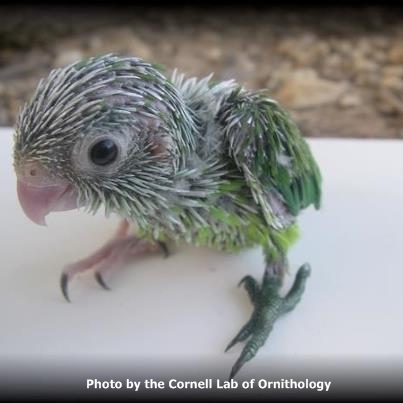
Quoted form the site: “One of the benefits of studying parrots is learning how they develop their complex vocal abilities. Another benefit is… baby parrots!!! Watch this fascinating video about how Green-rumped Parrotlets learn their “names” in the wild:”

 Off in the distance I saw a tree, its fallen leaves creating a colorful circle around the trunk.
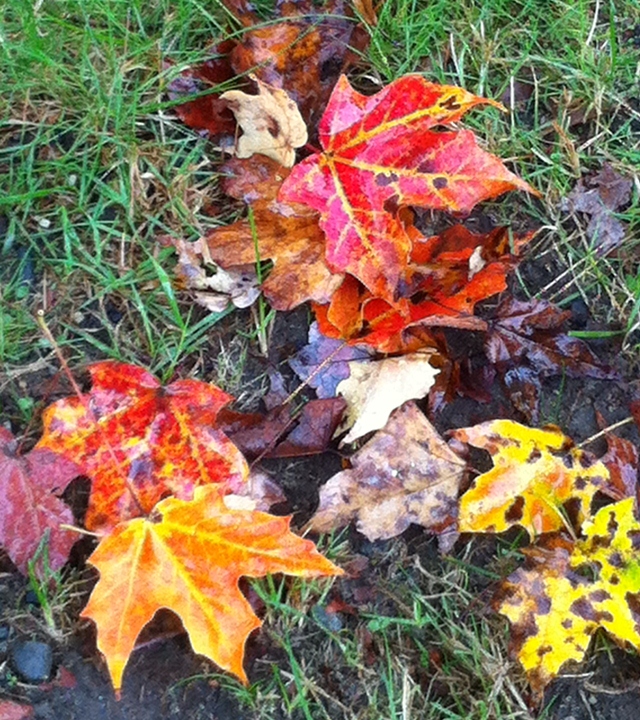 Reflecting on that thought (not unlike John 15:5 when Jesus calls Himself the vine and we the branches), I began examining the leaves on the ground.
 Even a leaf covered with raindrops cannot survive forever on its own. The drops will evaporate and the leaf will wither. It needs the tree to live.
 Thus the story of the vital relationship between God and humanity, told through His creation.
 A seamless circle of love, continuous and unbroken for all eternity. Perfect love, perfect harmony and we are invited to join.
 Click to Tweet & Share: God weaves His tales through the natural world. He told me one today, how about you? http://wp.me/p2D9hg-fU
 Would you like to learn along with Susan how to live your life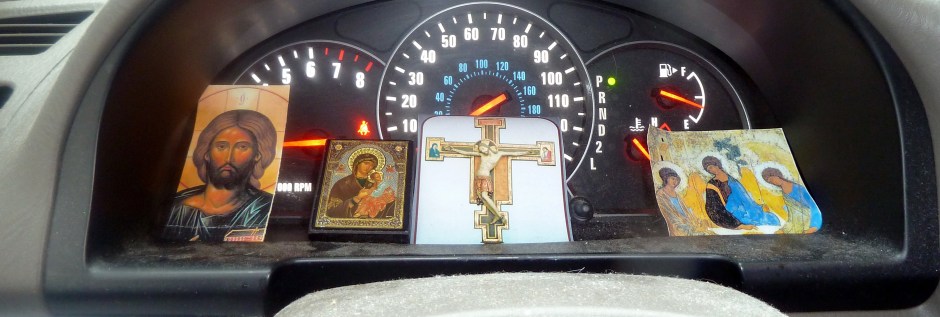










 . I love that line about this deciduous business being a radical scheme, the brainchild of a manic-depressive with limitless capital. When I took a walk this morning, I stood beneath a neighbor’s maple in a shower of shimmering leaves, each one the product of a hundred sunny days, watching as they twirled and tumbled about me, drawn toward earth in a dance they will take just once. Extravagance indeed.