The Sunday Readings: Deuteronomy 4: 32-34, 39-40, Psalm 33, Romans 8:14-17, Matthew 28: 16-20
Why is it that so many people today attack Christianity?
What are they so afraid of?
Is it because the Church is perceived as an authority figure bent on depriving us of personal freedoms, especially that of choice?
Is it because it is seen as an institution that deprives rather than as a life choice that fulfills?
For it is a choice.
God gave us free will which we can exercise as we please. Since choices have consequences, we need to be well informed before deciding.
God gave us his Holy Word as a means of helping us to make an informed choice. A thoughtful examination of this week’s Sunday readings points to reasons why inviting God into our lives could be considered a good choice.
The first reading portrays a powerful God, generous in spirit, going out of his way to demonstrate his love for his people. In Deuteronomy 4: 32-34, 39-40 Moses reminds the Israelites of all that has been done for them: “Did anything so great ever happen before?” referring to their miraculous release from slavery in Egypt. God intervened directly, raising a leader in Moses to take the people to a new land and a new life. The subsequent commandments of the Lord that Moses presented to the people were meant for their well-being, to ensure that they “may prosper” and have “long life.”
Does it sound like these people were being deprived?
The second reading from Romans 8:14-17 spells out the benefits of choosing God clearly: we are no longer slaves but children, heirs to a great fortune–a meaningful (though not trouble-free) life on earth and eternal life in paradise.
Children are disciplined and schooled, guided into adulthood by the love of their parents. We have the privilege of calling the Omnipotent God, the God we cannot see or ever hope to understand “Abba,” Daddy!
Slaves are deprived; children are privileged.
Spreading the word
With this in mind, today’s Gospel from Matthew 28 shows Jesus sending his disciples forth to spread the Word, the Good News, to inform the world that we can choose to be children; and not to be slaves.
We are fortunate in Massachusetts to have several chapters of WINGS, an organization dedicated to gathering together women of faith in an effort to support and deepen that faith.
Life is full of transitions. The longer we live, the greater the number of our years, the greater the number of transitions.
Some transitions are rather universal like adolescence and leaving home, marriage and childbirth, illness and aging, or separation through death. Other transitions feel as if they are thrust upon us like the loss of a job or an unwelcome medical diagnosis.
In every case we’re forced to look at life anew in order the rebuild our lives.
In this week’s gospel Jesus’ disciples are struggling to deal with his departure from this world. They will be forced to let go of their former ways of relating to him. In the future, Christ will be present to them, albeit in a new and different way.
Sorting all this out is something the disciples will have to do together. So Jesus prays that “they may be one.”
It has been said that most people belong to two families:
One family is your biological family. These are the folks with whom you share a common bloodline, genetics, DNA.
The other family is your psychological or spiritual family. These are the people that care for you, love you, stand by you. These are the communities that give you strength and hope when you need it most.
Biological families and spiritual families are sometimes the same. But frequently, they are not.
The disciples needed a community of faith to get through the transition.
We, modern-day disciples need spiritual families to navigate and find strength through the changes and upheavals of life. The big transitions of life are not meant to be travelled alone…
Who are the people that make up your “spiritual family?” Who are you a “spiritual family” to?
How are you traveling life as the years (and the transitions) add up? Traveling alone? Or, with companions?
We pray for the grace to have and to be, faith-filled, hope-filled and loving travel companions.
I created a video for this post with a musical backdrop and images to inspire you. You can read the text below:
Recently I wrote a post about dealing with the noise, busyness and general chaos of the Christmas season. Our involvement in the many worthwhile activities of decorating, cooking, entertaining, party-hopping, buying and wrapping gifts, sending cards, volunteering our time and treasure to charities, and spending time with our families can make our heads spin. I proposed that a renewed focus on the season of Advent, with its call to simplicity and quiet, would make a wonderful antidote.
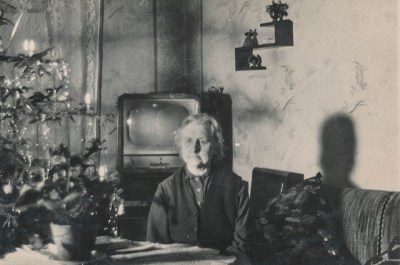
Elderly woman sits alone for Christmas by simpleinsomnia, Flickr Creative Commons
A reader responded with an unexpected comment: “I have the opposite problem. I would love a bit of noise and chaos at Christmas.” Jay described her situation of caring for a homebound mother and a disabled husband, with other family members living too far away to visit. Suddenly my assumption that a quiet Christmas was best for everyone felt arbitrary. “Quiet” can assume many forms, including loneliness and isolation.
I immediately wrote back to Jay, attempting to offer some consolation; I wanted to do something to mitigate her circumstance. In the writing I realized that I too understood the ramifications of a Christmas “gone quiet.” My own family circle has grown noticeably smaller over the years with my parents gone and my sister, brother-in-law and nephews scattered across the country. Although the circumstances were different, Jay and I ended up sharing a common problem.
Jay responded to my letter, opening up about her situation. Because of her husband’s disability, it is nearly impossible for them to visit friends. In fact, in order to see her mother on Christmas day, she has to leave him behind. She waxed nostalgic on the past, writing, “we had such a lovely time with the cousins and aunts and uncles when I was a child, and when we lived closer by.” She wrote of longing to help others, of getting a tree only to leave it unadorned and of the futility of buying gifts when no one really needed anything. She gently berated herself in her longing for Christmases past full of Santa Claus, gifts and overeating; as a teacher in the Methodist church she is keenly aware of the true meaning of the day.
However, as we continued to write back and forth, I noticed her mood quickly shifting from laments to gratitude. Jay began recounting her blessings, most notably the love she has for her husband and mother. I could feel the warmth of that love coming across the Atlantic from her home in Ipswich, England to mine in North Grafton, Massachusetts. It was then that I began to understand the power behind listening.
I had entered into the correspondence assuming my usual role of problem solver; I was going to make everything better! It soon became clear however that I was meant to be a friend; to listen to and acknowledge another person’s life story. It was not about me solving a problem and looking like a hero; it was about Jay needing someone to be fully present, listening with mind and heart. Paying attention to her life rather than mine required humility.
Yet, once I surrendered to the idea, I could see God’s grace unfolding. The focus of our letters changed from melancholic remembrances to gratitude for the blessings we both enjoy. Gratitude fueled action with Jay vowing to get into the spirit by attending a couple of get-together lunches and taking in a local concert of carols presented by her town’s brass band. I, in turn, volunteered to join a band of Christmas carolers in our parish, and inquired about taking communion to nursing home residents. Jay and I are exchanging gifts through the mail. Listening has turned strangers into friends.
Our correspondences caused me to examine myself: why do I insist on giving people what I would not want for myself? When I share my heart with someone, I don’t want judgment or unsolicited advice or easy answers. Many problems cannot be solved but rather, must be endured. I just want a sympathetic ear. Doesn’t it make sense then that sometimes my family and friends, neighbors and even strangers just want someone to accept where they are at that very moment and sit close by, saying nothing?
I experienced this recently as another friend shared with me the pain of watching her best friend slip away behind the fog of dementia. I empathized, recalling my mother’s mental deterioration and personality change, but decided that it was best just to let her talk. We ended our conversation in silence, looking at each other with misty eyes.
Jay taught me how to do that.
If I were to sit on Santa’s knee, I would say: “St. Nicholas, please ask the Lord to help me grow in grace as a good listener.”
For listening is one of the most precious gifts we can give to each other.
Note: It turns out Jay and I have something else in common–Foster Dad John’s Critter Room!
Did you know that blessings multiply? If you are familiar with the story of the multiplication of the loaves and fishes then you know that when Jesus blessed the five loaves and two fishes, they multiplied enough to feed five thousand people.
This is how I would characterize my miracle healing. It began with a visit to church on the feast of St. Blaise where I received a blessing on my throat (see previous post for more on St, Blaise).
I entered the line out of habit. The wait was long because the priest chose to do the blessings himself. Fr. Stephen LaBaire, pastor of Holy Family Parish in Worcester takes his liturgical responsibilities seriously, loving every ritual with fidelity and reverence. Each throat blessed received his utmost attention.
Desire for healing?
As I waited, I wondered why I was there. Did I believe in healing? Did I even want a healing? You may ask why someone might not desire a healing but when you get accustomed to being a certain way, change is hard to imagine. I was used to my voice being gone. I had accepted it.
Still, I remained in line, deciding it couldn’t hurt. I left the door open for possibilities, for anything God wished to give me.
Unfolding of a blessing
After receiving the blessing, I left the church in tears. What could possibly come of this? A few days later, the blessing began to unfold.
It began with an emotional healing.
Loss not private
When I initially lost my voice, I thought I could mourn in private. I could resign from music ministry at my parish and that would be the end of it. I was wrong. My singing was not a private, individual affair. I had shared it with a community and my loss impacted people. There were the other musicians who had to pick up the slack when I resigned. And there were the people who had enjoyed my singing. I should have been grateful for the many kind inquiries and offers of concern but instead I found it to be an intrusion. I didn’t want to accept my loss and thus I pushed music away from me. The inquiries and offers of concern pushed it right back at me. I couldn’t get away from my pain.
Thomas and his loss
It made me think of Thomas. Poor doubting Thomas. He was the one disciple who was not there when Jesus appeared to the apostles after the resurrection. Filled with joy to overflowing, they told Thomas they had seen the Lord and he would not believe. Hidden in a locked room out of fear, Thomas hid from his pain as well. It hurt too much to face it; thus he pushed away any semblance of hope that Jesus had risen. Just as I had pushed away any connection, any reminder of my music: it hurt too much. Healing through the wounds Thomas demanded to touch Jesus’ wounds. It was the only way he would believe.
The Incredulity of Saint Thomas by Caravaggio
A beautiful homily given by a newly ordained priest celebrating his first mass described what Jesus did for Thomas in response to his demands:
“‘Put your finger here and see my hands. Bring your hand and put it into my side. Hide yourself in me. Hide yourself from all that troubles you, from all you doubt, from all you fear. Hide yourself in a love more penetrating than a brush fire, more overwhelming than a deluge. Hide yourself in a love that will remake you entirely. Do not be afraid.’ Jesus invites Thomas to literally enter into his wounds of love, to pass so deeply into the reality of love incarnate as to move within it. To physically put himself into our Lord’s resurrected body, unconquered by everything that would seek to destroy love, to put to death all that smothered God’s life within him. To touch resurrection, to touch eternity. To hide himself in Christ’s love forever. But not to hide Christ’s love from the world. Not to remain behind locked doors. Not to continue in sadness and fear. Jesus fills Thomas with a love so transforming that he can proclaim without fear, without doubt, ‘My Lord and My God.’” Rev. Patrick E. Reidy, C.S.C., Basilica of the Sacred Heart, University of Notre Dame, April 27, 2014
Transformation through healing
Jesus transformed Thomas; he changed him from a man filled with fear, sadness and bitterness to a man who proclaimed his love for Jesus boldly throughout the world. He healed Thomas and Thomas embraced him. He healed me in the same way. Once at war with myself over the loss of my voice, I learned again to love music, to re-embrace my gift and to learn to use it in a new way.
Openness to God’s way
In the next post I will tell you how Jesus healed me. Like the loaves and fishes, it was a blessing that multiplied over and over. Remember when Jesus told the disciples to lower the net for another catch even though they had worked hard all night and caught nothing? The net was filled to overflowing.
That’s what happens when you leave the door open, just a bit, and let God have his way.
In the last post I wrote about my dear friend and the inner healing she received from God as she copes with Ménière’s disease.
I would now like to share my own story of healing from God, a healing I consider miraculous.
Some of you may know that I was a professional singer and songwriter, focusing on songs about my faith. For many years I recorded CDs and appeared on EWTN and CatholicTV. I was blessed with the opportunity to perform at World Youth Day 2002 in Toronto. I served for thirty-seven years in various capacities of music ministry in my home parish.
I poured my heart and soul into my music. Only my faith and my family meant more.
Four years ago, only a few months after my mother died I noticed that my voice was becoming weak. It always seemed to fail when I was performing in front of a crowd. Sometimes the clear, strong sound I was accustomed to would sail out of my throat; at other times this weak and wobbly noise would come out instead. I never knew when it would happen and I cringed at the sound of it.
My voice had been rock-solid; now it was erratic.
Once totally at home in front of people, I became terrified of singing in public.
I had to put a halt to my music career. I stopped doing live performances and resigned from music ministry at my parish.
It was a difficult loss to accept and the grieving process was not unlike mourning the death of my mother.
Four years later I can claim a healing.
It was completely unexpected and not something I asked for.
It began with having my throat blessed by the priest after mass in honor of the feast of St. Blaise. St. Blaise is the patron saint of ailments of the throat; legend has it that he cured a boy who got a fishbone caught in his throat.
The priest takes two candles crossed together and places them on the throat while reciting a short prayer.
The line was long since the priest insisted on doing the blessings himself. It gave me time to reflect. Did I want a healing? Did I believe I could be healed? I nearly stepped out of line but decided to stay. After my throat was blessed I left the church in tears.
I had no idea what would come of it. It turned out to be far more than I ever expected.
Consider this scripture where Jesus says “Give, and it will be given to you. A good measure, pressed down, shaken together and running over, will be poured into your lap. For with the measure you use, it will be measured to you.” Luke 6:38 (NIV).
Consider too the story of the handful of loaves and fishes feeding five thousand from Matthew 14:13-21.
These two scripture passages set the stage for the healing I was about to receive because I left myself open to what God wanted to give.






 I am pleased to present this guest post from




 Be as One