The Gospel reading for this Sunday is the story of the tempting (or testing) of Christ in the desert wilderness (Luke 4:1-13).
We’re told that after his baptism in the Jordan River but before undertaking his public ministry, that Jesus fasted for 40 days.
After his fast, he was tempted.
Luke describes three temptations:
To give into thinking that the needs of the body are all that matter;
To worship something or someone other than God (idolatry);
The three temptations can be stated in another way: We can be tempted into believing that our bodily or physical needs are all always the most important, or the only ones. (And yet, we know that the world is full of well-fed, full-bellied, in-shape people who experience life as meaningless and without purpose. The soul matters.).
Forms of idolatry
We can be tempted into making our work, our popularity, or money, our possessions, or a whole host of other things, the center and goal of our lives. (But this is simply a form of idolatry. God calls us to a more abundant path of love. But God sets the priorities along the path. We neither invent nor determine them.).
Trying to control God
Finally, we can be tempted into trying to manipulate God into serving our purposes. (“I’m a good person, I go to church, I give to the poor. But I smoke 2 packs of cigarettes a day. I’m sure God will take care of my health and protect me from any illnesses. “I know my son drinks excessively and drives. But I put a Miraculous medal on the dashboard. I’m sure he’ll be fine.” Oh really?)
In the wilderness, (and at other times in his ministry) Jesus was tempted in ways similar to these.
All are tested
What we can forget is that this story is the story of every Christian. In the wilderness of the world, each of us has and will be tested. Sometimes we resist, sometimes we fail.
treat-depression.com
And, what’s more: In every age, the Church has been tempted in these ways. And in every generation, the Church resists and the Church succumbs to the temptations. That’s because the Church is made up of imperfect, sometimes weak people, like us.
Temptations are part of our journey through life. The Gospel on Sunday tells us that there would be more ahead for Jesus. (That’s the last line of the Gospel!) Doing what is right is sometimes a struggle; even like an inner battle of sorts. Temptations can teach us a lot about ourselves too.
But God’s Spirit leads us, as it did Jesus.
Pray to resist evil
We pray that this same Spirit would impart the grace to resist what is evil. When we fail, may the Spirit lift us and give us what we need to mend what we have broken or injured.
Above all else, may that Spirit give us vision to see beyond the wilderness of this imperfect, broken world.
Eyes to see that eternal, undying Easter, where God’s love has triumphed over our every test.
The word “Lent” is derived from the old English word for “springtime.”
The word gives us a clue as to what Lent is all about.
Lent is about a “springtime” and rebirth of new life.
It is not so much a season in the external world but a season of renewal and new life within individuals, relationships and communities. Lent is about Christ calling you to springtime (new life) within yourself! Lent is the Church’s springtime.
On Ash Wednesday, ashes are placed on the foreheads of Christians.
Ashes evoke death and mortality. But ashes are also used as a cleansing agent and as fertilizer for gardens. We begin our journey of Lent by reminding ourselves of the fragility of life and of own mortality. As the old proverb goes: “No one really starts to live until he or she squarely faces death.”
The number 40 calls to mind the 40 days of rain during Noah’s flood, when evil was drowned and earth was washed clean. It calls to mind the 40 years the Hebrew people journeyed in the wilderness to the promised land. Also, Moses, Elijah and Jesus are said to have fasted 40 days to prepare them for their mission. The days of Lent are often compared to a journey. That means that at the end of Lent we should expect to find ourselves somewhere different from where we started.
Lent is not just about “trying harder” or “giving up.”
Lent is about re-awakening the presence of God in our lives. It invites us to “spring clean” our lives: throw out the rubbish and reclaim the spirit within that appreciates being alive; letting go of the “junk” that gets in the way of loving in the Spirit of Jesus Christ.
Here is a song of mine you can pray with as you enter into Lent called “Lead Me to the Wilderness.”
[huge_it_slider id=”25″]
Some ways we can observe Lent:
Fast from TV and computer.
Television and electronic devices now absorb 40% of our free time. Take some of that time back and use it with your family or be with your friends. Go to a meeting or group where your voice needs to be heard on behalf of children, the mentally ill, the rights of the unborn, poor families, or those dealing with addictions. Volunteer where you are needed.
Fast from eating on the run.
Make eating together a priority during Lent. When we eat together, more than food passes between us. We share our lives, difficulties and delights. We create bonds and strengthen relationships. Commit to eating with others at least twice a week. Invite people who might otherwise eat alone to share lunch or dinner with you.
Fast on Fridays.
Catholics are enjoined to abstain from meat on Fridays. The point is not to simply substitute jumbo shrimp or Maine Lobster for steak! (What sacrifice is there in that? C’mon now!) The point is to eat a simple meal by subtracting the meat part. Then take the monies saved and give to an organization that helps fight hunger or one that feeds the hungry like the St. John’s Food Pantry. Vegetarians can join in by eating more simply and donating what is saved to a relief agency.
Simplify your Life.
Do you have more clothes than you need? Is your attic or basement full of unused stuff? Are your children’s closets brimming with unused toys and games? Consider cleaning out part of your home and donating the unused stuff to a local charity as a Lenten project for your family. The Saint Vincent de Paul Society in Worcester accepts used clothing. The Urban Missionaries of the Poor in Worcester will use unwanted furniture to assist needy families. (Think of this: there is a scientific connection between “clutter” in your home and your stress level. De-cluttering can be a first step in de-stressing your life. There is peace in simplifying. What a wonderful way to observe Lent.)
Make life more welcoming to others . Visit a shut-in or are an elderly relative or neighbor. Offer some time to helping a family or an individual dealing with a personal loss. Run some errands for someone who can’t get out of the house. Drive someone to their doctor’s appointment. Walk the Stations of the Cross in church. While walking, think about a person who is carrying a heavy cross in life. Let that person know you are praying for them.
Examine your Consciousness.
At some point each day sit still. Turn off the devices. Tune out the noise. Breathe in, and breathe out. Allow yourself to be still for a while. Savor the quietness. Ask yourself how God may have been teaching you something this day. What have I learned today? Do any regrets surface that I could act upon? Am I holding on to any negativity? What am I grateful for? What could I change within myself to face tomorrow with more energy and hope? Ask the Holy Spirit to help you with this.
Listen Attentively.
Give to a spouse, a child or a friend 15-30 minutes of undivided attention. No cell phone interruptions. No texting. Make no comments, positive or negative; give no advice. Just give the gift of listening. Ask questions to clarify only. Attentive listening can help a person sort out a problem or recognize a desire or a direction by simply hearing it aloud. Pray regularly for the grace to be a good listener.
Reflect and learn.
Take the time to reflect on the scriptures proclaimed at Mass. Participate in a Bible Study. Or, go to www.sacredspace.ie for a daily reflection on the scripture from your computer. Or, read a bestselling book likeMy Life With the Saints orJesus: A Pilgrimage both by James Martin. Or, take some of the Lenten materials available in the vestibule of the church and use them daily. Participate in our Jewish Passover Seder Meal on March 6th and learn about the Jesus’ faith and the Jewish roots of our Catholic Mass and understand the Mass more deeply
Contemplate Beauty.
The media bombards us daily with images of violence and corruption. Entertainment is often focused on what is most “shocking” in order to attract attention. Have you neglected to incorporate “beauty” into your daily regimen? Go to a lecture, hear a concert, see a play, visit a museum. Gaze upon the beauty of human creativity. Go outside. Take weekly or daily walks and look around..really look around. Take in the beauty of creation. Be grateful for being able to take it in. Sit quietly in church. Look at the beauty of the artwork. Think about all the people that have prayed there before you. Open the hymnal before Mass. Prayerfully read the lyrics of the hymns for Mass. They are inspired poetry. What might they be saying to us? Go to Saint Joseph’s Abbey in Spencer and listen to calming chant of the monks there.
These are but a few ideas on what you might incorporate into your Lenten practice this year.
Everyone is in a different place in life. So the practice will be different for each person.
What matters is that we dare to do something that will open us more deeply to the presence of God and the gift of life so that we may grow more deeply in faith, hope and love.
If we have grown, even a little, to live in the Spirit of Jesus our Lenten ‘springtime” will not have been in vain.
My morning prayer begins with a deck of cards. Not playing cards but prayer cards with pictures of my favorite saints. I have amassed quite a collection—seventeen to be exact. Each day I begin my walk with God by inviting each saint to walk with me.
In the beginning …
It began thirty years ago with St. Anthony of Padua. He was a must-have saint when it came to our baby boy losing his pacifier. Our son preferred the old-fashioned kind, the kind that was hard to replace. St. Anthony became a good friend in short order, always finding that pacifier (whether it was the old one or a new one at the store).
For many years St. Anthony was the only one. I had trouble figuring out how to talk to God and also make room for other heavenly friends in the conversation. It made the room feel crowded.
Growing the list
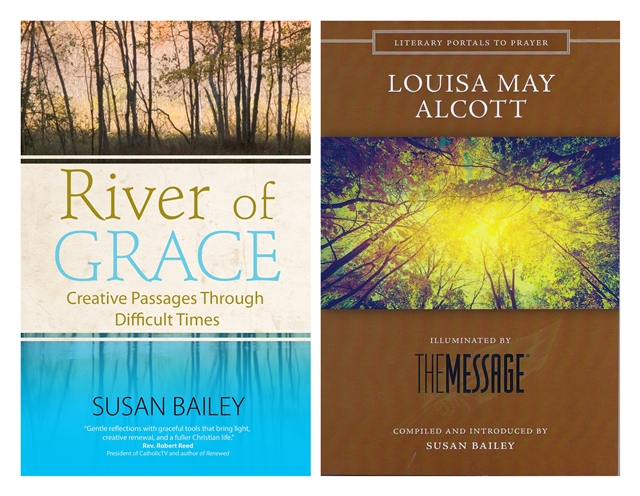
Then, a few years ago, an improbable event occurred in my life: I was asked to write a book. Having never done anything like that before and having no formal education in writing, I knew I needed help. And that’s when my list of saintly friends began to grow.
Teresa, Therese, Bernadette …
Saints Teresa of Avila and Therese of Lisieux were the first to make the list. Both were reluctant writers and both relied heavily on God. I even used some of St. Therese’s own words in River of Grace.
Next I saw “The Song of Bernadette” and became enamored with her. In reading her biography I was intrigued by her ability to be absorbed in thoughts of God even when surrounded by large crowds. I wanted that ability. Now I ask her for it every day.
Paul and Cecilia
I clearly remember the time and place where I first encountered St. Paul—it was in the middle of an emergency (stuck in traffic and desperate for a rest room!). St. Paul the marathon runner came to mind and I asked him to run with me and help me endure the pain. He did. Now I always ask him to run with me.
St. Cecilia is restoring my love of music. There was a time not so long ago when I wanted nothing more to do with music having been a performer for many years. But then, God invited me to join the choir at church and I turned to St. Cecilia. She has been working overtime for me, securing blessings which fill my heart up again with the sounds of music.
Meet my saintly friends: Top row, L to R: St. Teresa of Avila, Venerable Bruno Lanteri Row 2: St. Therese of Lisiuex, St. Francis de Sales, St. Lawrence, St. Thomas Aquinas, St. Francis of Assisi Row 3: St. John the Evangelist, St. Paul, The Blessed Mother, St. Martin de Porres, St. Cecilia Row 4: Sts. Monica and Augustine, St. Nicholas, St. Anthony of Padua, St. Bernadette, St. Christopher
Bruno, Nicholas and Francis
Last year I had the pleasure of meeting Venerable Bruno Lanteri, the founder of the Oblates of Mary Immaculate. Through author Father Timothy Gallagher, I met the man who would do anything to hear a person’s confession. He sought out the discouraged, helping them to rise and begin again.
St. Nicholas has become one of my favorites. While searching for a patron saint of finances, I was delighted to find that the man who inspired Santa Claus was that saint. His wisdom and generosity could inspire me to seek guidance in the handling of money, and healing for a heart made stingy by past financial troubles.
And finally there is Francis of Assisi. I am a crazy cat lady with many friends who love animals. And each day I ask St. Francis to remember them all.
Making room
Each day as I take a few moments to flip through my prayer cards I realize how rich my life is with all my saintly friends, all because I opened my heart and made room for them. Doing that reminds me to the same with my earthly friends, especially those in need.
It will be wonderful traveling through Lent this year with so many helpers.
Meet my seventeen special friends
SAINT
PATRON SAINT OF
WHY I PRAY TO THIS SAINT
St. Teresa of Avila
Writers
She was a reluctant writer and attributed all to God – helps me keep my perspective. She led me through River of Grace. Doctor of the church
St. Therese of Lisieux
Writers
Also a reluctant writer and master of insight into the sacredness of the everyday. She also led me through River of Grace. Doctor of the church
St. Francis de Sales
writers and journalists, because he made extensive use of broadsheets and books both in spiritual direction and in his efforts to convert the Calvinists of the region
His gentle face inspired me
St. Lawrence
librarians, archivists, cooks, and tanners
(and comedians!)
Inspired by his literal trial by fire, I ask him to put his fire into my writing; as I make use of libraries and archives, I ask for his help
St. Thomas Aquinas
Writers (students)
I turn to him for knowledge and understanding as I write – particularly clinging to him because of my Alcott biography
St. John the Evangelist
Writers
St. John was eloquent and mystical in his writing – asking for that in mine.
St. Paul
missionaries, evangelists, writers, journalists, authors, public workers, rope and saddle makers, and tent makers
My marathon runner partner! He runs next to me when I need endurance.
Venerable Bruno Lanteri
The confessor—encouraging the discouraged to make peace with their failing, get up and start again
I turn to him whenever I have fallen and feel discouraged. His caring demeanor attracted me.
Mary, the Mother of God
Bringing God’s children home to the sacred heart of Jesus through her own immaculate heart
I ask Mary our Mother to bring all of us home to her Son Jesus.
St. Martin de Porres
Mixed Race, Barbers, Public Health Workers, Innkeepers
private intention
St. Monica
and St. Augustine
Mothers—praying their children home
private intention
St. Nicholas
those in financial need
For wisdom in handling our money and for healing of stinginess (after all, he is the model for Santa Claus!)
St. Anthony of Padua
lost and stolen articles
For finding anything, from lost objects to lost thoughts!
St. Bernadette
illness, people ridiculed for their piety, poverty, shepherds, shepherdesses, and Lourdes, France
For humility and holy absorption
St. Cecilia
musicians
Offering my music through her
St. Christopher
travelers and of children
For help with driving, especially at night
St. Francis of Assisi
animals and the ecology
For all animal lovers, especially my kitten cam friends
The gospel this coming weekend tells us that Jesus while in Nazareth went to the synagogue on the Sabbath. At the appointed time, he was handed a scroll from which he read the appointed reading for the day.
Jesus was a Jew. Sometimes Christians forget this: Jesus was a Jew.
Jesus was raised in a Jewish home. Like all Jewish males, he was circumcised. When he was 13, he had a Bar Mitzvah. He celebrated Hanukkah and Passover. He learned the Hebrew scriptures. He prayed the psalms. He made a pilgrimage to the Temple in Jerusalem. And today, we’re told that he was in the habit of going to the Synagogue on the Sabbath.
Last Sunday, Pope Francis visited the Synagogue of Rome. He reminded those present that there is an inseparable bond between Christians and Jews. He spoke of how Christians and Jews are called to work together to overcome all forms of violence and terror.
But he added a rather interesting observation:
“In order to understand themselves, Christians must understand their Jewish roots.” In other words, if you want to understand what it means to be a Christian, you have to seek to understand the faith out of which the Church was born. And the Church was born within a Jewish matrix.”
One reason why we sing or say the responsorial Psalm at every Mass is because the psalms are the prayers that Jesus grew up with. When you pray the psalms you are praying what Jesus actually prayed.
When the deacon or priest carries the Gospel book to the lectern at Mass, he is imitating the rabbi carrying the Torah scroll to the reading desk.
The unleavened bread we use during Mass, evokes the unleavened matzo bread of the Jewish Passover, reminding us that we are all called to leave behind “Egypt” –whatever places or relationships that imprison, enslave or oppress. “Exodus” is a on-going part of life.
As a Jew, Jesus understood that God had intervened in human history; that the human story was not arbitrary or meaningless. We Christians see the human drama, despite its tragedies, as headed toward an ultimate fulfillment and destiny. That’s why hope is characteristic of a Christian.
And there’s so much more…
How could someone tell the story of your life without understanding what means to be a 21st century American?
So, how can we claim to understand Jesus and his message without understanding his Jewish faith?
How could we say that we really know someone, without striving to understand from what and where they come?
Let’s pray for a Church that honors her roots;
for an openness to understanding more about our connection with the Jewish faith;
for a future where we find strength for living from the wisdom our past;
and for overcoming the amnesia that would keep us from understanding who we are.
I would like to extend to Father Steven and his parishioners a hearty congratulations for the reopening of the fully renovated rectory at Holy Family! Three of the four suites in the home will be used to house retired priests. This is the first time that I can recall a parish literally being brought back from the dead (Holy Family is housed at St. Joseph’s Church on Hamilton Street, once slated for closing in the 1990’s, and saved by the parishioners). This is indeed a happy occasion! You can read more about this amazing story at the Catholic Free Press website.
For those who wish to deepen their understanding of the significance of this Sunday—The Solemnity of the Epiphany—the following is offered in preparation for Mass this weekend:
1—This weekend’s celebration ranks among the most important celebrations on our Catholic calendar, with only Easter, Christmas Day and Pentecost taking precedence.
2—The word “Epiphany” is a Greek word meaning “revelation” or “manifestation.” The word “epiphany” may be used in non-religious ways. An “epiphany” can refer to a sudden perception or insight about something. For example: “Then, one day, I had an epiphany, “Why not email my friends back home?”
3—On the Solemnity of the Epiphany we celebrate that the child born in the darkness of night in a lowly manger is revealed as the manifestation of God. Christ is revealed in many ways: as Lord, as King, as the one in whom God is present and acts. All of these manifestations (epiphanies) are “lights” that shine on Christ, revealing a deeper understanding of who he is. Notice that all the readings for today reveal, in a way, a different manifestation of who Christ is and what God is doing through him.
4—The First Reading from Isaiah will speak of a reversal of fortunes for the inhabitants of Jerusalem. Jerusalem will no longer be an insignificant city. A light will beckon peoples from many nations.
The Second Reading from Saint Paul speaks of Christ as the one who gathers all to share the same promise, the same inheritance, making them members of the same body.
The Gospel Reading recounts the wise men following the star and offering their gifts. Of course, the story represents the life of every Christian: we are guided by the light of faith to offer our gifts of service to Christ.
6—Because the liturgy refers to light, splendor, shining and appearance, the Roman Missal directs that the sanctuary should be decorated with more candles than usual. (Reminder: In Catholic worship, an age-old basic principle is that symbols often communicate truths of the faith better than just words.)
7—Epiphany is another moment in the Church’s celebration of the Christmas Season Actually, our celebration of Christmas will continue for another week, until the Feast of the Baptism of the Lord. From a Christian perspective, there are so many angles, so many perspectives, so much to “take in,” that it takes weeks to “digest” the many different meanings to Christ’s birth. The “secular” celebration of Christmas is now over: trees are coming down, decorations are being put away because the ‘holiday parties” are over and the money-making of the gift giving business is ending. Christians, however, are called to be different. We continue to celebrate and reflect on “the light of the world.” For Christians the primary meaning of Christmas is not gift-giving or parties. (Although gift-giving and parties are wonderful things we should all enjoy!) The meaning of Christmas is Christ-the light. We pray that by our celebrating that our minds and hearts would be transformed by that light. Why? Because there is always darkness to dispel. And that’s what Christ calls us to do.
Today I am attending mass at Father Steven LaBaire’s parish, Holy Family in Worcester. Father Steven sent out his weekly newsletter which announced that today’s mass would be celebrated “Ad Orientum.”
Just what is “Ad Orientum?” I will let Father Steven explain.
Ad Orientem is the practice of the priest turned toward the altar and the crucifix at Mass whenever the priest is addressing God. Whenever, the priest addresses the people, he turns toward the people. This is the way that our liturgy was celebrated for over 1800 years. It is still the normal way of celebrating Mass in Eastern Catholic churches. Pope Benedict revived the practice. Pope Francis occasionally continues it. Bishop McManus has also celebrated Mass Ad Orientem recently at Saint Paul’s Cathedral. The practice is continued in numerous church and cathedrals all over the world.
+ Does this mean the priest is celebrating the Mass with his back to us? Not really. He could only “have his back to us” if we were the center of his attention at Mass. But we aren’t. God is. So the priest simply faces the altar as the leader and representative before God and we are all united in the same direction and posture. Together we gaze upon the altar and cross—the symbols of Christ. Appropriately, when the priest addresses the people he faces the congregation.
+But this means I won’t see the priest’s face at some point during the Mass? That’s correct. But let’s remember that facing the same direction helps us focus our attention on God rather than on the priest. Praying the Mass ad orientem makes the mass less about the personality of the priest and more about the mystery that he stands in the person of Christ the High Priest, with us and for us. The man who is the priest disappears within the vestments (that’s part of their purpose)and when we do not see his face, we are more free to concentrate on God before us. Worship is about focusing on God.
Think of it this way: if someone points out a beautiful flower or a star in the night sky to you, do you look at him or what he’s pointing to? Just so with Ad orientem worship. The priest is pointing us to God. Look where he’s pointing, and less at the one pointing.
+Didn’t Vatican II change all this? This is a common point of confusion. While celebrating the entire Mass with the priest facing the people has become the primary way of celebrating Mass since the Council, ad orientem remains an accepted and time honored way of celebrating the liturgy. Each practice highlights different theological values. The way we celebrate most commonly today highlights the altar and Christ at the center. Ad Orientem highlights our being pilgrims with the priest leading and pointing toward Christ. Both practices attest to the richness of the liturgy.
Why are we celebrating Ad Orientem on this Sunday? The phrase Ad Orientem means ‘toward the east.” Christians for centuries prayed facing in a common direction toward the east. East signified Jerusalem and the breaking light of dawn. Of course, Christ is the light of the world. So, together, we look east to be reminded of the light of Christ. Churches were often constructed so that everyone faced east. When this was impossible, at very least everyone faced the altar and the cross, together. So on the final days of Advent, we will turn together toward Christ as we prepare to celebrate his coming.
The mass was beautiful. It gave me a sense of transcending this world and capturing a glimpse of heaven. There were times when I could not sing the hymns because I was crying.
It was a wonderful way to bring the Advent season to a close and welcome the birth of our Lord on Christmas morning. In his homily, Father Steven mentioned that December 25 is the day that the sun is just a bit brighter and the day, a tad longer than the night. How appropriate as we meditate on the light of the world in Jesus Christ, here on earth, present in our hearts.
It’s here. The Christmas season. How does this make you feel?
Is it excitement as in days of old when you were a child?
Or, is it long to-do lists that never end? Shopping till we drop? Noise and chaos and endless obligations that make us tired and cranky while all the while we are told to be “merry?”
Is it dread, trying to stretch limited financial resources to fulfill gift obligations? Is it regret, frustration and guilt that we cannot buy what we wish for our loved ones?
Is it loneliness? Are we missing someone, loved ones who have died or moved away? Do we feel empty, sad or bitter?
The Christmas season evokes powerful memories and emotions, magnifying every joy as well as all the hurt, disappointment and loss we have experienced in our lives. Our reaction to any unattended and festering wounds will be visited upon everyone around us, especially those we love.
Tucked away in the midst of all this is a liturgical season often overlooked: Advent. It is the antithesis of a chaotic, noisy commercial Christmas; a soothing and sanguine contrast to a season clouded by wounds and losses. Advent does not look mournfully to the past; it draws our attention to a hopeful future while being firmly rooted in the here and now.
Advent features the key players of our faith: Mary, Joseph and of course, Jesus Christ. It features some of the most moving and poetic passages from the Bible–prophesies of old heralding the coming of the Messiah as the shoot of Jesse, filled with the Spirit of wisdom and understanding, counsel and of strength, knowledge and fear of the Lord (from Isaiah 11).
It documents the greatest act of obedience in history when a young virgin accepts the invitation from God to bear his Son. That obedience is not an onerous “do not” but a joyful “I do!” as evidenced by Mary’s rushing to the side of her kinswoman Elizabeth (thought barren yet pregnant) and spontaneously praising God with her and the babes in their wombs in the exquisite prayer of the Magnificat.
It illustrates sublime acts of trust, surrender, generosity and courage in Joseph who fully embraces the responsibility of taking Mary to be his wife despite the fact that she is carrying a child not his own. Going against the grain of longstanding tradition and enduring the naysayers, he knows there is a bigger picture to consider: Mary’s child is God’s Son. And he makes room for them.
So how does all of this help to sooth frazzled nerves, heal the wounds of Christmases past and fill empty and grieving hearts?
I can’t say how specifically. I only know that each year as I focus on Advent and turn away from a commercial Christmas, I have felt that soothing, that healing. My empty heart is filled.
I still grieve for loved ones. I still struggle with squeezing out the last dollar. I still battle with a heart that is small (although it is growing). I only know that the other day when I went to the Christmas Tree shop to finish off a gift basket for church, I felt serene, even enjoying the experience. To me, the Christmas Tree shop is the quintessential representation of a frazzled, noisy, chaotic commercial Christmas. And yet I felt deep contentment.
It’s the fruit of Advents past, reflecting on the readings, listening to the music, and looking to Mary and Joseph as the examples. Philippians 4:8 sums it up perfectly: “Finally, brothers and sisters, whatever is true, whatever is noble, whatever is right, whatever is pure, whatever is lovely, whatever is admirable–if anything is excellent or praiseworthy–think about such things.” (NIV)
Immersion into the refuge of Advent has healed my Christmas.
The wreath itself is rich in symbolism: Evergreens signify undying life; life even amidst the barrenness of winter.
The circle of the wreath, which has no beginning and no end, symbolizes the eternity of God, and everlasting life found in Christ.
The four candles represent the four weeks of Advent.
Three candles are violet and one is rose. The violet candles represent the color of the sky before sunrise; a sign of hope and a new beginning.
The rose candle lit on the 3rdSunday of Advent, signifies the joy that hope and a new beginning bring.
The progressive lighting of the candles expresses light overcoming darkness; the light of Christ conquering whatever is contrary to love, mercy and compassion.
Of course, the wreath is meant to signify what Christ calls us to do: Bring light to wherever there is darkness.
Darkness is not confined to San Bernadino, California or Paris, or to the hearts of those who would wish us or anyone harm.
All kinds of shadows and shades of darkness can be found around us:
In the home where a child is beaten by hands or by hurtful words;
In the office where injustices and dishonesty are overlooked in the name of profit;
In the loveless marriage where partners are deaf to the needs of the one they promised to love and cherish;
In the residence where the elderly waste away, abandoned by their families;
On the playing field sidelines where the push to win the game at all costs, crushes a child’s feelings;
Among friends when an addiction is never addressed;
In our mouths when we speak criticism without being willing to help in the solution;
In cyberspace when a 14 year feels as if her reputation has been destroyed;
In popular culture, when prayer is mocked and faith is labeled as a “weakness of the intellect.”
In that family, where the gay son has been disowned and told that he does not belong;
Or, in a parish, when numbers of people and the almighty dollar are more important than fidelity to what Christ taught.
This weekend, with the First Sunday of Advent, we begin a new liturgical year.
And, with the start of a new Church Year, we begin a new cycle of Scripture readings at Mass. For the next fifty-two weeks, the Gospel Readings will be taken primarily from the Gospel according to Luke.
The word “Advent” is derived from a Latin word meaning “coming” or “arrival.” During this brief four-week season of Advent, the liturgy invites us to think about Christ entering our lives from three angles: past, present and future. Christ persistently knocks at the door of our hearts. Do we let him in? Or, like the innkeeper in Bethlehem, do we reply, “There is no room for you here.” And, if we allow Christ into our hearts, how might that change our attitudes, priorities, our schedules? Would we start to rethink our lives? Our past… Where we’re going… And what ultimately matters right now, today.
Obviously wider secular culture doesn’t focus on much on that during the period between Black Friday and Christmas. For the greater number of children, the primary way of preparing for Christmas is to go back and forth to the shopping mall. For many adults these last four weeks become a frenzy to buy and purchase as well as to show up at as many parties and holiday “gatherings” as required. And while joy (hopefully) can be found in both giving to others and in celebrating with others, the net result for all too many is fatigue and stress; a season overloaded with too much.
Deep within we know that it doesn’t have to be that way. We can make choices. Choices that may differ from the mainstream.
Going against the grain
Often as adults we tell teenagers that it is “OK” and even good to stand apart from “the crowd.” Simplifying this time of year might be an opportunity as adults to practice what we preach.
Here are some thoughts about simplifying and de-cluttering your schedule, if you feel a need to experience a calmer, more reflective season. If you like it just as it is, skip what’s below and have a Blessed Advent! But if you wonder, consider the following:
Jesus never said “give lots of gifts to celebrate my birthday.” He did say,” love another, as I have loved you.” (That’s 365 days a year.)
It’s OK to say “no” to an invitation. Reasonable people really do understand that it can be a busy time. Reasonable people understand you can’t go to everything. (If they are “unreasonable,” you probably may want to consider why you are going and if you really must go.)
Things don’t have to be “perfect” at your gathering. Most people are more touched by the warmth of hospitality rather than a perfectly decorated home or cuisine perfection in every detail.
The Christmas Season begins on December 24 and concludes on January 10. You don’t have to cram everything in before December 25. You CAN cram everything in. But remember if you do, that’s a choice YOU make. There’s no rule saying we have to follow “the crowd.” (Yes, in the church calendar, Christmas ends on Feast of the Baptism of the Lord, Jan 11)
If you want to create memories, think of this: most people remember the experience of being loved and being together. Few of us remember what we got for Christmas 10 years ago. It’s nice to put thought into a gift. But don’t go overboard. And, once you’ve given it to the person, let go. Otherwise it isn’t really a “gift,” you’re still “holding on” to it by thinking about it.
If you have friends and family that already have too much “stuff,” consider making a donation to a charity in their name.(Does Uncle Joe really need a fruit cake or another sweater?) Some folks would be delighted to have a donation made to cancer research or to Saint Vincent de Paul in their name.
You are NOT responsible for everyone having a good time at Christmas. We can welcome and create an environment of hospitality. Beyond that, each individual makes his or her own choice about whether he or she will enjoy themselves. Don’t clutter your mind with the worry.
Gift giving doesn’t have to be an ordeal: If you know people who enjoy going out to dinner, give a gift of a night out to dinner together. If someone could use some extra cash, a monetary gift may very well be what they need. Sometimes we over-complicate the gift-giving of Christmas. We can obsess over getting something “creative” or “distinctive” or finding that “unique gift.” A rule of thumb:
What do they need? What would be useful to them? What brings them joy? Between those three, you can figure it out. Keep it simple.
The holiday season is a difficult time for many people for reasons ranging from grief to separation to financial difficulties. Respect their feelings. Be kind. Listen. Be compassionate But don’t try to make them “feel” what you feel about Christmas. That’s not your job or responsibility.
At some point you may drop the ball: Forget to buy a gift, overlook something you were supposed to do, miss an appointment. Can you forgive yourself? It’s not the end of the world. (Charity begins at home.)
If you are working with a group (family, co-workers, parishioners) and are in charge of an event, inevitably someone won’t like some aspect of what you’ve done. Can you live with that? Or are youliving with the child-like fantasy that you can please everyone? If you still cling to the fantasy, beginning to “let go” might be one of the best gifts you give yourself this year.
As Catholics, we don’t have to downplay the religious dimension of Christmas when we celebrate. Being Catholic is part of who we are in the same way that being American or of Italian or French heritage or being male or female are aspects of who we are. If the people you gather with love you, they will love you for who you are. No need to downplay your faith. Be who you are and celebrate that.
It’s OK to ask questions: Do my kids really need one more thing? Is all the stuff making them kinder, more generous? Can we find ways of downplaying “the stuff” and just have fun together? Or do my kids “need” devices to keep them entertained? Can we do Christmas differently this year? What would happen if we changed our routines? If we try something different and it doesn’t work out, will the sky fall in? Why do we HAVE to things this way every year? And perhaps most importantly: How does Christ fit into all this? Asking the questions doesn’t mean anything has to change. It just opens the door in case they should change.
On airplanes we’re advised in the event of urgency to put on our own oxygen masks before attempting to assist the person next to us. When we can’t breathe we can’t help others. It is important to care for ourselves both physically and spiritually. These weeks are no exception. There is nothing noble about “burning out” and “acting out” because we haven’t cared enough for our bodies and souls. Grace enters our lives when we honestly acknowledge our need. Can you hear Christ knocking at the door, yearning to enter?
May the Advent of a new Church Year bring new insights, opportunities and new life.

 I am pleased to present this guest post from


 Join my Email List (special surprises just for you!)




 Be as One