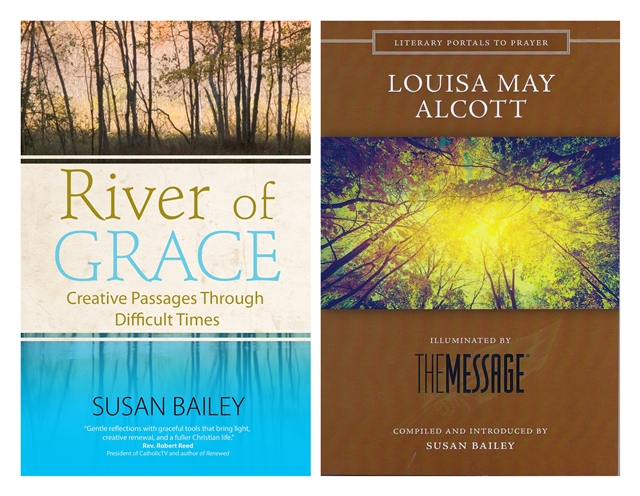
Louisa May Alcott:Illuminated by The Message is here!
Book Signing/Launch this Sunday, Dec. 6, 4 pm (I will also be signing copies of River of Grace – bring yours!) Short presentation followed by conversation and signing. The Barrow Bookstore, 79 Main Street, Concord, MA(rear of the building, behind Fritz & Giggi)
Part of the Literary Portals to Prayer series by ACTA Publications.
Other classic authors in the series include Elizabeth McGaskell, William Shakespeare, Herman Melville, Hans Christian Anderson, Charles Dickens and Jane Austen.
You can purchase your copy of Louisa May Alcott: Illuminated by The Message online: Regular edition and Large Print available. Makes a great gift!
One of the unique features of my upcoming book, River of Grace: Creative Passages Through Difficult Times are its Flow Lessons: prayerful exercises using concrete elements from our every day lives to reveal spiritual truths. They combine prayer with action, creating a practical life application.
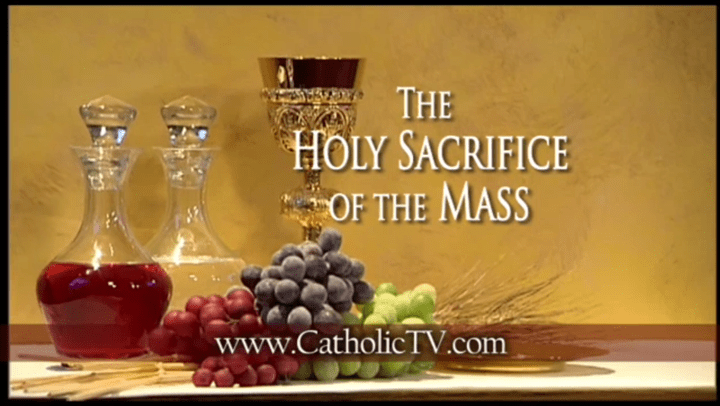
Here is the first Flow Lesson from the introduction to my book. Did this exercise change the way you look at receiving the Eucharist? Please share in the comments section.
I hope this blesses you. I did it a couple of weeks ago when I received communion and it made for a wonderful, lingering meditation that lasted long after mass was over.
Materials needed: pen or pencil and paper, food, and your imagination.
Pick a quiet place in your home to do this exercise and make sure you can sit still comfortably for several minutes.
Be still
To begin, take a moment to be still with God. If you are having trouble with noise in your mind from the cares of the day, close your eyes and imagine a tree in winter filled with screeching birds. The tree is dense with these birds and the noise is unbearable. Now watch as each bird flies away. Attach a thought or care to that flying bird and bid it adieu. Do this until the tree is entirely empty of birds and it is quiet.
After a few moments of quiet, go to the kitchen and fix yourself something to eat that is both nutritious and something you really like. As you prepare your food, say a prayer of thanksgiving to God for that food and for the privilege of eating it in his presence.
Describe your food
Return with your food to the place you had designated for this exercise and examine it carefully. Write down a few descriptive phrases about the food, noting its color, smell and texture. Now take a bite and chew slowly, thinking about how the food tastes, what it feels like in your mouth and what you enjoy about that food. Write down phrases that pop into your mind.
When you finish your meal, think about where food goes after you eat it, how it goes to your stomach, is digested and then circulated throughout your body via your bloodstream. As you are thinking about that, consider how you are feeling: do you feel energized and satisfied after eating? Does it give you what you need to carry on with your day?
Meditate
Write down your impressions and then put your piece of paper in a prominent place so you will remember to take it with you the next time you go to mass. Ask God to take what you have written and plant it on your heart for when you receive communion.
During mass take out that piece of paper and read it before you receive the Eucharist. Now consider the Eucharist in the same way you considered the food you ate during your meditation. Be mindful of the texture of the wafer as you receive it and notice how you eat it:
Do you chew it or let it dissolve?
Think about why you eat it in that way and how it makes you feel. If you also receive the wine, do you hold the wafer in your mouth and wait to consume it until you drink the wine?
How does the wine add to the experience?
Pray and Ponder …
When you get back to your place, think about the wafer and the wine being digested, soon to be coursing through your veins.
What symbols come to mind, if any?
How will the Eucharist nourish you, both spiritually and physically?
Thinking about the Eucharist being the body and blood of Christ, how does it make you feel to know it is now present within your body?
When you get home from mass, take a few moments and write down your impressions of receiving communion on your piece of paper and compare notes. Ask God to continue to offer insight, opening the eyes of your mind to new ideas and possibilities.
Sarah Hart is a prolific songwriter of faith-based songs. She has won a Grammy award for song she co-wrote for Amy Grant and a earned a gold record for a song she co-wrote for the Newsboys.
This is her first video for a song called “Praying with a Broken Heart,” from her album, Above Earth’s Lamentation. In this song she describes a common prayer experience of “Where are you, God?”
Sometimes it seems our prayers hit the ceiling and go no further. There is no stirring in the heart, no sense of consolation. No warmth. And yet we are told that in those moments of cold and doubt, God is closer to us than ever. Perhaps so close that we just plain miss him.
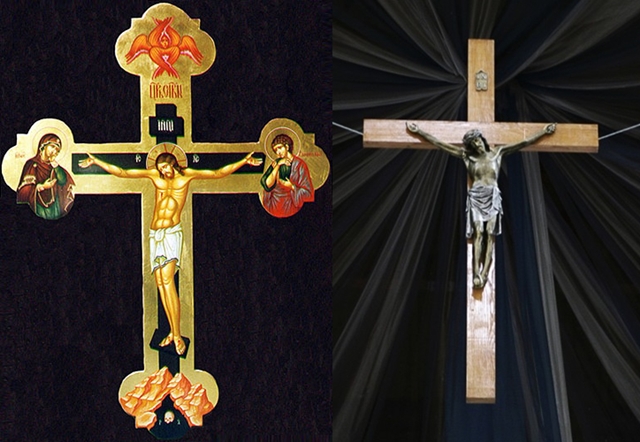
I know I often feel that in the middle of the night when fear is magnified. Jesus knew that on the cross when he cried out, “Why have you abandoned me?”
Sarah’s song reminds us that faith is more than what we feel. It needs to get beyond feeling to the knowing:”I know you are there!”
When I push through my fear in middle of the night to that knowing, it gets better, even if the fear is still there.
How about you?
Visit sarahhart.com to hear more of Sarah’s music and see where she is appearing.
I am so excited to share this wonderful new version of Be as One with you all! Allow me to give you a tour of the new home. Just click on the headline to go to the page.
Here I pose a simple question: How would your life change if you were connected to God? Clicking on that question will take you to a short video where I share how a renewed connection with God changed my life into one of adventure and exhilarating discoveries.
On this page you can find out more about me, from my work and passions to my family and pets. There is contact information and a media kit in case you would like to bring me to your parish or group to speak. And, there is a video explaining the beginnings of the Be as One site and how we as a community can share in the blessings of making a firm connection to the Spirit of God within us.
I am particularly excited about this page! This is the home of all of my blog posts, organized in a way that will make them easier to find. You will see many topics listed in the main menu. I have many interests that I love sharing with you and I’d love to hear about yours!
You will see two sliders (aka, slide shows) of blog posts: the one on the left highlights the latest posts while the one on the right highlights the most popular posts. You can advance the slide show yourself by clicking on the arrows; just click on the image to get to the blog post.
This page is a work in progress. I have just begun loading practical and prayerful exercises that you can do yourself called Flow Lessons. They are featured in my book, River of Grace: Creative Passages Through Difficult Times (read more about my book here). They are designed to help make a connection between a common everyday experience and deeper spiritual truths. I hope you enjoy them!
Here is where I display all my wares for sale including my book, River of Grace, my sung rosary, The Critter Room Memory Book for you cat lovers plus all of my CDs (with links to digital music). I even have an easy One-Stop Shopping link if you already know what you want to buy. Your purchases are the fuel keep my ministry engine running and I am so appreciative of your support!
And last but not least …
Live Appearances
Here you can find out not only where I have been speaking but how you can invite me to your church, group or conference. I enjoy presenting at all kinds of venues from small and intimate groups to large auditoriums. Along with speaking I also provide live music!
I have provided several references with contact information.
And finally, you can go to the Book Me link to find out how we can begin a conversation about my coming to present for you!
So, that’s it! I hope you have enjoyed the tour. Please share your impressions on the website and if there is something I can add that could help you, let me know.
This is from my recent Tech Talk column on Catholicmom.com. Portions of this article were taken from my upcoming book, River of Grace: Creative Passages Through Difficult Times, from Ave Maria Press. It is available on Amazon.
Life is full of transitions. The longer we live, the greater the number of our years, the greater the number of transitions.
Some transitions are rather universal like adolescence and leaving home, marriage and childbirth, illness and aging, or separation through death. Other transitions feel as if they are thrust upon us like the loss of a job or an unwelcome medical diagnosis.
In every case we’re forced to look at life anew in order the rebuild our lives.
In this week’s gospel Jesus’ disciples are struggling to deal with his departure from this world. They will be forced to let go of their former ways of relating to him. In the future, Christ will be present to them, albeit in a new and different way.
Sorting all this out is something the disciples will have to do together. So Jesus prays that “they may be one.”
It has been said that most people belong to two families:
One family is your biological family. These are the folks with whom you share a common bloodline, genetics, DNA.
The other family is your psychological or spiritual family. These are the people that care for you, love you, stand by you. These are the communities that give you strength and hope when you need it most.
Biological families and spiritual families are sometimes the same. But frequently, they are not.
The disciples needed a community of faith to get through the transition.
We, modern-day disciples need spiritual families to navigate and find strength through the changes and upheavals of life. The big transitions of life are not meant to be travelled alone…
Who are the people that make up your “spiritual family?” Who are you a “spiritual family” to?
How are you traveling life as the years (and the transitions) add up? Traveling alone? Or, with companions?
We pray for the grace to have and to be, faith-filled, hope-filled and loving travel companions.
For many Christians, the late winter/early spring signifies a time of stepping back and examining how we are practicing our faith. It is a time of assessing our failings and sins: how have we strayed from God as the center of our lives? How have we forgotten the needs of family members, friends and strangers? How can we come back home to God?
The season of Lent
In my Roman Catholic tradition, this time of assessment is known as Lent. In my childhood I recall purple cloth (signifying penance or, being sorry for your sins) all over the church, covering the statues. It was a time to give up chocolate or some other treat as a symbol of penance.
Lent is so much more
As an adult, Lent can offer so many wonderful opportunities if we can get beyond our preconceived childish notions and misunderstandings. The words “penance” and “sacrifice” and even the color purple can denote negative thoughts and feelings when in fact, they offer chances for healing and purification. The word “repent,” often misunderstood, brings reconciliation and wholeness. Just as the Prodigal Son (Luke 15:11-32)
The true meaning
I like to think of the Prodigal Son, despairing and destitute, falling into the loving arms of his Father. Coming back home prompted merrymaking on the part of his father rather than judgment. This is such a beautiful illustration of turning around and coming home, the true meaning of repentance. It is a moment of sorrow that leads to celebration.
The Prodigal had to do a lot of soul searching to humble himself and come back home to his father. After all, in essence, he told his father to “drop dead” by taking his inheritance money early. We can learn from his example.
Tools for soul searching
Keeping a journal, whether you are a writer or not, is a wonderful way to search your soul. I took up the practice again a couple of years ago and find it especially helpful for sorting out confusing times in my life. A block of quiet time and a notebook can help you connect the past with the present in powerful ways. It can even be life-changing.
Since writing things down was not done in the Prodigal Son’s time, he had sort out his life without that tool. He had the other essential tool however: time. As he was feeding pigs and longing to eat his fill, he had plenty of time to recall his past life (which he realized had been quite good), his past behavior (taking his inheritance and squandering it) and his current situation. He realized in the end it was worth the price of killing his pride to come back home to his father.
My soul searching
We are lucky because we can write things down. Of late I have been exploring in my journal why I feel the way I do about losing my singing voice and music in general (a series of posts for another day) and have made some important discoveries about how I have treated (or mistreated) this special gift that God gave to me. It has shone a glaring spotlight on past sins which I am now bringing before God, asking for forgiveness.
I am using my Lenten journey to focus on how I can too return home to my heavenly Father, make peace with past actions, and learn again to embrace my gift for his people and his glory. Through taking the time to be quiet and write down my thoughts, I have been able to navigate through murky waters and come to understand what I did, how I feel, and how everything can be made right again.
Connections and healing
More than one author I know has told me they see writing as a spiritual experience, even as prayer. I am beginning to see this too. I do know it helps me connect the fragments of my life, bring them together and make sense of them. This is the beginning of wholeness and healing.
Rejoice in the Lord always. I shall say it again: rejoice! So says Saint Paul in the fourth chapter of Philippians.
Each reading this third Sunday of Advent proclaimed joy:
Shout for joy, daughter Zion! sing joyfully, Israel! Be glad and exult with all your heart, daughter Jerusalem! (Zephaniah 13:4)
Shout with exultation, City of Zion, for great in your midst is the Holy One of Israel! (Isaiah 12:6)
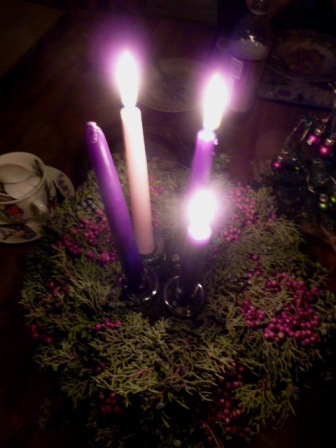
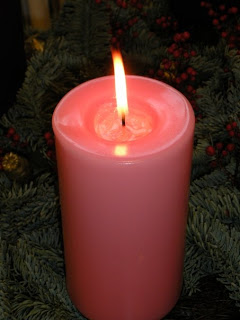
Amidst a sea of somber purple, the rose-colored candle was lit on the Advent wreath; a sign of joyful expectation for the Lord’s coming as Christmas day draws near.
Yet why does my heart not rejoice? Why is it that a mist hangs heavily over so many?
We all know why. A modern version of the slaughter of the Holy Innocents took place that past Friday in an idyllic, close-knit Connecticut town.
It was senseless and cruel when Herod ordered the original deed in his irrational desire to destroy the Christ Child. The first chapter of Exodus described the Pharaoh’s heartless decree to drown infant boys in his quest to slay the baby Moses.
And it is just as incomprehensible, just as heart-wrenching now knowing those twenty precious little children between the ages of six and seven, and six courageous women died an equally terrible death. Watching their families and friends in Newtown, CT careen from terror to shock and finally, to a grief so deep that it feels bottomless casts a pall over a joyful holiday. There appears to be no consolation.
And yet we were called to be joyful this Gaudate Sunday. We are expected to celebrate Christmas morning with our families while others will have unopened presents under the tree and an empty space at the dinner table.
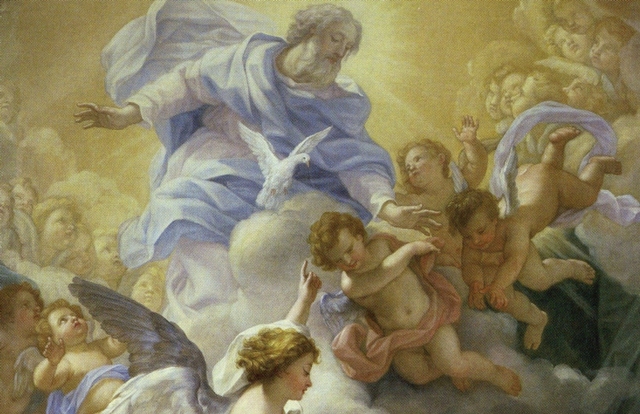
I try to picture the children and the heroic adults who attempted to save them in the arms of Jesus, hovering over their families like the angels they are, trying to impart some consolation.
Will their loved ones be able to know it? To feel it?
The Christian faith teaches us that God is nearest in those moments when we cannot find the words or process the feelings or even lift our heads in our grief.
I think of Jesus at the Garden of Gethsame, begging for consolation from His Heavenly Father and the angels coming to minister to Him. He knew His Father was listening and therefore could experience their consolation.
All those new angels in Heaven are waiting and ready to offer that same consolation to their grieving loved ones.
Jesus calls on us to be alert, awake and ready: prepared to see Him at any turn.
I dig deep to pray that these grieving people will be able to recognize God in their midst and thus experience the ministering presence of their angels who long to offer consolation.
Grief is an opportunity, a moment of supreme and sublime vulnerability. It can be a time of transformation if we allow ourselves to be carried on the journey. It is tumultuous, frightening and exceedingly painful. If we are open, we can find that joy that Saint Paul talks about beneath the hurt. Slowly, gently, this joy can be the healing balm.
The newest angels up in Heaven are ready and waiting to apply the balm. The rose-colored candle in the Advent wreath can be the sign of their consolation.
So I will pray these grieving parents, siblings and husbands will be ready to receive that consolation and I invite you to do the same.
My husband represents the East as a deacon in the Eastern Catholic Melkite Church. The Eastern Catholic Churches celebrate the Byzantine liturgy with its many beautiful and meaningful rituals. Their sanctuaries are full of beautiful icons with gold backgrounds; they appear at times translucent, permitting the eye and the imagination to travel beyond this world to heavenly heights.
It’s the Orthodox tradition: experiential, sacramental, mystical, rich and deep.
I represent the West as a Roman Catholic. My home parish is a mini cathedral with carved pillars supporting graceful Corinthian arches. Light-filled and colorful, the stained glass windows tell stories of the Gospels through the rosary mysteries. Paintings of the stations of the cross line the walls, inviting one to prayer. And the golden tabernacle, holding the true presence of Christ in the host, is positioned in the place of honor at the front of the church, behind the altar.
I come from the Roman tradition, also sacramental, rich and deep, but based more on reason perhaps than experience.
I love living in an East-West household, receiving the benefits of Eastern thinking, augmenting, and softening perhaps my Western way of thought.
My husband and I share many lively discussions about our faith.
His conversion to the Eastern Catholic Church was one of the greatest gifts to our marriage.
I enjoy learning about his approach to faith and can do so readily through a website known as Ancient Faith Radio. One can listen 24/7 to beautiful Byzantine chant and learn from the many podcasts espousing Orthodox teaching.
My favorite is “Search the Scriptures,” hosted by Dr. Jeannie Constantinou, presenting “interesting and accessible bible study for busy people.” Dr. Jeannie, thanks to her vast education in a variety of settings, combines a passionate love for the Bible and Orthodox spirituality with her love of ancient history. She makes the pages and people of the Bible truly come alive.
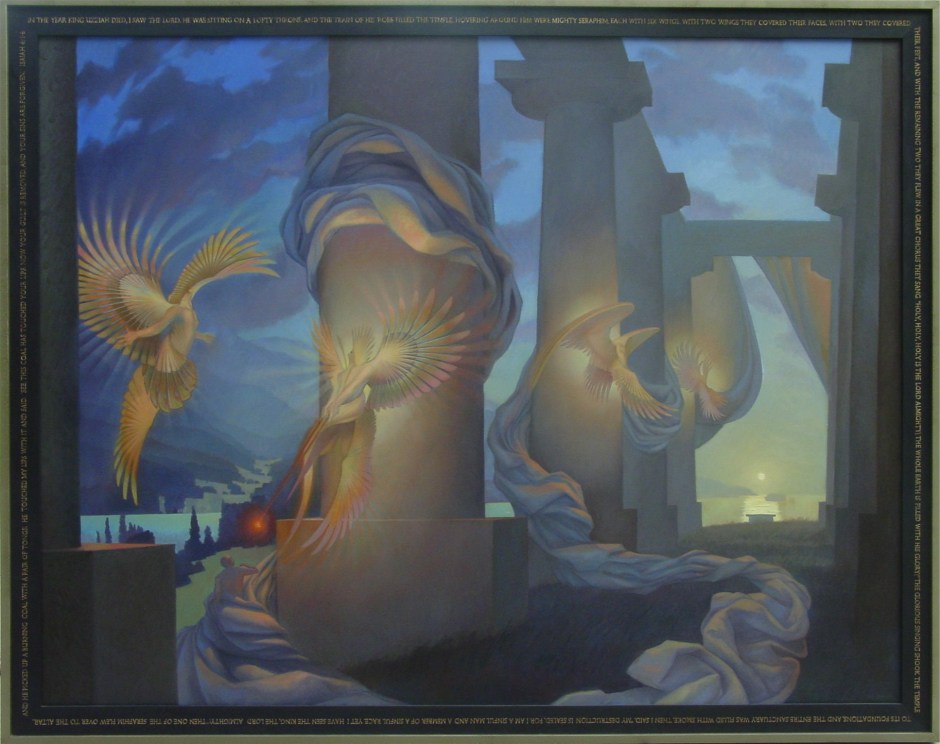
Today she taught about Isaiah, chapter 6 which describes the prophet’s vision of heaven
It reminded me of why mystery is such a wonderful and freeing concept.
The first three verses of chapter 6 read as follows (New King James version):
In the year that King Uzziah died, I saw the Lord sitting on a throne, high and lifted up, and the train of His robe filled the temple. Above it stood seraphim; each one had six wings: with two he covered his face, with two he covered his feet, and with two he flew. 3 And one cried to another and said:
“Holy, holy, holy is the Lord of hosts; The whole earth is full of His glory!”
Dr. Jeannie went on to explain, citing her favorite Church Father St. John Chrysostom (aka, “The Golden Mouth), the impossibility of describing the nature and essence of God. As God is formless, there is no way to physically describe Him. Why even the seraphim are formless!
So how can Isaiah write this description of heaven?
Isaiah needed a way to convey the truth of what he saw in his vision: the utter majesty and glory of God. Even though seraphim are not known to have form, the traditional image is of an angel with wings (and in this case, six). By having the seraphim covering his face and feet with his wings, Isaiah is demonstrating how the being could not look upon the countenance of God, for His glory was too much for him. St. John Chrysostom goes on to explain the meaning of the feet being covered as well as the face, as a means of demonstrating the seraphim’s knowledge that he was a lowly creature in the sight of such magnificence.
Dr. Jeannie cited other parts of the Bible, including the Genesis creation story as similar examples of writers using human examples to describe the indescribable so as to convey important theological and spiritual truths.
Looking at the Bible that way, backed up by rich ancient history she provides, surely does make the pages and people come alive.
But the reason why I so enjoy hearing the Bible taught in this way, through the lens of Orthodoxy, is that it reminds me of the utter mystery of God.
Rather than trying to explain difficult concepts such as the Holy Trinity or the essence of God, how much more enjoyable, fruitful and freeing it is to just release the need to understand and go with the flow of the mystery, allowing it to sweep me along.
This, of course, requires a Guide (the Holy Spirit), thus I need to remain in prayer to continue the journey safely.
The book I cited in my last post, The Naked Now, presents a simple and profound way to remain in prayer at all times and it fits in perfectly with the indescribable magnificence of God.
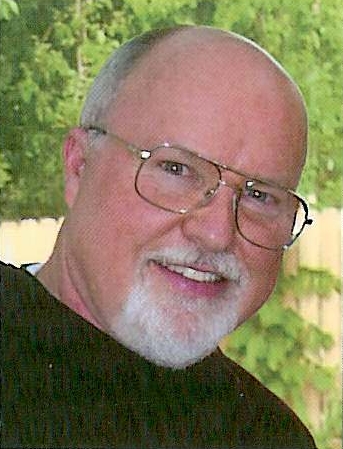
Author Richard Rohr
Richard Rohr, in talking about the name of God, said that word Yahweh (in Hebrew, YHVH) “was considered a literally unspeakable word … From God’s side the divine identity was kept mysterious and unavailable to the mind; when Moses asked for the divinity’s name, he got only the phrase that translates something to this effect: “I AM WHO AM … This is my name forever, this is my title for all generations.” (Exodus 3:14-15) (page 25, The Naked Now by Richard Rohr).
Rohr says the word was not spoken; no, it was breathed. The first and last thing we do each day, and at the beginning and end of life. The thing that we must do to live.
We breathe, thus speaking the unspeakable, over and over again.
Breathing and mystery … wonderful things to lose myself in today …



 Join my Email List (special surprises just for you!)


 This is from my recent Tech Talk column on Catholicmom.com. Portions of this article were taken from my upcoming book, River of Grace: Creative Passages Through Difficult Times, from Ave Maria Press. It is available on




 Be as One