Healed of Christmases Past–the cure is in plain view

Here is my December column for the Catholic Free Press.

* * * * * * * * * * * * * * * * * * * * * * * * * * * * * *

It’s here. The Christmas season. How does this make you feel?

Is it excitement as in days of old when you were a child?

Or, is it long to-do lists that never end? Shopping till we drop? Noise and chaos and endless obligations that make us tired and cranky while all the while we are told to be “merry?”

Is it dread, trying to stretch limited financial resources to fulfill gift obligations? Is it regret, frustration and guilt that we cannot buy what we wish for our loved ones?

Is it loneliness? Are we missing someone, loved ones who have died or moved away? Do we feel empty, sad or bitter?

Miguel Fraga, Flickr Creative Commons

The Christmas season evokes powerful memories and emotions, magnifying every joy as well as all the hurt, disappointment and loss we have experienced in our lives. Our reaction to any unattended and festering wounds will be visited upon everyone around us, especially those we love.

Tucked away in the midst of all this is a liturgical season often overlooked: Advent. It is the antithesis of a chaotic, noisy commercial Christmas; a soothing and sanguine contrast to a season clouded by wounds and losses. Advent does not look mournfully to the past; it draws our attention to a hopeful future while being firmly rooted in the here and now.

Jorbasa Fotografie 4. Advent 2011, Flickr Creative Commons

Advent features the key players of our faith: Mary, Joseph and of course, Jesus Christ. It features some of the most moving and poetic passages from the Bible–prophesies of old heralding the coming of the Messiah as the shoot of Jesse, filled with the Spirit of wisdom and understanding, counsel and of strength, knowledge and fear of the Lord (from Isaiah 11).

Barta IV Jesus Joseph Mary, Flickr Creative Commons

It documents the greatest act of obedience in history when a young virgin accepts the invitation from God to bear his Son. That obedience is not an onerous “do not” but a joyful “I do!” as evidenced by Mary’s rushing to the side of her kinswoman Elizabeth (thought barren yet pregnant) and spontaneously praising God with her and the babes in their wombs in the exquisite prayer of the Magnificat.

It illustrates sublime acts of trust, surrender, generosity and courage in Joseph who fully embraces the responsibility of taking Mary to be his wife despite the fact that she is carrying a child not his own. Going against the grain of longstanding tradition and enduring the naysayers, he knows there is a bigger picture to consider: Mary’s child is God’s Son. And he makes room for them.

So how does all of this help to sooth frazzled nerves, heal the wounds of Christmases past and fill empty and grieving hearts?

I can’t say how specifically. I only know that each year as I focus on Advent and turn away from a commercial Christmas, I have felt that soothing, that healing. My empty heart is filled.

I still grieve for loved ones. I still struggle with squeezing out the last dollar. I still battle with a heart that is small (although it is growing). I only know that the other day when I went to the Christmas Tree shop to finish off a gift basket for church, I felt serene, even enjoying the experience. To me, the Christmas Tree shop is the quintessential representation of a frazzled, noisy, chaotic commercial Christmas. And yet I felt deep contentment.

It’s the fruit of Advents past, reflecting on the readings, listening to the music, and looking to Mary and Joseph as the examples. Philippians 4:8 sums it up perfectly: “Finally, brothers and sisters, whatever is true, whatever is noble, whatever is right, whatever is pure, whatever is lovely, whatever is admirable–if anything is excellent or praiseworthy–think about such things.” (NIV)

Immersion into the refuge of Advent has healed my Christmas.

Hope in the midst of darkness – Isaiah 29: 17-24

Thus says the Lord GOD:
But a very little while,
and Lebanon shall be changed into an orchard,
and the orchard be regarded as a forest!
On that day the deaf shall hear
the words of a book;
And out of gloom and darkness,
the eyes of the blind shall see.
The lowly will ever find joy in the LORD,
and the poor rejoice in the Holy One of Israel.

auntjojo Surely..., Flickr Creative Commons
auntjojo Surely…, Flickr Creative Commons

For the tyrant will be no more
and the arrogant will have gone;
All who are alert to do evil will be cut off,
those whose mere word condemns a man,
Who ensnare his defender at the gate,
and leave the just man with an empty claim.
Therefore thus says the LORD,
the God of the house of Jacob,
who redeemed Abraham:
Now Jacob shall have nothing to be ashamed of,
nor shall his face grow pale.
When his children see
the work of my hands in his midst,
They shall keep my name holy;
they shall reverence the Holy One of Jacob,
and be in awe of the God of Israel.
Those who err in spirit shall acquire understanding,
and those who find fault shall receive instruction.

from http://www.usccb.org/bible/readings/120415.cfm, Friday of the First Week of Advent

00 twitter profile 400x400both books river first-640Join my Email List (special surprises just for you!)
to subscribe to this blog.

Join Susan on Sunday, Dec. 6 at 4pm at The Barrow Bookstore in Concord. MA
for book signing/launch of Louisa May Alcott: Illuminated by The Message

Susan Bailey, Author, Speaker, Musician on Facebook and Twitter
Read Susan’s blog, Louisa May Alcott is My Passion

Find Susan’s books here on AmazonPurchase Susan’s CD.

Diving deep into River of Grace with Elizabeth Reardon, host of “An Engaging Faith”

ad radio

In this in-depth hour-long interview: we dive deep into River of Grace – gratitude in the midst of difficult times – obedience as a joyful “yes” to new adventures, new life after loss and restoring the joy of living, life metaphors for grace … Also, a quick sneak peak at Louisa May Alcott: Illuminated by The Message! Elizabeth Reardon really did her homework! Check it out.

Visit An Engaging Faith on Facebook.

00 twitter profile 400x400both books river first-640Join my Email List (special surprises just for you!)
to subscribe to this blog.
Keep up with news and free giveaways regarding Susan’s new books, River of Grace
and Louisa May Alcott: Iluminated by The Message!
Susan Bailey, Author, Speaker, Musician on Facebook and Twitter
Read Susan’s blog, Louisa May Alcott is My Passion

Find Susan’s books here on AmazonPurchase Susan’s CD.

What is Your Spiritual Catalyst? Try this Flow Lesson to discover yours!

We all have experienced “triggers” – things or events that causes us to remember something. These memories can be pleasant or unpleasant, and often we are not even aware of what is triggering a memory.

Sometimes we intentionally create these triggers so that we will remember to do something. Before we had Google Calendar and smart phones to remind us, we’d write notes on our hands, tie a string around a finger or create a little ritual that will trigger the reminder to do what we want to do.

This same idea can be applied to the spiritual life. Imagine having something that would instantly place you in the “zone,” that place where you can give yourself over to God. That place where peace reigns within and you meet your Beloved.

Here’s a flow lesson that helps you discover your spiritual catalysts – those triggers that bring you close to God. Try it out and then share in the comments about your spiritual catalysts and how they help you come closer to God.

flow lesson logo-640
Materials needed: pen or pencil and paper, and your memories

Pick a quiet place in your home to do this exercise and make sure you can sit still comfortably for several minutes.

Be still

Take a moment to be still with God, taking several long and deep breaths and listening as you breathe. In and out, in and out. Be conscious of the rhythm of the breathing. As you breathe in, whisper the name of Jesus; as you breathe out whisper, “Be with me.” Do this for several moments until you feel quiet and still.

Shawn Rossi Breathe
Shawn Rossi Breathe, Flickr Creative Commons

Recalling a happy memory

Take a piece of paper and fold it vertically in half so that you have two columns. Next recall one memory, object or smell that makes you feel especially good. In thinking of it, what words pop into your mind? Write them down in the left hand column. What feelings come to mind? Why do you feel that way? Write those down too in the same column.

Brainstorm with these ideas:

Look at your list. Are there any words on that list that you could equate with your relationship with God? Can you match up any of those impressions with how you feel when you spend time with God, either in a formal setting, such as attending Mass or a worship service, or on your own, praying for yourself or others, or simply meditating? In the right hand column, write down any words that pop into your head when you think of your experience with God.

Once your list is done, see if there are any similarities between the list in the left hand column and the list in the right. If you see similarities, draw a line from the word or words in the left hand column to the one in the right. Is there a possibility that in the future, your favorite memory, object, or aroma could prompt a pleasant memory about attending church or simply being in the presence of God?

Matthew Doyle Incense and Sunlight
Matthew Doyle Incense and Sunlight, Flickr Creative Commons

Pray and Ponder …

Do not be disturbed if you can’t see an immediate connection; it can take some practice. Ask God to reveal it to you over the course of several days and then look at your notes again to see if a connection becomes more evident.

00 cover drop shadowcopyright 2015 Susan W. Bailey;
from Chapter 1 of River of Grace: Creative Passages Through Difficult Times,
published by Ave Maria Press
Visit the Flow Lesson Pages for more of these prayerful exercises.

The food of wisdom: Reflections on the Sunday Gospel (John 6:51-58) by Father Steven LaBaire

I am pleased to present this guest post from Father Steven LaBaire, pastor of Holy Family Parish in Worcester, MA.

In preparation for mass this Sunday:

While driving along route 140 North in Grafton this morning, I spotted a cluster of maple trees whose leaves were turning orange and red.

A few minutes later, a radio commercial boldly proclaimed “back-to school-savings.”

While the warmth of summer still embraces our days and nights, the signs of an impending change of season and routine are around us as the days grow shorter. Continue reading “The food of wisdom: Reflections on the Sunday Gospel (John 6:51-58) by Father Steven LaBaire”

Changing your Outlook: Reflections on the Sunday Gospel (John 6:1-15) by Father Steven LaBaire

father steven labaireI am pleased to present this guest post from Father Steven LaBaire, pastor of Holy Family Parish in Worcester, MA.

In preparation for mass this Sunday:

This morning the U.S. Surgeon General was interviewed on the radio. Not surprisingly, he was talking about medicine and health.

He said, “People tend to think that healthy people are happier people… That might be true.”

“But,” he added, “ so much science and research is pointing to the fact that happy people are healthier people.

People who choose to be happy, end up being healthier overall. So it works the other way around. Choose happiness first and health follows. “

Riccardo Cuppini Happiness, Flickr Creative Commons

That’s an interesting way of looking at it: Happiness is a choice we make. It isn’t something that just suddenly “happens.” A person’s chosen outlook can often change the course and outcome of things.

That goes to the heart of this week’s gospel: Jesus feeding an immense crowd of people with very few resources, some bread and a few fish.

Some argue that Jesus simply got  everyone in the crowd to share what they brought with them. Who would bother to leave home and travel in the wilderness without food in the first century? If people saw Jesus and his disciples sharing a few loaves and fishes with others and by that were inspired to share what they had brought themselves, isn’t that miracle enough? Good point.

On the other hand, if humans can fly to the moon and defy the laws of gravity, why couldn’t God defy the laws of nature and “miraculously” multiply loaves to feed a huge crowd in order to teach a lesson about how we ought to live? Can’t God do more than our minds can imagine? That’s a good point too.

Either way, there is a lesson here about life: God begins to work in us when we focus on what we have rather than what we lack.

BK Gratitude changes the way we look at the world, Flickr Creative Commons

Start your day, start your next big project  focusing on what you have been given, blessed with.

Focusing on what you lack, on what you don’t have will leave you disappointed and afraid.

Jesus got people to be grateful and use what they had. He dared them to trust that what had would go much further than they imagined.

And somehow,  they ended up dealing with the challenge at hand: everybody got fed.

Outlook can change a lot. Jesus knew that.

Our way of looking at the day can leave us feeling happy or starving.

You choose.

I choose.

We all choose.

00 twitter profile 400x400River of Grace Creative Passages Through Difficult TimesJoin my Email List (special surprises just for you!)
to subscribe to this blog.
Keep up with news and free giveaways regarding Susan’s new book, River of Grace!
Susan Bailey, Author, Speaker, Musician on Facebook and Twitter
Read Susan’s blog, Louisa May Alcott is My Passion

Praying with a Broken Heart by Sarah Hart

Sarah Hart is a prolific songwriter of faith-based songs. She has won a Grammy award for song she co-wrote for Amy Grant and a earned a gold record for a song she co-wrote for the Newsboys.

sarah hart above earth's lamentationThis is her first video for a song called “Praying with a Broken Heart,” from her album, Above Earth’s Lamentation. In this song she describes a common prayer experience of “Where are you, God?”

Sometimes it seems our prayers hit the ceiling and go no further. There is no stirring in the heart, no sense of consolation. No warmth.  And yet we are told that in those moments of cold and doubt, God is closer to us than ever. Perhaps so close that we just plain miss him.

I know I often feel that in the middle of the night when fear is magnified. Jesus knew that on the cross when he cried out, “Why have you abandoned me?”

Sarah’s song reminds us that faith is more than what we feel. It needs to get beyond feeling to the knowing:”I know you are there!”

When I push through my fear in middle of the night to that knowing, it gets better, even if the fear is still there.

How about you?

Visit sarahhart.com to hear more of Sarah’s music and see where she is appearing.

00 twitter profile 400x400River of Grace Creative Passages Through Difficult TimesJoin my Email List (special surprises just for you!)
to subscribe to this blog.
Keep up with news and free giveaways regarding Susan’s new book, River of Grace!
Susan Bailey, Author, Speaker, Musician on Facebook and Twitter
Read Susan’s blog, Louisa May Alcott is My Passion

Traveling a life of transitions: Reflections on the Sunday Gospel John 17:11B-19 by Father Steven LaBaire

father steven labaireI am pleased to present this guest post from Father Steven LaBaire, pastor of Holy Family Parish in Worcester, MA.

In preparation for mass this Sunday:

Life is full of transitions. The longer we live, the greater the number of our years, the greater the number of transitions.

Some transitions are rather universal like adolescence and leaving home, marriage and childbirth, illness and aging, or separation through death. Other transitions feel as if they are thrust upon us like the loss of a job or an unwelcome medical diagnosis.

In every case we’re forced to look at life anew in order the rebuild our lives.

Martin LaBar Jesus and His Disciples at the Last Supper
Martin LaBar Jesus and His Disciples at the Last Supper, Flickr Creative Commons

In this week’s gospel Jesus’ disciples are struggling to deal with his departure from this world. They will be forced to let go of their former ways of relating to him. In the future, Christ will be present to them, albeit in a new and different way.

Sorting all this out is something the disciples will have to do together. So Jesus prays that “they may be one.”

It has been said that most people belong to two families:

One family is your biological family. These are the folks with whom you share a common bloodline, genetics, DNA.

The other family is your psychological or spiritual family. These are the people that care for you, love you, stand by you. These are the communities that give you strength and hope when you need it most.

www.GlynLowe.com Family Walk, Flickr Creative Commons

Biological families and spiritual families are sometimes the same.  But frequently, they are not.

The disciples needed a community of faith to get through the transition.

We, modern-day disciples need spiritual families to navigate and find strength through the changes and upheavals of life. The big transitions of life are not meant to be travelled alone…

Who are the people that make up your “spiritual family?”  Who are you a “spiritual family” to?

How are you traveling life as the years (and the transitions) add up?   Traveling alone?  Or, with companions?

We pray for the grace to have and to be, faith-filled, hope-filled and loving travel companions.

Copyright 2015 by Steven Michael LaBaire

Join Susan Bailey’s Email List (special surprises just for you!)
to subscribe to this blog.

Follow Susan Bailey, Author, Speaker, Musician on Facebook and Twitter
Listen to Susan’s music Read Susan’s blog, Louisa May Alcott is My Passion

Thankful for simple gifts

This is a teaser to my monthly column on Catholicmom.com.

Some of the most wonderful gifts from God come in the form of whispers.

They are the small gifts. The gifts for a particular moment, not to be grasped at, but merely accepted. And if the taker is alert and awake, the heart will swell with gratitude.

On a Sunday not too long ago, I was the fortunate recipient of a bevy of such gifts.

First, a little background. For most of my life, I was a vocalist and songwriter …

The greatest joy as a vocalist was leading the singing at Sunday mass. My parish, St. Luke the Evangelist in Westborough, MA is a blessed community full of active, generous and loving people.

The church building is a minor cathedral, acoustically perfect with high concrete ceilings, carved pillars supporting graceful Corinthian arches, and shiny slate floors. Voices ring and linger in that sacred space.

Each Sunday I enjoyed the privilege of choosing the music and leading the congregation in prayer through song …

I led music for most of my adult life. In 2010, all that changed …

Click here to finish the post on Catholicmom.com. Feel free to post comments there.

Click to Tweet & Share: We live our lives in compartments; feeling disconnected. How about living life in a single flow? Where might it lead? http://wp.me/p2D9hg-x

Would you like to learn along with Susan how to live your life
in single flow?
Send an email to susanwbailey@gmail.com
to subscribe, and never miss a post!
Follow Susan on Facebook and Twitter
Listen to Susan’s music Read Susan’s blog, Louisa May Alcott is My Passion

The mystery of God is but a breath away …

I live in an East-West household.

My husband represents the East as a deacon in the Eastern Catholic Melkite Church. The Eastern Catholic Churches celebrate the Byzantine liturgy with its many beautiful and meaningful rituals. Their sanctuaries are full of beautiful icons with gold backgrounds; they appear at times translucent, permitting the eye and the imagination to travel beyond this world to heavenly heights.

It’s the Orthodox tradition: experiential, sacramental, mystical, rich and deep.

I represent the West as a Roman Catholic. My home parish is a mini cathedral with carved pillars supporting graceful Corinthian arches. Light-filled and colorful, the stained glass windows tell stories of the Gospels through the rosary mysteries. Paintings of the stations of the cross line the walls, inviting one to prayer. And the golden tabernacle, holding the true presence of Christ in the host, is positioned in the place of honor at the front of the church, behind the altar.

I come from the Roman tradition, also sacramental, rich and deep, but based more on reason perhaps than experience.

I love living in an East-West household, receiving the benefits of Eastern thinking, augmenting, and softening perhaps my Western way of thought.

My husband and I share many lively discussions about our faith.

His conversion to the Eastern Catholic Church was one of the greatest gifts to our marriage.

I enjoy learning about his approach to faith and can do so readily through a website known as Ancient Faith Radio. One can listen 24/7 to beautiful Byzantine chant and learn from the many podcasts espousing Orthodox teaching.

My favorite is “Search the Scriptures,” hosted by Dr. Jeannie Constantinou, presenting “interesting and accessible bible study for busy people.” Dr. Jeannie, thanks to her vast education in a variety of settings, combines a passionate love for the Bible and Orthodox spirituality with her love of ancient history. She makes the pages and people of the Bible truly come alive.

Today she taught about Isaiah, chapter 6 which describes the prophet’s vision of heaven

It reminded me of why mystery is such a wonderful and freeing concept.

The first three verses of chapter 6 read as follows (New King James version):

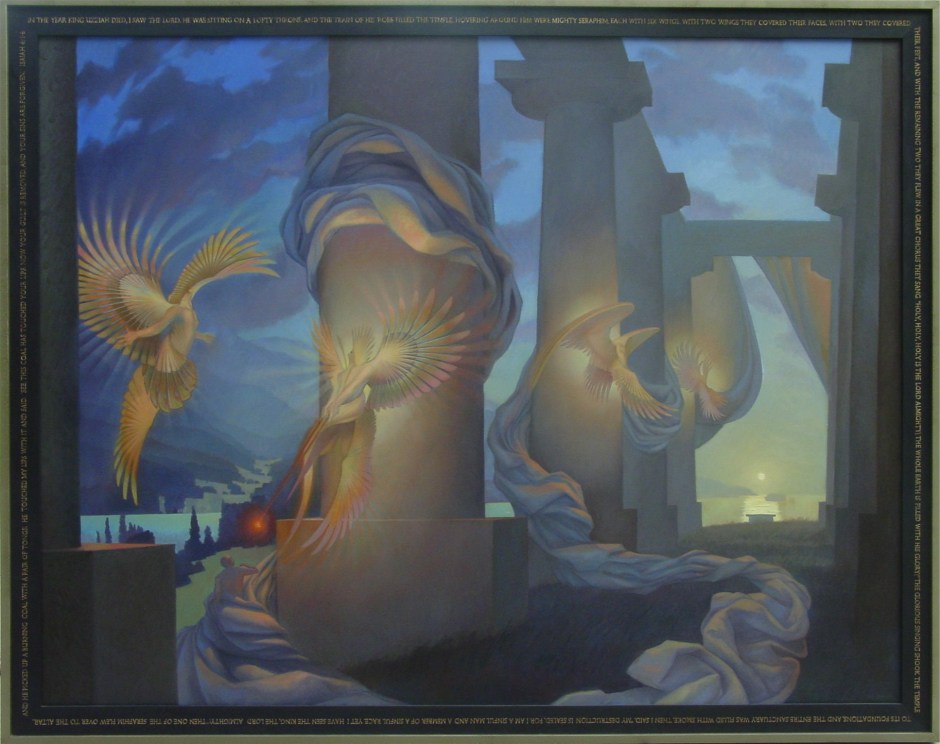
In the year that King Uzziah died, I saw the Lord sitting on a throne, high and lifted up, and the train of His robe filled the temple. Above it stood seraphim; each one had six wings: with two he covered his face, with two he covered his feet, and with two he flew. 3 And one cried to another and said:

“Holy, holy, holy is the Lord of hosts; The whole earth is full of His glory!”

The Vision of Isaiah by Luke Allsbrook

Dr. Jeannie went on to explain, citing her favorite Church Father St. John Chrysostom (aka, “The Golden Mouth), the impossibility of describing the nature and essence of God. As God is formless, there is no way to physically describe Him. Why even the seraphim are formless!

So how can Isaiah write this description of heaven?

Isaiah needed a way to convey the truth of what he saw in his vision: the utter majesty and glory of God. Even though seraphim are not known to have form, the traditional image is of an angel with wings (and in this case, six). By having the seraphim covering his face and feet with his wings, Isaiah is demonstrating how the being could not look upon the countenance of God, for His glory was too much for him. St. John Chrysostom goes on to explain the meaning of the feet being covered as well as the face, as a means of demonstrating the seraphim’s knowledge that he was a lowly creature in the sight of such magnificence.

Dr. Jeannie cited other parts of the Bible, including the Genesis creation story as similar examples of writers using human examples to describe the indescribable so as to convey important theological and spiritual truths.

Looking at the Bible that way, backed up by rich ancient history she provides, surely does make the pages and people come alive.

But the reason why I so enjoy hearing the Bible taught in this way, through the lens of Orthodoxy, is that it reminds me of the utter mystery of God.

Rather than trying to explain difficult concepts such as the Holy Trinity or the essence of God, how much more enjoyable, fruitful and freeing it is to just release the need to understand and go with the flow of the mystery, allowing it to sweep me along.

This, of course, requires a Guide (the Holy Spirit), thus I need to remain in prayer to continue the journey safely.

The book I cited in my last post, The Naked Now, presents a simple and profound way to remain in prayer at all times and it fits in perfectly with the indescribable magnificence of God.

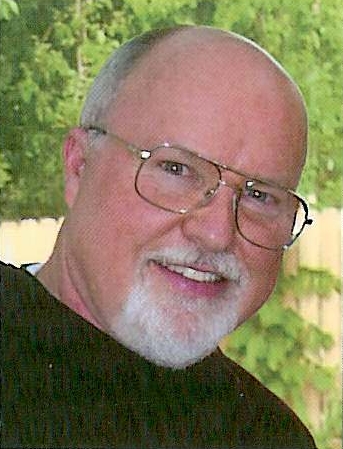
Author Richard Rohr

Richard Rohr, in talking about the name of God, said that word Yahweh (in Hebrew, YHVH) “was considered a literally unspeakable word … From God’s side the divine identity was kept mysterious and unavailable to the mind; when Moses asked for the divinity’s name, he got only the phrase that translates something to this effect: “I AM WHO AM … This is my name forever, this is my title for all generations.” (Exodus 3:14-15) (page 25, The Naked Now by Richard Rohr).

Rohr says the word was not spoken; no, it was breathed. The first and last thing we do each day, and at the beginning and end of life. The thing that we must do to live.

We breathe, thus speaking the unspeakable, over and over again.

Breathing and mystery … wonderful things to lose myself in today …

What is mysterious to you?

Join Susan Bailey’s Email List (special surprises just for you!)
to subscribe to this blog.

Follow Susan Bailey, Author, Speaker, Musician on Facebook and Twitter
Listen to Susan’s music Read Susan’s blog, Louisa May Alcott is My Passion