Anyone who enjoys Contemporary Christian praise and worship music knows about Matt Maher. Coming on the scene in 2007, Maher has written and produced eight solo albums with three of them having reached the Top 25 Christian Albums Billboard chart; four of his singles have reached the Top 25 Christian Songs chart (Wikipedia). He was awarded the Dove Award this year for Songwriter of the Year and Best Song (“Because He Lives (Amen))” Continue reading “Matt Maher rocks the house for Christ”→
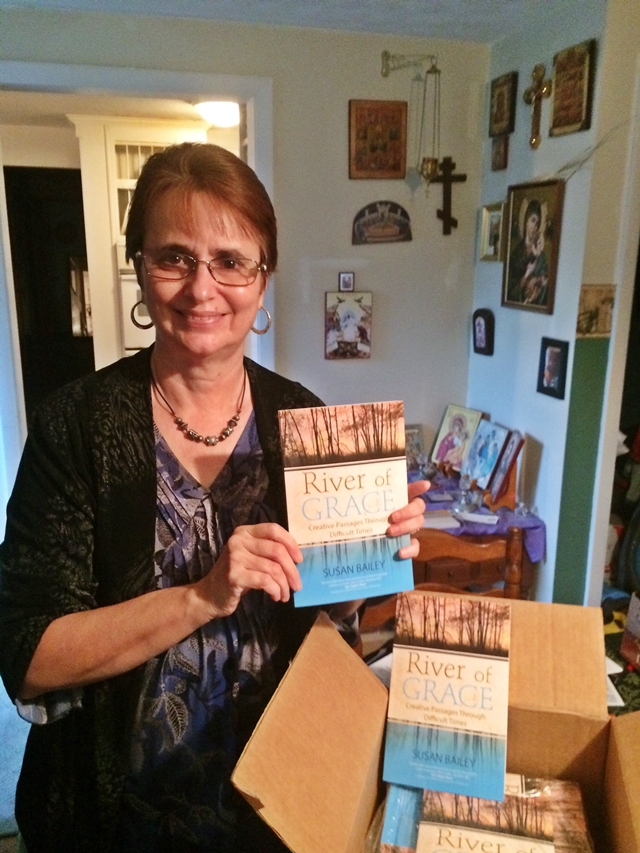
This past Wednesday was a BIG day. This arrived in the mail …
But that was not all. I also got the final mix of my soundtrack CD for River of Grace from the producer. And I have to say he really outdid himself. I sent him a text back with 7 hearts – one for each song!
It was one of those rare, extraordinary days that sends you into orbit and you just want to cling to that feeling forever. I will write about it in my journal so I can go back and bathe in that grace, that pure gift from God whenever discouragement knocks on my door.
Now, I would like to share what God gave to me with you.
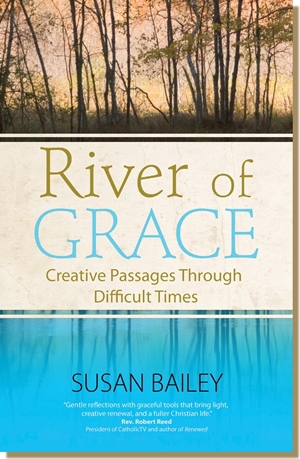
River of Grace: Creative Passages Through Difficult Times is a spiritual memoir that reveals how several major losses helped me rediscover creativity and faith. Published by Ave Maria Press, it is described as “Filled with powerful insights on the presence and action of grace–in the Mass and the sacraments, nature and grief, and even through the life and works of Louisa May Alcott–River of Grace guides readers in strengthening their faith, discovering their own hidden gifts and restoring a joy in living during and after tough times.” It contains lots of practical spiritual exercises called Flow Lessons that lead you there. (Some of the Flow Lessons are on this site–check them out here.)
Losing a part of yourself
One of the losses I experienced was that of my singing voice. Yet throughout the writing of River of Grace, I kept thinking of songs that would fit with each chapter. While writing the third chapter on the loss of my voice, I experienced a miraculous healing after receiving a throat blessing on the Feast of St. Blaise.
This song was playing in my head; here’s a passage from chapter 3 on why:
How Can I Keep from Singing • Traditional Quaker hymn
“Instead of being raw and fragmented, I began to feel whole. A sense of wonder and deep gratitude welled up inside. The following Sunday as I entered the church to go to Mass I was immediately struck with the knowledge that I had received a significant healing with that throat blessing. I couldn’t wait to tell the priest.
Thereafter during Mass I noticed that it became easier to sing the hymns. Buoyed, I pushed my voice a bit further each week. One day while driving home after Mass I sang some of the most challenging songs in my repertoire including “I Know That My
Redeemer Liveth” from Handel’s Messiah and discovered to my delight that I could sing them just as I had before. My voice had been restored. I had received a physical healing along with the emotional and spiritual.” (from chapter 3, River of Grace)
New life after loss
River of Grace is also about new life. In the writing I learned that creativity is far more than being able to sing, dance, paint or write. Creativity is all about intention. As the Lord led me on my journey towards a new creativity in my life, I thought of Psalm 103, traditionally read during the Easter season, and this song:
River of Grace is also about overcoming fear; stepping out and seeing life as a glorious adventure. Seeing obedience to God’s will as a series of wonderful “yeses” rather than onerous no’s.
So that’s the big reveal! This project has been my life for the last two years and a lot of the transformation I write about happened as I was writing the book. Gotta love the immediacy of the Holy Spirit at work.
Ave Maria Press is everything everyone said it would be. Totally professional, really helpful, and daring, taking chances on newbies like myself. I am so honored to have a book published by them.
You can order River of Grace (the book) through Ave Maria Press and Amazon. Don’t forget to write a review after you’ve read it!
The CD will be available by the end of October; I’ll let you know when it’s ready.
Fundraiser almost over; still need your help
I hope you are enjoying these clips from the new CD. With the deadline of October 15 looming just around the corner, I still need much help in meeting the goal of raising $1600 to pay for the making of the CD. You can donate at http://igg.me/at/susanbailey. Every dollar counts. If you can only give $5 or $10, I will be so grateful. And for those who can give more, I am offering some rewards which I think you’ll appreciate.
Have you ever wondered just how a song is recorded? It’s rather like building a building from the ground up, or making a layer cake. Here’s a simple demonstration from the recording of “Spirit of Life” (written by Carolyn McDade, Surtsey Publishing Company) for my River of Grace Soundtrack CD:
Recording is a long and tedious process of such layering but it’s fun and rewarding too when you hear the final product. Besides the layering of vocals, instruments are added in (more than you can imagine!). Then the engineer (in this case Ron) makes sure every little piece can be heard – this is done by something called panning. When you listen to a stereo recording through headphones you can pick out how there’s a little guitar here, a little percussion there … it’s all quite fascinating to figure out just what is in a recording of your favorite song.
Special effects are added in as well (such as putting a little echo into the voice, known as reverb. Without reverb, it sounds like you’re singing in a small room. With reverb, it can sound like you’re singing in a cathedral with slate floors (or something a little smaller).
This is just the beginning of the process for “Spirit of Life;” very soon I can show you the final result.
By the way, here’s a peak at the cover for the CD. Longtime readers of Be as One will recognize it:
8 days left … need your help!
With just 8 days left in the campaign I really need your help! Please visit my Indiegogo site at http://igg.me/at/susanbailey and contribute what you can. And thank you!
Thank you to all who have pre-ordered River of Grace! You can find it on Amazon.com.
The CD is coming along nicely and I expect to have some finished product later this week! I will share as I receive them. There are several short videos on my Indiegogo campaign page that you can view for a sneak preview.
Here is one showing the progress so far on a classic hymn, “How Can I Keep from Singing:”
We recorded the lead vocals at Ron Zabrocki’s studio and then later I added on harmonies from my own studio which I then sent to Ron. He then will polish it with additional instruments and vocals. I can’t wait to hear what he does and share it with you!
In River of Grace, I wrote about how it felt to lose my singing voice …
“Eventually we face the prospect of letting go of something we cherish about ourselves. As my voice began to lose consistency, I knew now how others felt: the loss of my voice truly was a death. I missed that sensual feeling of singing, how it used to vibrate in my throat and buzz in my head. I’d never again hear that nice clear sound echo throughout the church and come back to me. I had sung with such ease that I could forget all about the technique of singing and just get into the prayer of it. There were times when those memories would flood my mind, and I would break out in spontaneous tears.” (Chapter 3, River of Grace)
And then regain it again:
“Instead of being raw and fragmented, I began to feel whole. A sense of wonder and deep gratitude welled up
inside. The following Sunday as I entered the church to go to Mass I was immediately struck with the knowledge
that I had received a significant healing with that throat blessing. I couldn’t wait to tell the priest.
Thereafter during Mass I noticed that it became easier to sing the hymns. Buoyed, I pushed my voice a bit further each week. One day while driving home after Mass I sang some of the most challenging songs in my repertoire … and discovered to my delight that I could sing them just as I had before … I had received a physical healing along with the emotional and spiritual.” (Chapter 3, River of Grace)
Thus you can see how I had to record “How Can I Keep from Singing”!
Coping with loss
Perhaps you have lost something precious about yourself; something that was once so natural, so easy to do is now hard or impossible to do. As we age, this kind of loss can occur. We can lose something we cherish about ourselves and feel sad and adrift. It is a great challenge that requires patience and faith; we have to learn to let it go.
Mysterious mercy
In River of Grace I write about the struggle of letting something I loved go; I never expected to get it back again, It was in the course of writing the chapter that I experienced the healing. I did not seek it nor ask for it; I just wanted to learn to live with the loss. It was pure gift, abundant grace, and that is the mystery of God’s merciful love.
All I know is that now I feel deep gratitude every time I open my mouth to sing. I savor the moments I can sing in church, awestruck that God would give me a second chance to sing for Him.
This is why I had to record this album. I wanted a musical testimony to accompany what I had written. I wanted to share my gratitude and offer a witness to God’s merciful love. His love is available to all of us!
Launch day is coming soon!
By the end of the month, River of Grace will be officially launched. The CD will be available as well. In the meantime, I would really appreciate your help in financing the CD. There are ten days left to contribute to my Indiegogo campaign; click here to contribute.
Over the course of the next ten days I will share other songs from the soundtrack and passages from the book to show you how these songs correspond with the text.
When I texted my dear friend Lisa Hendey of Cathoilicmom.com what happened in the last couple of days, she replied back, “God has a funny sense of humor!”
Indeed he does. And the blessings are coming like a deluge!
They asked if I would focus on the works of Louisa May Alcott. As you know, I am passionate about Alcott’s life and works, having run a blog called Louisa May Alcott is My Passion for the last five years. Here is the result:
This book contains fifty passages from several of Alcott’s book including Little Women. Each passage is accompanied by a Bible passage from The Message, a fresh and contemporary translation of the ancient text.
What is cool about this is that In River of Grace I write extensively on the impact of Louisa’s life and works on my life as I was grieving over my mother. There were many passages from her books on which I wrote about and pondered which acted as a balm on my grief. This reading and writing eventually led to my becoming a published author.
A prayer book to accompany River of Grace
Many of the passages that I have included in this Louisa May Alcott volume as those that inspired me during that time. It’s like reading an accompanying prayer book to River of Grace!
As each of the songs on the River of Grace music CD is dedicated to a chapter, this one about Louisa is dedicated to chapter 4. Here is a video showcasing the song:
Have you donated yet to the River of Grace CD?
Speaking of the music CD, the Indiegogo fundraising campaign is nearing the October 15 deadline (as you can see from the countdown clock).
We all have experienced “triggers” – things or events that causes us to remember something. These memories can be pleasant or unpleasant, and often we are not even aware of what is triggering a memory.
Sometimes we intentionally create these triggers so that we will remember to do something. Before we had Google Calendar and smart phones to remind us, we’d write notes on our hands, tie a string around a finger or create a little ritual that will trigger the reminder to do what we want to do.
This same idea can be applied to the spiritual life. Imagine having something that would instantly place you in the “zone,” that place where you can give yourself over to God. That place where peace reigns within and you meet your Beloved.
Here’s a flow lesson that helps you discover your spiritual catalysts – those triggers that bring you close to God. Try it out and then share in the comments about your spiritual catalysts and how they help you come closer to God.
Materials needed: pen or pencil and paper, and your memories
Pick a quiet place in your home to do this exercise and make sure you can sit still comfortably for several minutes.
Be still
Take a moment to be still with God, taking several long and deep breaths and listening as you breathe. In and out, in and out. Be conscious of the rhythm of the breathing. As you breathe in, whisper the name of Jesus; as you breathe out whisper, “Be with me.” Do this for several moments until you feel quiet and still.
Take a piece of paper and fold it vertically in half so that you have two columns. Next recall one memory, object or smell that makes you feel especially good. In thinking of it, what words pop into your mind? Write them down in the left hand column. What feelings come to mind? Why do you feel that way? Write those down too in the same column.
Brainstorm with these ideas:
Look at your list. Are there any words on that list that you could equate with your relationship with God? Can you match up any of those impressions with how you feel when you spend time with God, either in a formal setting, such as attending Mass or a worship service, or on your own, praying for yourself or others, or simply meditating? In the right hand column, write down any words that pop into your head when you think of your experience with God.
Once your list is done, see if there are any similarities between the list in the left hand column and the list in the right. If you see similarities, draw a line from the word or words in the left hand column to the one in the right. Is there a possibility that in the future, your favorite memory, object, or aroma could prompt a pleasant memory about attending church or simply being in the presence of God?
Do not be disturbed if you can’t see an immediate connection; it can take some practice. Ask God to reveal it to you over the course of several days and then look at your notes again to see if a connection becomes more evident.
Do you go to your specially designated study to write?
Do you paint your latest masterpiece in a light-filled studio?
Do you shut the door when you enter your room?
Why do secret hideaway places draw us like magnets?
I wanted a room of my own when I first discovered Louisa May Alcott as a kid. There was an illustration of Louisa in her special room where it was quiet and she could think. When she had finished writing her latest poem or story, she could indulge in her other favorite passion, running, by racing out the door to her room that led outside.
drawing by Flora Smith from The Story of Louisa May Alcott by Joan Howard
Getting away from the noise
Louisa’s family was noisy; quiet and privacy were hard to come by. Journals were a community affair with the parents writing notes in the margins. Louisa’s father Bronson often encouraged the children to read from their journals during the evening meal. Louisa was criticized by her father for writing too much about herself.
No wonder then that Louisa spent much of her life seeking out rooms of her own.
Finding a separate space
I used to think that a separate space away from everyone was necessary in order to create. A busy household with younger children makes finding quiet time difficult. It’s even more difficult when your home is too small to afford a separate space.
This was when I began to learn that any space could be a room of my own. The physical space was not the key; it was the rituals you established that created that space.
illustration by Flora Smith, from The Story of Louisa May Alcott by Joan Howard
With that kind of mindset, a room of one’s own can be portable.
You might think it’s a waste of time to explore tools and work routines.
It is time well-invested. In the end, it saves time.
Why?
It took me hours, days, weeks, even months to figure out what worked for me. I searched diligently for those t00ls, those routines that would catapult me away from the world into my creative “zone” in an instant.
I can set up anywhere, anytime, in quiet spaces and noisy ones too. The rituals and tools I use act as a trip wire, sending me into my head for a delicious time of writing.
As this blog is about collecting and connecting all the pieces of a life together into one flow, I realized I needed to add another interest to this blog: technology. I love technology and have ever since I started on my first Mac back in the 1980’s. I’m a PC person now but I have the iPhone, 2 iPods and a Barnes & Noble Nook. I was holding my iPod when I heard Steve Jobs passed away and I shed a tear.
A great example
As a practical example of collecting pieces together, the Nook is my favorite example. You won’t believe what I require of my Nook and how it delivers!
Why I love the Nook
I have had a Nook for a few years and I love it. The backlighting and adjustable size of type and line spacing is perfect for my failing eyesight. It’s so convenient having most of my favorite books in one tablet that I can put in my pocketbook and take anywhere. As I have gotten into writing I began to long for the capability to write and save files on it.
With last year’s upgrade, I am not only writing on it, I am writing books on it. And I have all my research on it too.
Write a book on a Nook?
How can that be done? Better yet, why would anyone want to do that?
In my dreams I had several things I wanted a tablet to do for me. Rather than invest a large sum in an iPad (which is rather heavy to carry around), the Nook provided a very affordable alternative along with its lesser size and weight.
I probably spent around $350 total including the tablet, cover, keyboard and apps.
What do I ask my Nook to do?
Provide a word processor that saves Word files so I can write as much as I want and edit too.
Provide a means of transferring files easily back and forth between the Nook and my computer.
Have every piece of research I have done on the Nook.
Give me a light-weight, smaller tablet that I can easily take with me to the library.
How can a Nook do all this, you say?
You’d be surprised …
It begins with the right apps.
Office Suite Professional 7 provides me with a paired-down Microsoft Word version of a word processor. It is easy to use and gives me the perfect place to jot down notes as I read, journal or actually write chapters for my books. I balked at first at the $14.99 price tag as that seemed high for an app, but it was worth every cent.
Another “must” app is the ES File Explorer. It allows for the easy organization, management and the transfer of files to and from my laptop. Since the Nook has Wi-Fi capability, I can back up files to DropBox on my computer through ES File Explorer (and also from Office Suite Professional 7).
A blue tooth keyboard is a must.
I bought the Poetic KeyBook Bluetooth Keyboard Case and while it’s small, once you get used to its size, it works very well. The blue tooth connection is easy and the fact that the keyboard is wireless means I can have the keyboard in my lap and the Nook on a tabletop if I want to. This is especially helpful when I visit the library.
The Nook’s capacity to hold a mini SD card (plus knowing how to make PDF files) is the trick to holding all of my research.
I scanned numerous pages out of books into PDF files so that I can have all my notes in one place. When I go to the library, all I need to do is bring my Nook to have all my research available at the press of a button.
The Nook doesn’t weigh much nor does it have a large footprint.
That makes transporting it a breeze. This was important to me as I often travel from Central Massachusetts to Cambridge and the libraries at Harvard University to do my research. This requires travel on the subway and a certain amount of walking. It is much easier to get there without a heavy laptop in a bag banging against my body as I walk!
I can pull out the Nook literally anywhere, sit down and write.
It’s my electronic notebook. Because I’ve learned to associate writing with the Nook, it puts me in the “zone”; I can immediately fixate on the job at hand. Only one app can be open at a time proving to be just enough of a deterrent from checking email and Facebook. I have my iPhone nearby if I want to get at an online dictionary quickly or check out a fact or theory on Google.
A great reminder
The Nook is a wonderful physical reminder of how wonderful life can be when have all the pieces are gathered together into one place and work in harmony.
Now if I could just live my life like that all the time, I’d be all set! It’s a work in progress.
Have any of you used a Nook, Kindle, iPad or other tablet in this way?
For many Christians, the late winter/early spring signifies a time of stepping back and examining how we are practicing our faith. It is a time of assessing our failings and sins: how have we strayed from God as the center of our lives? How have we forgotten the needs of family members, friends and strangers? How can we come back home to God?
The season of Lent
In my Roman Catholic tradition, this time of assessment is known as Lent. In my childhood I recall purple cloth (signifying penance or, being sorry for your sins) all over the church, covering the statues. It was a time to give up chocolate or some other treat as a symbol of penance.
Lent is so much more
As an adult, Lent can offer so many wonderful opportunities if we can get beyond our preconceived childish notions and misunderstandings. The words “penance” and “sacrifice” and even the color purple can denote negative thoughts and feelings when in fact, they offer chances for healing and purification. The word “repent,” often misunderstood, brings reconciliation and wholeness. Just as the Prodigal Son (Luke 15:11-32)
The true meaning
I like to think of the Prodigal Son, despairing and destitute, falling into the loving arms of his Father. Coming back home prompted merrymaking on the part of his father rather than judgment. This is such a beautiful illustration of turning around and coming home, the true meaning of repentance. It is a moment of sorrow that leads to celebration.
The Prodigal had to do a lot of soul searching to humble himself and come back home to his father. After all, in essence, he told his father to “drop dead” by taking his inheritance money early. We can learn from his example.
Tools for soul searching
Keeping a journal, whether you are a writer or not, is a wonderful way to search your soul. I took up the practice again a couple of years ago and find it especially helpful for sorting out confusing times in my life. A block of quiet time and a notebook can help you connect the past with the present in powerful ways. It can even be life-changing.
Since writing things down was not done in the Prodigal Son’s time, he had sort out his life without that tool. He had the other essential tool however: time. As he was feeding pigs and longing to eat his fill, he had plenty of time to recall his past life (which he realized had been quite good), his past behavior (taking his inheritance and squandering it) and his current situation. He realized in the end it was worth the price of killing his pride to come back home to his father.
My soul searching
We are lucky because we can write things down. Of late I have been exploring in my journal why I feel the way I do about losing my singing voice and music in general (a series of posts for another day) and have made some important discoveries about how I have treated (or mistreated) this special gift that God gave to me. It has shone a glaring spotlight on past sins which I am now bringing before God, asking for forgiveness.
I am using my Lenten journey to focus on how I can too return home to my heavenly Father, make peace with past actions, and learn again to embrace my gift for his people and his glory. Through taking the time to be quiet and write down my thoughts, I have been able to navigate through murky waters and come to understand what I did, how I feel, and how everything can be made right again.
Connections and healing
More than one author I know has told me they see writing as a spiritual experience, even as prayer. I am beginning to see this too. I do know it helps me connect the fragments of my life, bring them together and make sense of them. This is the beginning of wholeness and healing.








 Be as One