FEBRUARY 25, 2016–Driving in the rain and meeting an inspiring young man
How is your eyesight at night? Obviously it depends on your age. I will be 60 in a couple of weeks and my eyesight at night is TERRIBLE. I’ve taken to whispering a quick prayer every morning to St. Christopher to get me from point A to point B in one piece; I also keep his card in the car. I need him, especially in the rain! Driving in the rain at night is the worst. Honestly, I keep losing a sense of where I am because I can’t see marker points, and I just have to trust my gut that I know where I am going. The glare from the lights just blinds me. And is it me, or are headlights twice as bright as they used to be? Or does everyone just leave their high beams on? A downside to nearing 60 …
But, the upside is I get these wonderful freelance assignments from our local Catholic newspaper to cover stories. The last two assignments have taken me to a wonderful ecumenical prayer service at Assumption College, and a closing mass for a parish mission at St. Rose of Lima in Northborough. I love newspapers, having worked on both sides of the spectrum, as a production artist and now as a columnist and reporter. Life is good. God is good.
Anyway, last night I met an eighteen-year-old man who truly inspired me. A senior in high school, he has just become an altar server. Last night’s mass was his first mass and he was a poised and confident pro. I asked him after mass how he happened to make this unusual decision to become a server and he explained that the pastor, Father Houston, had invited him to serve. His first assignment? A military funeral. He spoke of the power of that funeral and how that experience led him to ask Father Houston if he could serve again. When I asked him what he wanted to study in college, he replied, “Criminology.,” and when I asked why, he said that he loved public service. Be still my heart.
It was worth driving at night in the rain to hear that story.
FEBRUARY 24, 2016–I used to dread going to confession; now I look forward to it!
I’ve been a Catholic since birth (60 years this March 19) and always dreaded going to confession. As a kid it was scary; as an adult it was embarrassing–I could never remember my sins! I mean I know I screw up big time but I never can remember the specifics. Thankfully I now have a tool based on the Ten Commandments to help me come up with those specifics.
If you are of another faith tradition, I know confession is hard to understand. Why should someone have to act as an intermediary between me and God when it comes to owning up to what I’ve done wrong? It all begins to make sense when you find the right confessor. Honestly, it’s like trying to find the right doctor or shrink–you have to know what you want in that person and be aware when you find it.
Our associate pastor, Father Jim, is the confessor I’ve been looking for. Such a patient listener, compassionate and quite wise for a man of thirty (my son is that age!). He’ll let me babble on trying to explain my sins to him only to assure me I’ve made a good confession. He then figures out the theme of my sins, offers good counsel and assigns a penance that makes sense, I feel tremendous relief and gratitude every time I confess to him. Honestly, I actually looked forward to going yesterday! I examined my conscience yesterday morning, made my list and waited all day to see Father Jim.
God is near, we know that. Some Christian faith traditions believe the Eucharist is the physical presence of Jesus. But there is something about spilling your guts to another human being, especially one who has been ordained and appointed by God to help. And help it does.
I hope you’re as lucky as I in finding a good confessor.
FEBRUARY 23, 2016 — First entry in my spiritual journal. I had a “comeuppance” with God last week. It began with disappointing news which led to doubts and confusion about everything I am doing, and then to other, more painful realizations. I feel like I am squinting under a very bright light, totally naked, utterly exposed. A really raw, uncomfortable feeling! It’s been like that since the weekend. I feel like I lost my footing. And all the while I am preparing a presentation about getting to know yourself better by following the way Jesus did it. Yeah, right! Who feels like the hypocrite now?
So last night I am recording this presentation to make it available here on the website and my words keep accusing me! It took over an hour to record that sucker but you know something? By the end I started smiling because I realized that besides being exposed, I was also the butt of a joke. God has a dear sense of humor. 🙂
I began to feel the worst of it fade just a tad. Last night when going to bed I thought I would take my rosary to bed as clutching it always helps. I found a rosary bracelet that my dearest friend Jackie gave me and I wore it. And this morning I felt a wonderful sense of peace and the beginning of clarity on how to deal with my “comeuppance.”
It’s never fun having one’s delusional bubble burst; man it hurts! But knowing that I can go back to God and make it right, and knowing how kind and caring (and funny) he can be makes it a lot easier to deal with.
In my quest for a harmonious life I understand the need to be still. Certain tools help in that effort:
Reading, to organize my thoughts.
Praying, to tap into my soul, drawing me closer to God.
Time spent outdoors, especially in the Spring, to quiet myself.
Achieving mindfulness
The landscape is slowly coming to life here in New England and when I see signs of Spring, I think of Henry David Thoreau. His intimate knowledge of the outdoors came from a sense of mindfulness–no detail missed his watchful eye. He took the time to be still and observe. And in following that simple maxim, the world revealed itself to him.
New book on Thoreau
I recently reviewed a book on my Louisa May Alcott blog by Corinne Hosfeld Smith (certified tour guide of the Thoreau birthplace and author of Westward I Go Free: Tracing Thoreau’s Last Journey) calledHenry David Thoreau for Kids:
Demanding writer
I welcomed this book because while I have always appreciated Thoreau’s message, I find his his works difficult to get through. The writing is dense, demanding your full attention. Many of us suffered through high school and college English classes with his classic Walden. And yet, that message of a different way of living got through to me even though I could not begin to digest all the words.
Making Thoreau concrete
What I loved about Henry David Thoreau for Kids were the twenty-one activities geared for middle school students that help you live out his ideas. Many of these activities are just as engaging for adults.
I was intrigued by the exercise which encouraged the participant to sit outdoors for thirty minutes in total silence, waiting for wildlife to appear. Sure enough, after a few moments birds and other creatures come close for observation. I was eager to try this exercise in my quest to be still.
Helpful tool
Stillness, however, does not come easily in this busy world so I was grateful that Smith recommended another exercise to help me focus–creating a sound map.
Sitting in my lawn chair, I sketched the area you see here in my notebook and every time I heard a sound from nature, I drew an “x” where I thought I heard it and wrote down what it was. As you can see, I heard quite a bit!
From listening to observing
In the listening, I began to appreciate the visual imagery around me.
This slideshow requires JavaScript.
Stillness opens the inner eye
Stillness and mindfulness are hard to achieve in this high tech, multi-tasking, noisy world. Patience and due diligence are rewarded however with the opening of the inner eye, that which sees beauty and truth around us and eventually, within us. It’s a simple truth really: the wonder of life and how it was created, and how we are lucky to be alive despite all the challenges.
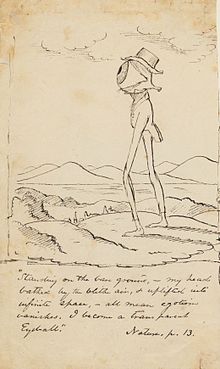
Houghton MS Am 1506 (4)-Cranch
A compatriot of Thoreau’s, Ralph Waldo Emerson, once wrote of the transparent eyeball, an expression for which he was mocked. Wikipedia explains it this way:
“The transparent eyeball is a philosophical metaphor originated by Ralph Waldo Emerson. The transparent eyeball is a representation of an eye that is absorbent rather than reflective, and therefore takes in all that nature has to offer.”
Emerson experienced an epiphany that day–the discovery of the ability to read between the lines in the world around him, and come to an understanding of a deeper existence within him.
Once that eye is opened …
… you never want it to close. All of a sudden, the smallest things become lovely, compelling, even exciting. Once I became mindful of what surrounded me in the natural world, I couldn’t get enough of it, especially when it came to bird watching and kayaking.
And once I made a commitment to pay attention to what was there inside of me, allowing myself to to be drawn closer to my Creator, I find I can’t get enough of that either.
Silence is becoming an elixir.
I understand from the great mystics that you can learn to be quiet and still even in the midst of noise and chaos. Wouldn’t that be something! Somehow I think a bunch of people with that kind of inner harmony could truly change the world for the good. Think about it.
Your time of stillness
Try spending thirty minutes in the woods, in a field or by a pond this Spring. Create your own sound map and share it here. Let’s compare notes and find out how we are doing on our journey to harmony.
You can find out more about Henry David Thoreau for Kidshere, and read about the author, Corinne Hosfeld Smith, here.
Many people find coloring to be a wonderful way to relax and experience harmony in their lives. Is that you? Join my Email List to subscribe to this blog and receive your free Harmony coloring book (and more).
Familiarity breeds contempt. It’s true, even with prayer. Maybe especially with prayer.
Do the prayers taught to you as a child still mean anything to you?
How can something we’ve recited so many times still stir the heart and fill the soul?
Most of us have been reciting The Lord’s Prayer since we were children. In my Roman Catholic tradition, I was also taught the “Hail Mary,” a prayer to my guardian angel, and the “Act of Contrition,” said when I confessed my sins to the priest. I’ve said those many, many times.
In nursery school my children were taught a simple prayer before meals that is familiar to most everyone:
“God is great, God is good. Let us thank him for our food. Amen”
It was the prayer we said as a family before meals for many years.
NOTE: My book is on sale at 50% off through next Wednesday, April 20th. Great time to give it a try–click here.
I came very late to reading. And I was led there by someone with whom I have been fascinated all my life: Louisa May Alcott.
I discovered Louisa through a children’s biography given to me by my aunt after we had visited Orchard House, a museum home dedicated to the Alcott family, and the home where Louisa wrote her classic, Little Women.
Sometimes we meet authors
who penetrate
our hearts to the core.
The gospel reading for the first Sunday after Easter features the doubting Thomas as depicted in John 20:24–29. I have always been moved by his story. In my book, River of Grace, I wrote the following:
“When the others told him that they had ‘seen the Lord,’ he refused to believe. He treated their story with skepticism that bordered on rejection. He was provocative in his declaration that he would not believe unless he placed his hand in the side of Jesus and probed the wounds with his fingers. Thomas deliberately pushed away any semblance of hope that Jesus was alive. He did not dare to believe. Reading that passage I understood the bitterness in his demands and the refusal to face his pain. When Jesus appeared to all the apostles several days later, he invited Thomas to do as the others had done: touch his wounds.”
Death is a traumatic experience. In the case of Jesus, it came as a total shock to the disciples despite the fact that Jesus had warned them many times of his impending death. He also promised them hope in the aftermath. Yet as we have witnessed in the readings following Easter, even when Jesus was right in front of them, they could not believe. Continue reading “Hiding ourselves in the wounds of Christ – a post-Easter reflection”→
MARCH 31, 2016–Today’s meditation from The Word Among Us (based upon Luke 24:35-48) reflects upon the wounds Christ received at his death–wounds that remained on his glorified body after the resurrection:
“Jesus’ victory looked so different from what the disciples had expected. Instead of arriving with a king’s crown or a huge army, he returned bearing the wounds of a brutal death. Even though he is now risen in glory, his body remains marred. He isn’t just restored to his former state—he is transformed in a way that reflects the price he paid for our salvation. God didn’t just press a reset button. He took Jesus through death into a new and eternal life.
Jesus’ scars are the marks of his love for us—a love unto death. Every day, he invites us to gaze at these wounds and to see in them the proof of his victory. What’s more, he wants to convince us that he can turn our own wounds into marks of triumph. There is no situation too desperate for him to overcome.”
It may seem morbid to focus on such graphic wounds. But then I am reminded of the love behind those wounds, the love that gave Jesus the courage to follow through with his suffering so that we might know hope in this life and paradise beyond this life.
When I put together my sung rosary book (Mary, Queen of Peace Meditation Guide & Sung Rosary) I included a special meditation on those wounds, based upon a simple practice in Eastern Catholic prayer–that of repeating “Lord, have mercy!”
I invite you try this meditation and see where it leads. It’s led me to some pretty amazing spiritual places.
Meditations on the Wounds of Christ
A prayer frequently chanted during the Divine Office in the Eastern Catholic Church is “Lord, have mercy.” Often this prayer is chanted 40 times in succession.
I formulated a method with this repetition that turned into a meaningful devotion focusing on the wounds of Christ:
Gazing upon the crucifix, begin by reciting or chanting “Lord, have mercy” 5 times. Each time it is recited, focus on a wound on Christ’s body. For example, recite “Lord, have mercy” and meditate on Christ’s feet. Recite it again and focus on the left hand. Recite it a third time and meditate on the right hand. Recite it again and gaze on the wound in his side. Then recite it a fifth time and focus on the head.
Repeat this cycle 8 times, thus reciting or chanting the prayer 40 times in total.I found, for example, that as I focused on the nail marks in His feet, I thought about where those feet had traveled. I studied the wounded hands and wondered whom they had healed. I thought about his heart, pierced and yet so full of love. I thought about the head and the emotional and mental agony he went through, and yet also marveled at all the wisdom and knowledge that resided in that head. I recalled his teachings, exhortations, and words of comfort.
These are just some of the places where this devotion can take you. May the Spirit of the Living Lord guide you as you gaze upon His wounds and contemplate His love.
Note: My spiritual journal still resides here but I will also be publishing each post on the blog as well.
* * * * * * * * * * * * * * * * *
MARCH 30, 2016–Today’s readings put forth a common theme–that we need each other. I loved the line from the meditation found at The Word Among Us website:
“There’s something about opening ourselves to other people that makes us more open to the Lord’s presence and his comfort.”
The meditation cites the examples of the two disciples walking to Emmaus, pouring themselves out to Jesus even though they did not recognize him. What they did recognize was his openness to their plight. He was willing to listen.
It also discusses the reading from Acts where Peter and John “give what they have” to the lame beggar–the healing power of Christ.
The meditation concludes with the idea that we most often find God in one another.
Such discovery requires trust. I have to go out on a limb based upon my initial feelings about someone, and trust that they want to hear what I have to say.
It makes me think about the vibe I give out–does my face convey openness, or am I annoyed that you are bothering me? Am I sitting still and being attentive or am I fidgeting? Is my mind focused on you or pushing in the future, waiting for you to leave?
It’s not easy to trust. It’s a lot easier on my part to think that my problem is so “special” that no one will understand it and so I keep it to myself. That’s a form of pride. There is no problem that is unique to one individual. At least one other person in the world has been through my problems. If I go out on a limb and confide in another, will I find God waiting there to listen?
I love St. Paul. And I am a woman. Yes, I am fully aware of the famous passages in which he instructs wives to be “submissive to their husbands” and how they are not to speak in public. I believe these passages need to studied carefully for their true meaning for nothing is ever as it seems, but that’s for another day.









 Familiarity breeds contempt. It’s true, even with prayer. Maybe especially with prayer.
 Most of us have been reciting The Lord’s Prayer since we were children. In my Roman Catholic tradition, I was also taught the “Hail Mary,” a prayer to my guardian angel, and the “Act of Contrition,” said when I confessed my sins to the priest. I’ve said those many, many times.
 NOTE: My book is on sale at 50% off through next Wednesday, April 20th. Great time to give it a try–




 Be as One