The Sunday Readings: Deuteronomy 4: 32-34, 39-40, Psalm 33, Romans 8:14-17, Matthew 28: 16-20
Why is it that so many people today attack Christianity?
What are they so afraid of?
Is it because the Church is perceived as an authority figure bent on depriving us of personal freedoms, especially that of choice?
Is it because it is seen as an institution that deprives rather than as a life choice that fulfills?
For it is a choice.
God gave us free will which we can exercise as we please. Since choices have consequences, we need to be well informed before deciding.
God gave us his Holy Word as a means of helping us to make an informed choice. A thoughtful examination of this week’s Sunday readings points to reasons why inviting God into our lives could be considered a good choice.
The first reading portrays a powerful God, generous in spirit, going out of his way to demonstrate his love for his people. In Deuteronomy 4: 32-34, 39-40 Moses reminds the Israelites of all that has been done for them: “Did anything so great ever happen before?” referring to their miraculous release from slavery in Egypt. God intervened directly, raising a leader in Moses to take the people to a new land and a new life. The subsequent commandments of the Lord that Moses presented to the people were meant for their well-being, to ensure that they “may prosper” and have “long life.”
Does it sound like these people were being deprived?
The second reading from Romans 8:14-17 spells out the benefits of choosing God clearly: we are no longer slaves but children, heirs to a great fortune–a meaningful (though not trouble-free) life on earth and eternal life in paradise.
Children are disciplined and schooled, guided into adulthood by the love of their parents. We have the privilege of calling the Omnipotent God, the God we cannot see or ever hope to understand “Abba,” Daddy!
Slaves are deprived; children are privileged.
Spreading the word
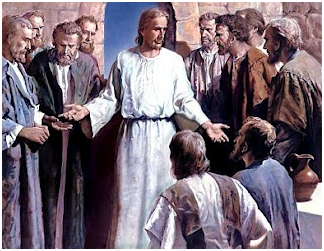
With this in mind, today’s Gospel from Matthew 28 shows Jesus sending his disciples forth to spread the Word, the Good News, to inform the world that we can choose to be children; and not to be slaves.
Life is full of transitions. The longer we live, the greater the number of our years, the greater the number of transitions.
Some transitions are rather universal like adolescence and leaving home, marriage and childbirth, illness and aging, or separation through death. Other transitions feel as if they are thrust upon us like the loss of a job or an unwelcome medical diagnosis.
In every case we’re forced to look at life anew in order the rebuild our lives.
In this week’s gospel Jesus’ disciples are struggling to deal with his departure from this world. They will be forced to let go of their former ways of relating to him. In the future, Christ will be present to them, albeit in a new and different way.
Sorting all this out is something the disciples will have to do together. So Jesus prays that “they may be one.”
It has been said that most people belong to two families:
One family is your biological family. These are the folks with whom you share a common bloodline, genetics, DNA.
The other family is your psychological or spiritual family. These are the people that care for you, love you, stand by you. These are the communities that give you strength and hope when you need it most.
Biological families and spiritual families are sometimes the same. But frequently, they are not.
The disciples needed a community of faith to get through the transition.
We, modern-day disciples need spiritual families to navigate and find strength through the changes and upheavals of life. The big transitions of life are not meant to be travelled alone…
Who are the people that make up your “spiritual family?” Who are you a “spiritual family” to?
How are you traveling life as the years (and the transitions) add up? Traveling alone? Or, with companions?
We pray for the grace to have and to be, faith-filled, hope-filled and loving travel companions.
Did you know that blessings multiply? If you are familiar with the story of the multiplication of the loaves and fishes then you know that when Jesus blessed the five loaves and two fishes, they multiplied enough to feed five thousand people.
This is how I would characterize my miracle healing. It began with a visit to church on the feast of St. Blaise where I received a blessing on my throat (see previous post for more on St, Blaise).
I entered the line out of habit. The wait was long because the priest chose to do the blessings himself. Fr. Stephen LaBaire, pastor of Holy Family Parish in Worcester takes his liturgical responsibilities seriously, loving every ritual with fidelity and reverence. Each throat blessed received his utmost attention.
Desire for healing?
As I waited, I wondered why I was there. Did I believe in healing? Did I even want a healing? You may ask why someone might not desire a healing but when you get accustomed to being a certain way, change is hard to imagine. I was used to my voice being gone. I had accepted it.
Still, I remained in line, deciding it couldn’t hurt. I left the door open for possibilities, for anything God wished to give me.
Unfolding of a blessing
After receiving the blessing, I left the church in tears. What could possibly come of this? A few days later, the blessing began to unfold.
It began with an emotional healing.
Loss not private
When I initially lost my voice, I thought I could mourn in private. I could resign from music ministry at my parish and that would be the end of it. I was wrong. My singing was not a private, individual affair. I had shared it with a community and my loss impacted people. There were the other musicians who had to pick up the slack when I resigned. And there were the people who had enjoyed my singing. I should have been grateful for the many kind inquiries and offers of concern but instead I found it to be an intrusion. I didn’t want to accept my loss and thus I pushed music away from me. The inquiries and offers of concern pushed it right back at me. I couldn’t get away from my pain.
Thomas and his loss
It made me think of Thomas. Poor doubting Thomas. He was the one disciple who was not there when Jesus appeared to the apostles after the resurrection. Filled with joy to overflowing, they told Thomas they had seen the Lord and he would not believe. Hidden in a locked room out of fear, Thomas hid from his pain as well. It hurt too much to face it; thus he pushed away any semblance of hope that Jesus had risen. Just as I had pushed away any connection, any reminder of my music: it hurt too much. Healing through the wounds Thomas demanded to touch Jesus’ wounds. It was the only way he would believe.
The Incredulity of Saint Thomas by Caravaggio
A beautiful homily given by a newly ordained priest celebrating his first mass described what Jesus did for Thomas in response to his demands:
“‘Put your finger here and see my hands. Bring your hand and put it into my side. Hide yourself in me. Hide yourself from all that troubles you, from all you doubt, from all you fear. Hide yourself in a love more penetrating than a brush fire, more overwhelming than a deluge. Hide yourself in a love that will remake you entirely. Do not be afraid.’ Jesus invites Thomas to literally enter into his wounds of love, to pass so deeply into the reality of love incarnate as to move within it. To physically put himself into our Lord’s resurrected body, unconquered by everything that would seek to destroy love, to put to death all that smothered God’s life within him. To touch resurrection, to touch eternity. To hide himself in Christ’s love forever. But not to hide Christ’s love from the world. Not to remain behind locked doors. Not to continue in sadness and fear. Jesus fills Thomas with a love so transforming that he can proclaim without fear, without doubt, ‘My Lord and My God.’” Rev. Patrick E. Reidy, C.S.C., Basilica of the Sacred Heart, University of Notre Dame, April 27, 2014
Transformation through healing
Jesus transformed Thomas; he changed him from a man filled with fear, sadness and bitterness to a man who proclaimed his love for Jesus boldly throughout the world. He healed Thomas and Thomas embraced him. He healed me in the same way. Once at war with myself over the loss of my voice, I learned again to love music, to re-embrace my gift and to learn to use it in a new way.
Openness to God’s way
In the next post I will tell you how Jesus healed me. Like the loaves and fishes, it was a blessing that multiplied over and over. Remember when Jesus told the disciples to lower the net for another catch even though they had worked hard all night and caught nothing? The net was filled to overflowing.
That’s what happens when you leave the door open, just a bit, and let God have his way.
To all of you, a blessed and happy Easter. Here are some scenes from last night’s Easter Vigil at St. Luke the Evangelist in Westboro, MA, my home parish.
photo taken at Betania II, Medway, MA – from the Mary, Queen of Peace Meditation Guide & Sung Rosary
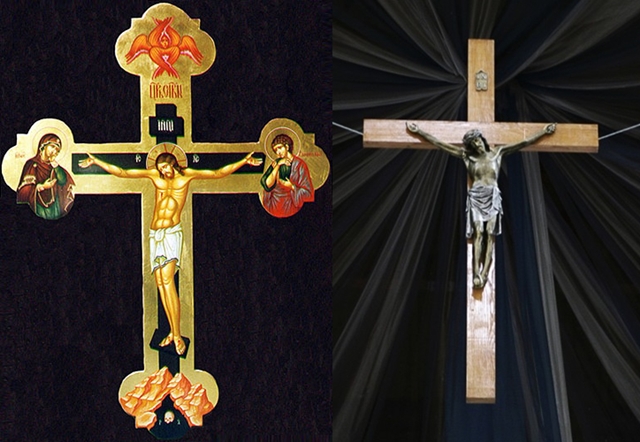
Much has been said by wiser minds on all that took place on Good Friday. As I cannot add anything to enhance these insights, I thought instead to offer you a simple meditation on the crucifix as a way of honoring and learning from our Lord’s great suffering for us.
Gazing upon the crucifix, begin by reciting or chanting “Lord, have mercy” five times (you can chant the phrase by just singing the same note for each word). Each time it is recited, focus on a wound on Christ’s body.
For example, recite “Lord, have mercy” and meditate on Christ’s feet. Recite it again and focus on the left hand. Recite it a third time and meditate on the right hand. Recite it again and gaze on the wound in his side. Then recite it a fifth time and focus on the head.
Repeat this cycle eight times, thus reciting or chanting the prayer forty times in total.
In my meditations I found, for example, that as I focused on the nail marks in His feet, I thought about where those feet had traveled. I studied the wounded hands and wondered whom they had healed. I thought about his heart, pierced and yet so full of love. I thought about the head and the emotional and mental agony he went through, and yet also marveled at all the wisdom and knowledge that resided in that head. I recalled his teachings, exhortations, and words of comfort.
These are just some of the places where this meditation can take you. May the Spirit of the Living Lord guide you as you gaze upon his wounds and contemplate his love.
For many Christians, the late winter/early spring signifies a time of stepping back and examining how we are practicing our faith. It is a time of assessing our failings and sins: how have we strayed from God as the center of our lives? How have we forgotten the needs of family members, friends and strangers? How can we come back home to God?
The season of Lent
In my Roman Catholic tradition, this time of assessment is known as Lent. In my childhood I recall purple cloth (signifying penance or, being sorry for your sins) all over the church, covering the statues. It was a time to give up chocolate or some other treat as a symbol of penance.
Lent is so much more
As an adult, Lent can offer so many wonderful opportunities if we can get beyond our preconceived childish notions and misunderstandings. The words “penance” and “sacrifice” and even the color purple can denote negative thoughts and feelings when in fact, they offer chances for healing and purification. The word “repent,” often misunderstood, brings reconciliation and wholeness. Just as the Prodigal Son (Luke 15:11-32)
The true meaning
I like to think of the Prodigal Son, despairing and destitute, falling into the loving arms of his Father. Coming back home prompted merrymaking on the part of his father rather than judgment. This is such a beautiful illustration of turning around and coming home, the true meaning of repentance. It is a moment of sorrow that leads to celebration.
The Prodigal had to do a lot of soul searching to humble himself and come back home to his father. After all, in essence, he told his father to “drop dead” by taking his inheritance money early. We can learn from his example.
Tools for soul searching
Keeping a journal, whether you are a writer or not, is a wonderful way to search your soul. I took up the practice again a couple of years ago and find it especially helpful for sorting out confusing times in my life. A block of quiet time and a notebook can help you connect the past with the present in powerful ways. It can even be life-changing.
Since writing things down was not done in the Prodigal Son’s time, he had sort out his life without that tool. He had the other essential tool however: time. As he was feeding pigs and longing to eat his fill, he had plenty of time to recall his past life (which he realized had been quite good), his past behavior (taking his inheritance and squandering it) and his current situation. He realized in the end it was worth the price of killing his pride to come back home to his father.
My soul searching
We are lucky because we can write things down. Of late I have been exploring in my journal why I feel the way I do about losing my singing voice and music in general (a series of posts for another day) and have made some important discoveries about how I have treated (or mistreated) this special gift that God gave to me. It has shone a glaring spotlight on past sins which I am now bringing before God, asking for forgiveness.
I am using my Lenten journey to focus on how I can too return home to my heavenly Father, make peace with past actions, and learn again to embrace my gift for his people and his glory. Through taking the time to be quiet and write down my thoughts, I have been able to navigate through murky waters and come to understand what I did, how I feel, and how everything can be made right again.
Connections and healing
More than one author I know has told me they see writing as a spiritual experience, even as prayer. I am beginning to see this too. I do know it helps me connect the fragments of my life, bring them together and make sense of them. This is the beginning of wholeness and healing.
My husband represents the East as a deacon in the Eastern Catholic Melkite Church. The Eastern Catholic Churches celebrate the Byzantine liturgy with its many beautiful and meaningful rituals. Their sanctuaries are full of beautiful icons with gold backgrounds; they appear at times translucent, permitting the eye and the imagination to travel beyond this world to heavenly heights.
It’s the Orthodox tradition: experiential, sacramental, mystical, rich and deep.
I represent the West as a Roman Catholic. My home parish is a mini cathedral with carved pillars supporting graceful Corinthian arches. Light-filled and colorful, the stained glass windows tell stories of the Gospels through the rosary mysteries. Paintings of the stations of the cross line the walls, inviting one to prayer. And the golden tabernacle, holding the true presence of Christ in the host, is positioned in the place of honor at the front of the church, behind the altar.
I come from the Roman tradition, also sacramental, rich and deep, but based more on reason perhaps than experience.
I love living in an East-West household, receiving the benefits of Eastern thinking, augmenting, and softening perhaps my Western way of thought.
My husband and I share many lively discussions about our faith.
His conversion to the Eastern Catholic Church was one of the greatest gifts to our marriage.
I enjoy learning about his approach to faith and can do so readily through a website known as Ancient Faith Radio. One can listen 24/7 to beautiful Byzantine chant and learn from the many podcasts espousing Orthodox teaching.
My favorite is “Search the Scriptures,” hosted by Dr. Jeannie Constantinou, presenting “interesting and accessible bible study for busy people.” Dr. Jeannie, thanks to her vast education in a variety of settings, combines a passionate love for the Bible and Orthodox spirituality with her love of ancient history. She makes the pages and people of the Bible truly come alive.
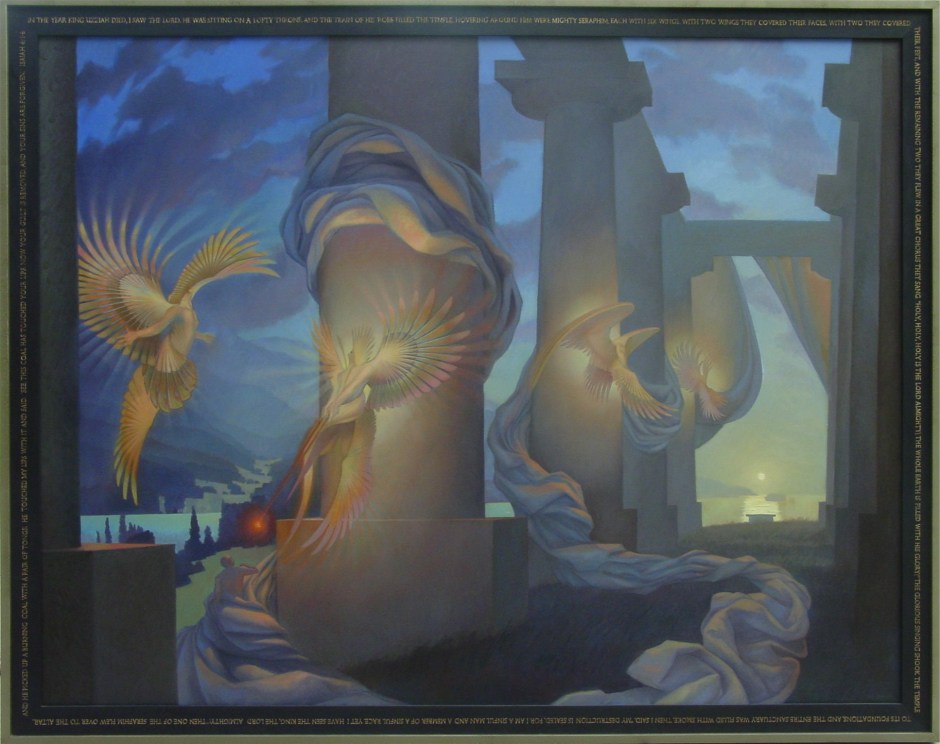
Today she taught about Isaiah, chapter 6 which describes the prophet’s vision of heaven
It reminded me of why mystery is such a wonderful and freeing concept.
The first three verses of chapter 6 read as follows (New King James version):
In the year that King Uzziah died, I saw the Lord sitting on a throne, high and lifted up, and the train of His robe filled the temple. Above it stood seraphim; each one had six wings: with two he covered his face, with two he covered his feet, and with two he flew. 3 And one cried to another and said:
“Holy, holy, holy is the Lord of hosts; The whole earth is full of His glory!”
Dr. Jeannie went on to explain, citing her favorite Church Father St. John Chrysostom (aka, “The Golden Mouth), the impossibility of describing the nature and essence of God. As God is formless, there is no way to physically describe Him. Why even the seraphim are formless!
So how can Isaiah write this description of heaven?
Isaiah needed a way to convey the truth of what he saw in his vision: the utter majesty and glory of God. Even though seraphim are not known to have form, the traditional image is of an angel with wings (and in this case, six). By having the seraphim covering his face and feet with his wings, Isaiah is demonstrating how the being could not look upon the countenance of God, for His glory was too much for him. St. John Chrysostom goes on to explain the meaning of the feet being covered as well as the face, as a means of demonstrating the seraphim’s knowledge that he was a lowly creature in the sight of such magnificence.
Dr. Jeannie cited other parts of the Bible, including the Genesis creation story as similar examples of writers using human examples to describe the indescribable so as to convey important theological and spiritual truths.
Looking at the Bible that way, backed up by rich ancient history she provides, surely does make the pages and people come alive.
But the reason why I so enjoy hearing the Bible taught in this way, through the lens of Orthodoxy, is that it reminds me of the utter mystery of God.
Rather than trying to explain difficult concepts such as the Holy Trinity or the essence of God, how much more enjoyable, fruitful and freeing it is to just release the need to understand and go with the flow of the mystery, allowing it to sweep me along.
This, of course, requires a Guide (the Holy Spirit), thus I need to remain in prayer to continue the journey safely.
The book I cited in my last post, The Naked Now, presents a simple and profound way to remain in prayer at all times and it fits in perfectly with the indescribable magnificence of God.
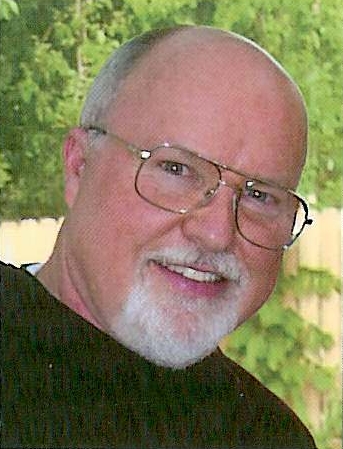
Author Richard Rohr
Richard Rohr, in talking about the name of God, said that word Yahweh (in Hebrew, YHVH) “was considered a literally unspeakable word … From God’s side the divine identity was kept mysterious and unavailable to the mind; when Moses asked for the divinity’s name, he got only the phrase that translates something to this effect: “I AM WHO AM … This is my name forever, this is my title for all generations.” (Exodus 3:14-15) (page 25, The Naked Now by Richard Rohr).
Rohr says the word was not spoken; no, it was breathed. The first and last thing we do each day, and at the beginning and end of life. The thing that we must do to live.
We breathe, thus speaking the unspeakable, over and over again.
Breathing and mystery … wonderful things to lose myself in today …
This blog is supposed to be about making connections.. Lately it’s felt more like a hodgepodge, just a collection of unrelated posts. This blog is certainly challenging me to live out what I preach: living life in a single flow.
It ain’t easy!
This weekend however, it suddenly got a lot easier. I was blessed to attend two extraordinary events which practically shouted “Connections! Connections!” to me. The pen couldn’t move fast enough across the page of my notebook to capture all I was hearing so I could share it with you.
I will begin with this past Sunday night.
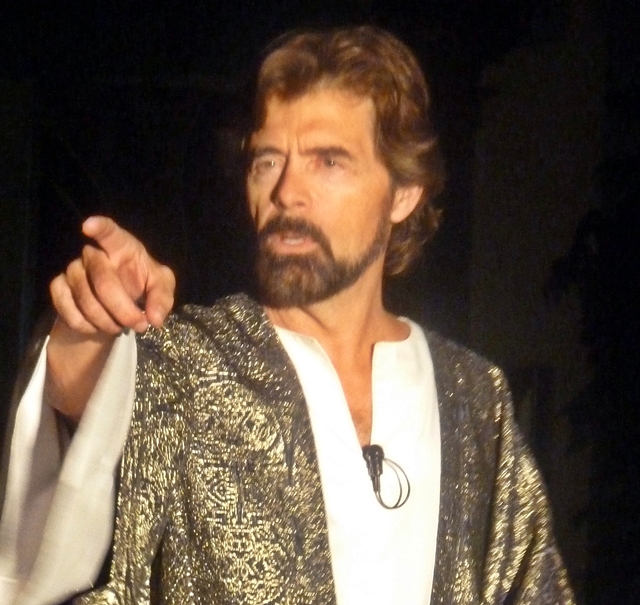
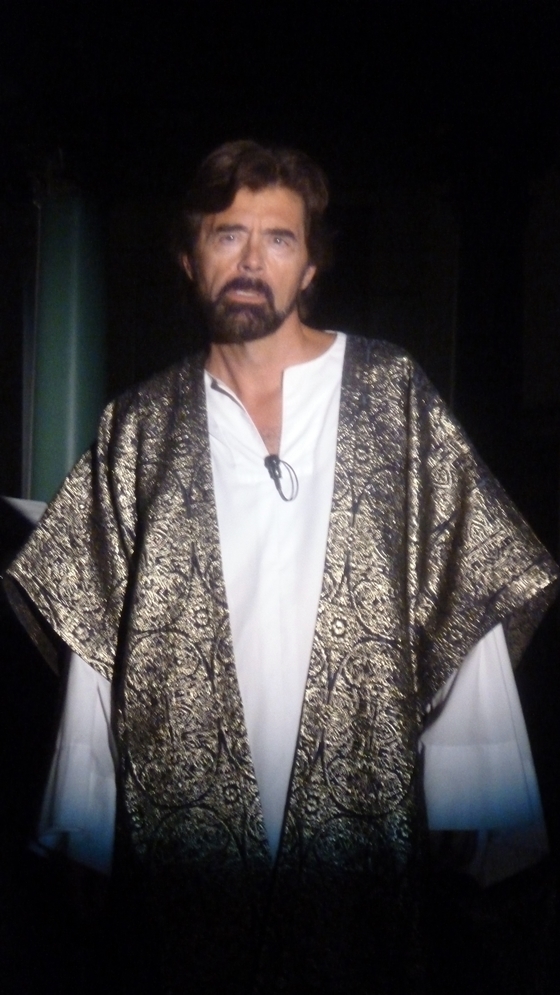
I teach CCD to high school students and needless to say, it is a challenge. Instead of our normal class last night, the students were treated to a one-man play about the Gospel of St. Luke. It was written and performed by Frank Runyeon.
Frank is a successful actor in television and movies. His bio reads, “He starred for seven years as Steve Andropoulos on As the World Turns opposite Meg Ryan, a storyline that garnered the second highest ratings in the history of daytime television. He next appeared for four years as Father Michael Donnelly on the Emmy award-winning Santa Barbara, and as tycoon Simon Romero on General Hospital, opposite Emma Samms. Frank has also guest-starred in recurring roles on L.A. LAW as talk-show host Brooks Tapman, on Falcon Crest as chess genius Jovan Dmytryk, on Melrose Place as Father Tom, and on All My Children as Forrest Williams.”
But Frank would rather be associated with the art closest to his heart: spreading the Good News of Jesus Christ through his vibrant performance of the Gospels.
He debuted his latest one-man play, “Luke, Stories on the Road” at the parish to which I belong, St. Luke the Evangelist in Westborough, MA.
Ah, the first connection!
I came with low expectations. I’m not a big movie-goer nor have I seen a lot of live plays. I had had a fight with my husband, was blown-out from a weekend of endless activity and just wanted to crawl under the covers.
So it took a bit of time to warm up.
About a half hour into the performance I felt a sudden urge to whip out my notebook and write. Frank spoke and I’d write. His performance became riveting.
The camera soon followed. As a former girl scout, I am always prepared!
Dressed in a simple robe, Frank wove stories from the Old and New Testament, focusing first on the story of King David and his disastrous affair with Bathsheba and moving into the stories of Jesus as recorded by Luke the Evangelist.
In each story, he shared a similar and striking insight: the stories, in many cases, had open endings.
The reason? WE are the ending to the story.
How can that be? These stories are thousands of years old. But inspired by the Spirit of the Living God, their truths are as pertinent today as they have ever been.
And Frank made the scriptures come alive with his talented way of weaving a tale.
Past and present – another connection.
Frank made an important association between the story of King David and Bathsheba (2 Samuel 11; 2 Samuel 12) and the parable of The Rich Man and Lazarus found in Luke 16:19-31.
In the story of King David, Bathsheba found she was pregnant after their affair. To cover up their relationship, David arranged to have her dutiful warrior husband killed in battle (2 Samuel 11). Nathan the prophet was sent by the Lord to point out David’s sin (2 Samuel 12) and he did it through a heart-wrenching tale of a rich man robbing a poor man of his only lamb who had been a member of the family so that he could roast it for his friends.
David was incensed. Who was that man? He should be punished!
It was then that Nathan turned the story around on David, using it to accuse him before God of his sin.
Frank put out the palm of his hand: the story was a mirror clearly showing David’s guilt.
David listened, made the connection and repented of his sin.
The Rich Man and Lazarus Meister des Codex Aureus Epternacensis (source: Wikipedia)
The rich man did the same with poor Lazarus, committing evil against him by not offering him food or comfort as the poor man suffered outside the door of his home.
When both died, Lazarus, in the bosom of Abraham became the mirror to the rich man in agony in Hades. The rich man listened but too late: he must suffer the consequences.
The rich man had Moses and the Prophets, but he didn’t listen.
He failed to make the connection.
Frank shared many such stories from the Gospel of St. Luke, the most powerful being The Prodigal Son (Luke 15:11-32) and The Publican and the Tax Collector (Luke 18:9-14).
In both cases we are most definitely the end of the story. And it’s not the character that you would imagine.
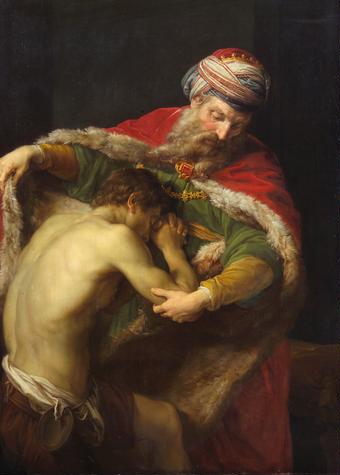
Frank beautifully conveyed the deep emotion in the story of Prodigal Son, showing the arrogance, ignorance and finally, redemption of the younger son, the deep, generous love of the father, and the bitter resentment of the older son.
The so-called “good” son.
The Return of the Prodigal Son (1773) by Pompeo Batoni
The father and the younger son reconciled. The older son, faithful in service to his father, complained, feeling entitled to better treatment.
And as Frank pointed out, the ending with the “good” son was open-ended.
The “good” son is us. We have to create our own ending.
The same was true with the Publican and the Tax Collector. Both praying in the temple, the Publican pontificating before God about how much he tithed and how much better a person he was than the wretched Tax Collector.
The Tax Collector, knowing he was an outcast in Jewish society, never raised his eyes to God but begged forgiveness.
He was justified. The “good” Publican was not.
And the mirror shines back on us – are we that Publican?
Do we consider ourselves as the “good guys?”
Frank Runyeon, through his vibrant, deeply emotional performance, demonstrated the deep connection of the Living Word of God to our daily lives. We at St. Luke’s were fortunate to have him tell these stories, opening our ears and eyes, helping us to listen and make those connections.
Bring Frank to your church
Frank is available for bookings throughout the country with “Luke: Stories from the Road” and other biblical one-man plays, all written by him. Visit his website at frankrunyeon.com.
Sometimes we need a place to jot down our thoughts and feelings.
We learn something new.
We screw up. Big time.
We receive a surprise blessing.
I wanted to establish this quiet space to share things as they happen to me with the hope that you will see yourself here too. Free free to comment and I will answer. Let’s talk and share.
In this journal I will be sharing insights I learn from scripture, experiences of prayer, encounters with people and with the world … whatever I run into that leads me to God.
I am hoping that in my sharing you will find something that resonates with your spiritual life.
We are never alone. God is with us and not just in church. He in our hearts and souls. He is in each one of us. And he is in the world around us.
In our modern culture we have so many options that many times we can’t choose one over the other.
We can have 500 hundred channels of cable TV and still have nothing to watch on the television.
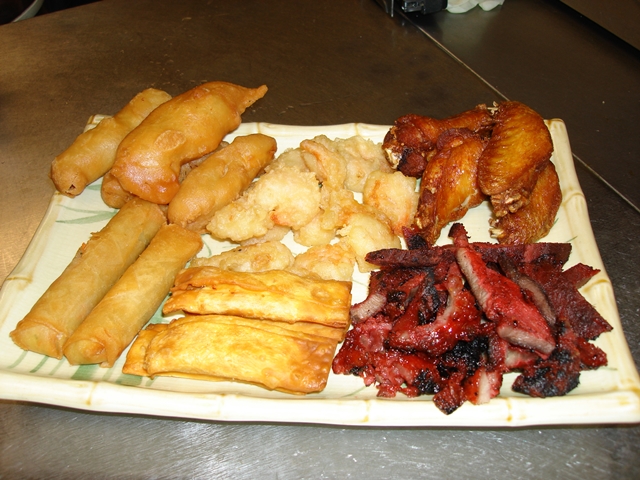
We treat life like sampling a Chinese pu pu platter: we want to be able to try everything.
College students many times have 2, 3 or 4 majors … different degrees so they can have a lot of job options.
Too many choices! And we want to have it all.
Today we have two examples in the scriptures of just the opposite.
The fact is that spiritually and honestly for the best things in our lives we do need to make choices that exclude other things.
Joshua in our first reading tells the people that they could choose to worship the God of their ancestors, the God that they were used to, or they could choose to worship the God of this new land, the God that will be unfamiliar to them. Joshua leads the people to choose to serve the Lord, the one God of Israel. They made their choice.
A choice between goods will always be a difficult choice
and it always excludes something else.
The same thing happens with Jesus in our Gospel, This is the 5th week in a row that we hear “I am the bread of life”.
Stop saying that!
What they said was, “This is too hard. This teaching is too hard; we cannot accept it!”
Jesus made it clear a choice had to be made: “Choose to believe that I am the Son of God that came down from heaven. And the way that you believe in me is that you will eat my body and drink my blood.”
This saying is too weird. This teaching is too hard.
The healing, the teachings were nice, the reaching out was nice and inspired them, but now he has gone too far.
What is sad about this scripture is that some of his disciples turned away and no longer follow him. They went back to their former lives.
Choices!
I wonder what in our day will make us choose like that. What could Jesus say to us that will make us say, “This is getting too hard, I do not know if I can do it!”
Some of us struggle with some of the teachings of the church.
I have and I do. There are a few things that I can think of that cause me to say, “This is hard, who can accept it?”
For some of us it is hard to accept that God is forgetful.
He forgives us and unlike humans, he forgets. God holds no bitterness, no resentments, and no anger against you.
It is hard to accept that God is blind and he is indeed blind.
He does not see the negative or the broken in us, only the positive and the possibility of healing and fullness of life.
It is hard to accept that God is stubborn and he is indeed stubborn
He will not give up on us, ever. There is nothing we can do to make him love us any more than he does. And there is nothing we can do to make him stop loving us. He will pursue our hearts, for decades if he has to, until he gets us to fall in love with him and let him in.
I think what the gospel is inviting us to say is what Peter says, what Peter representing all the apostles said to Jesus:
“Lord, to whom shall we go, you have the words of everlasting life.”
“We are convinced that you are the holy one of God.” Notice that Peter does not say, “Okay! I got it, I understand it all, and I am right on board with you.” I am sure Peter and the disciples were as freaked out as everyone else.
But Peter’s answers reflect faith and faith sometimes needs to step out.
There are things that we do not believe, things that we do not completely understand. Maybe there are things we do not agree with. We say, “This is a hard saying,” but where else will we go?
“You have the words of everlasting life.”
We had to make a choice by coming here. There are a lot of things that we could be doing but we made a choice to come here.
At some point in our life we are forced to make a choice between one thing and another.
The choices we make now will affect us later on. We will need to let go of things in order to get what is really important. To me the choice is to be present as much as I can in my life. To see the beauty in everything, to find God in everything, even in our struggles, shortcomings and sins, and to remain open and aware that nobody has all the answers.
For me it is about letting go of all my junk, letting go of my prejudice, my control, my securities and the false belief that I have to know it all and have all the answers.
So, maybe we do struggle, I know I struggle. Sometimes I do not get it. And yet to whom shall we go?


 Join my Email List (special surprises just for you!)












 Be as One