In my quest for a harmonious life I understand the need to be still. Certain tools help in that effort:
Reading, to organize my thoughts.
Praying, to tap into my soul, drawing me closer to God.
Time spent outdoors, especially in the Spring, to quiet myself.
Achieving mindfulness
The landscape is slowly coming to life here in New England and when I see signs of Spring, I think of Henry David Thoreau. His intimate knowledge of the outdoors came from a sense of mindfulness–no detail missed his watchful eye. He took the time to be still and observe. And in following that simple maxim, the world revealed itself to him.
New book on Thoreau
I recently reviewed a book on my Louisa May Alcott blog by Corinne Hosfeld Smith (certified tour guide of the Thoreau birthplace and author of Westward I Go Free: Tracing Thoreau’s Last Journey) calledHenry David Thoreau for Kids:
Demanding writer
I welcomed this book because while I have always appreciated Thoreau’s message, I find his his works difficult to get through. The writing is dense, demanding your full attention. Many of us suffered through high school and college English classes with his classic Walden. And yet, that message of a different way of living got through to me even though I could not begin to digest all the words.
Making Thoreau concrete
What I loved about Henry David Thoreau for Kids were the twenty-one activities geared for middle school students that help you live out his ideas. Many of these activities are just as engaging for adults.
I was intrigued by the exercise which encouraged the participant to sit outdoors for thirty minutes in total silence, waiting for wildlife to appear. Sure enough, after a few moments birds and other creatures come close for observation. I was eager to try this exercise in my quest to be still.
Helpful tool
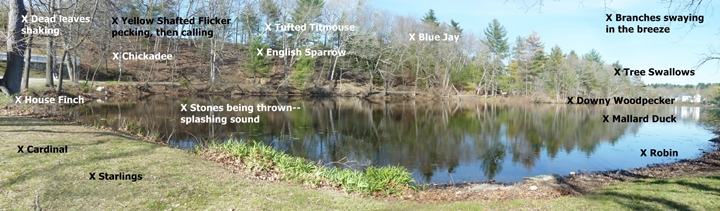
Stillness, however, does not come easily in this busy world so I was grateful that Smith recommended another exercise to help me focus–creating a sound map.
Sitting in my lawn chair, I sketched the area you see here in my notebook and every time I heard a sound from nature, I drew an “x” where I thought I heard it and wrote down what it was. As you can see, I heard quite a bit!
From listening to observing
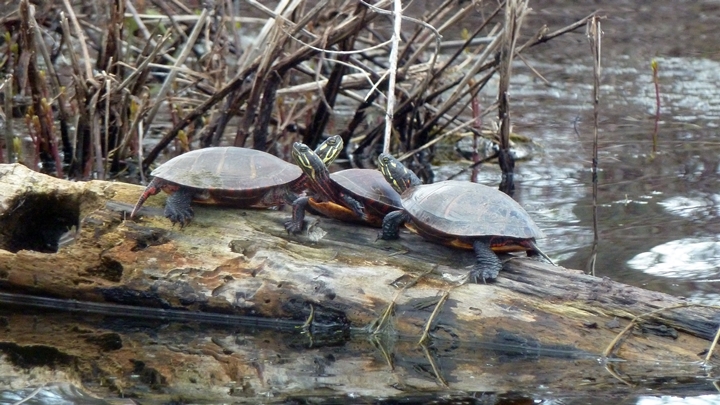
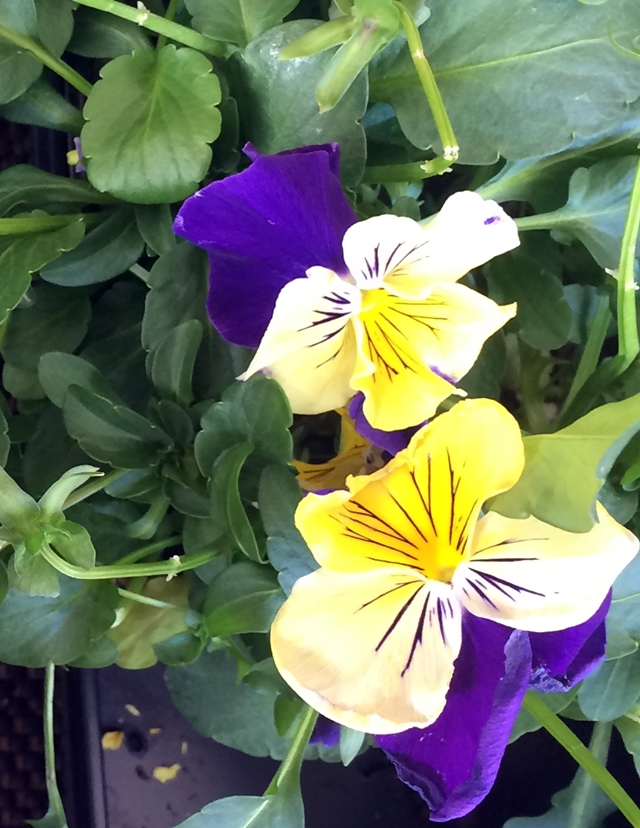
In the listening, I began to appreciate the visual imagery around me.
This slideshow requires JavaScript.
Stillness opens the inner eye
Stillness and mindfulness are hard to achieve in this high tech, multi-tasking, noisy world. Patience and due diligence are rewarded however with the opening of the inner eye, that which sees beauty and truth around us and eventually, within us. It’s a simple truth really: the wonder of life and how it was created, and how we are lucky to be alive despite all the challenges.
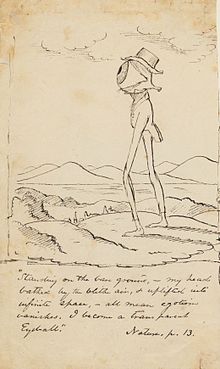
Houghton MS Am 1506 (4)-Cranch
A compatriot of Thoreau’s, Ralph Waldo Emerson, once wrote of the transparent eyeball, an expression for which he was mocked. Wikipedia explains it this way:
“The transparent eyeball is a philosophical metaphor originated by Ralph Waldo Emerson. The transparent eyeball is a representation of an eye that is absorbent rather than reflective, and therefore takes in all that nature has to offer.”
Emerson experienced an epiphany that day–the discovery of the ability to read between the lines in the world around him, and come to an understanding of a deeper existence within him.
Once that eye is opened …
… you never want it to close. All of a sudden, the smallest things become lovely, compelling, even exciting. Once I became mindful of what surrounded me in the natural world, I couldn’t get enough of it, especially when it came to bird watching and kayaking.
And once I made a commitment to pay attention to what was there inside of me, allowing myself to to be drawn closer to my Creator, I find I can’t get enough of that either.
Silence is becoming an elixir.
I understand from the great mystics that you can learn to be quiet and still even in the midst of noise and chaos. Wouldn’t that be something! Somehow I think a bunch of people with that kind of inner harmony could truly change the world for the good. Think about it.
Your time of stillness
Try spending thirty minutes in the woods, in a field or by a pond this Spring. Create your own sound map and share it here. Let’s compare notes and find out how we are doing on our journey to harmony.
You can find out more about Henry David Thoreau for Kidshere, and read about the author, Corinne Hosfeld Smith, here.
Many people find coloring to be a wonderful way to relax and experience harmony in their lives. Is that you? Join my Email List to subscribe to this blog and receive your free Harmony coloring book (and more).
We just got hit with a couple of back-to-back snowstorms, bringing back painful memories of last winter here in the Northeast (four feet of snow!). I love to feed the birds and have often wondered how they survive blizzard-like conditions.
Just to show how wonderful creation can be, here is a very informative article about how birds survive storms. They may appear to be small and helpless, but obviously their Creator has equipped them well for survival.
With threats of a monster blizzard barreling towards the Northeast this weekend, many people are stocking up on supplies and planning movie marathons. But how will the birds survive the storm? The answer is threefold: Location, preparation, and adaptation.
Shelter in Place
When bad weather hits, birds generally seek shelter in microhabitats, such as inside a thick hedge, or on the downwind side of a tree—in this case, being petite has its advantages. Hunkering down in these spots can protect them from wind, rain, and even cold (it’s warmer closer to the ground). Birds that nest in cavities, including woodpeckers, bluebirds, and chickadees, can also hide out in their tree holes.
The long Christmas break (along with the mild weather) is over and reality comes back with a thud. The prospect of a long winter ahead is daunting especially with memories of the epic snowfall amounts of last year still haunting many of us.
I once anticipated January with dread. Winter can be dark, oppressive and confining: the arctic air and biting winds… the deep snows burying the landscape … ice covering the streets and sidewalks … darkness that greets us when we rise and meets us at the end of each work day.
January is a quiet month. Birds don’t come to the feeder; their songs no longer greet me in the morning. Crickets and locusts have gone silent at night.
January was a month without life.
Then I read Henry Beston’s classic, The Outermost House. Beston chronicles a year of his life spent in solitude in an isolated one bedroom cottage which he built and christened the Fo’castle. Built in 1925, the 20 ft. x 16 ft. cottage was located at the edge of Coast Guard Beach in Eastham (now part of the Cape Cod National Seashore). Named a National Literary Landmark in 1964, it was washed out to sea by the Blizzard of ’78.
Originally planning to spent two weeks at the cottage, Beston was so taken with the “beauty and mystery of this earth and outer sea … that [he] could not go.” During that year he wrote of the change of seasons and its effect upon his surroundings: the birds, animals, and insects; vegetation; the sand and the waves; the stars in the night sky. His prose is poetic, painting vivid pictures of color and texture. He describes the chaos and despair aroused by a devastating blizzard which nearly washed away his cottage, putting his life in peril. Yet even in the bleakest of settings, Beston’s writing inspires wonder and awe.
The Outermost House changed my perception of January because of Beston’s descriptions of arctic birds migrating down from the north, resting on the beach in the dead of winter. That description lifted me out of my own small circumstance and reminded me that life still goes on around me.
There was not only life, but light in the darkness: “Light came slowly into the world, coming not so much from the east as from some vague, general nowhere – a light that did not grow brighter but only increased in quantity.” It reminded me that by the end of January, the sky becomes pink again by the time I leave the office. The days are growing longer and the light, brighter.
January is not unlike time spent in the womb, waiting to be born. The caterpillar metamorphoses into a butterfly within the confines of the cocoon and breaks through into the sunlight. The baby, its delicate features forming nine months inside the dark, protective womb of its mother, emerges into the light at birth.
We just celebrated the coming of such a baby who brought his eternal Light into the world. His Light pierces the darkness and brings new life.
So, rather than give in to the melancholy that can come with the conclusion of Christmas and the reality of winter, I seek instead to embrace this Light. It may be cold, snowy and dark outside but within, that Light will increase in brightness and quantity as I take advantage of the quiet of January to bask in it.
The arctic birds are returning to the Outer Cape. The days are growing longer. In the repose of January it is time to partake of the Light of Christ.
Are you enjoying the Pope’s visit as much as I am? I have been glued to EWTN and CatholicTV, listening carefully to the words of the Holy Father.
Do you find as I do that his words are pregnant with meaning? That you need time to process what he has said?
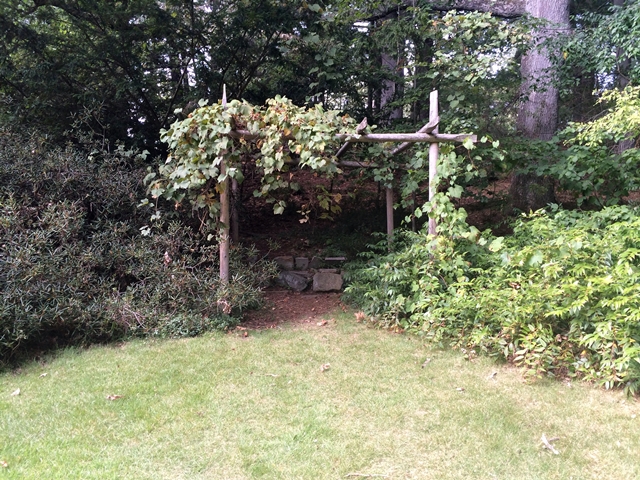
I do. My head is full. Today I took some time to walk outdoors to a favorite spot in the Wellesley College botanical gardens to sit, pray, think and sort out my head. I took pictures of this “outdoor chapel” and I will share them with you, so you can go there too to think on the words of Pope Francis. Continue reading “Come and meditate on the words of Pope Francis”→
This is an amazing initiative by Tinykittens.com with a feral colony of cats. The first experiment, that of trapping a pregnant feral so that she could give birth in in a warm and safe place resulted in her four kittens being totally socialized and adopted out to loving families while the mother cat was returned to the colony where she would be the happiest.
How many of us remember making mud pies? Hiking in the woods? Splashing in a stream? Observing birds and butterflies? Every kid needs to experience the outdoors and this program offers some amazing options.
As an avid kayaker familiar with its therapeutic benefits, I can see how this would be a tremendous benefit to our vets.
Music
As you all seemed to enjoy the video I posted of Sarah Hart singing “Praying from a Broken Heart” so I thought I’d share this:
October 26, 2013 – Sarah Hart singing in St. Peter’s Square for Pope Francis and a crowd of 150,000; Sarah meeting the Pope at the end of the video
















 Be as One