I am pleased to present this guest post from Brunhilde Luken, a painter and spiritual writer. I met Brunhilde several years ago as we were both members of the Commission for Women of the Diocese of Worcester. She is one of those people that truly wears her heart on her sleeve–you know you’ve met someone who is authentic with an inner beauty that draws you into her creative works.
I can’t think of a better way to remember Thanksgiving than through this lovely meditation of image and words. Happy Thanksgiving to you all!
In a few days we are celebrating Thanksgiving; it is a wonderful day set aside to celebrate with family and friends to give thanks. I am especially thankful to live in a country where I can celebrate and proudly confess my Catholic faith. A faith that stood firm generation after generation.
I am also thankful that we can hold hands with all our neighbors, friends and all those that cross our path, Christian and non-Christian alike, where we allow each one to be free. A country where we can share the love that Christ brought into the world for all of us alike. We have to remember He died on the cross for all the world. These are hard times right now. There is so much suffering in the world right now. At times we all suffer. By embracing our suffering, God will pull us closer to Him. This will help us to pray for all. Let us all pray especially for those that need it most. Let us share the gifts that God gave us. When we pray we speak to God, when we read the scripture, God speaks to us. A Gift given to all of us, a gift we can share with all.
We are the ones to show the face of Christ to the world, and to see the face of Christ in everyone. Let each moment be a moment of thanks. I am also most thankful for each one of you.
I wish all of you a wonderful Thanksgiving, may God’s blessing be upon you and your whole family.
Psalm 95
Oh come, let us sing to the Lord!
Let us shout joyfully to the Rock of our salvation
Let us come before His presence with thanksgiving
Let us shout joyfully to Him with psalms.
For the Lord is the great God,
And the great King above all gods.
In His hand are the deep places of the earth.
The heights of the hills are His also
The sea is His, for He made it.
And His hands formed the dry land.
Oh come let us worship and bow down.
Let us kneel before the Lord our Maker.
For He is our God.
And we are the people of His pasture,
And the sheep of His hand.
Today, if you hear His voice:
“Do not harden your hearts, as in the rebellion.
As in the day of trial in the wilderness,
When your fathers tested me;
They tried me, though they saw my work
For forty years I was grieved with that generation.
And said, ‘It is a people who go astray in their heart.
And they do not know my ways.’
So I swore in my wrath’,
‘They shall not enter my rest.’ ”
Let us bow our heads in Thanksgiving to the Almighty, the “I AM WHO I AM”, “FATHER, SON, AND HOLY SPIRIT.”
I was privileged to appear this morning on “Jon and Jeanne in the Morning” on Iowa Catholic Radio to talk about River of Grace:
We talked about the creative ways that God’s grace works through our grief when we lose someone we love. Turns out I’m far from alone in thinking my grief journey after my mom died was strange! Jon shares a similar story during the interview about losing his beloved grandmother.
All of you who have “been-there-done-that” will nod your heads in agreement when I say there are no rules when it comes to grief except that it is yours. It is a unique experience, one that if embraced, will bring us to new and wonderful things after the sorrow begins to pull back.
We know how grief can reappear in unexpected ways during the Thanksgiving and Christmas holidays. Coining a phrase often used by author Joyce Rupp, “leaning” into our grief releases us into God’s hands where his river of grace can carry us to eventual healing.
Here is this morning’s interview. Maybe this little snippet can help nudge you in the right direction.
I will be at Boucher’s Good Books, 254 Lake Street, Worcester for a River of Grace book signing and impromptu live concert featuring the music from the River of Grace Soundtrack CD! The book and CD would make a great gift for someone you love. Come on down and say hello!
Susan Bailey has faced her fair share of challenges and “difficult times” and yet she’s emerged not only a survivor, but also even stronger in her spiritual commitment and joy. In this book, learn what made the difference for Susan in her spiritual journey, but even more so how to face your own struggles with a faith that will renew and support you. A perfect gift for any friend or loved one facing a time of loss or difficulty, or for yourself when you need the companionship of a trusted friend. The “Flow Lessons” contained in this book are the perfect tools to help you more fully rely on God’s love in your life. Highly recommend!
In this EXCEPTIONALLY well-written book, Susan Bailey shares some of her most challenging moments and shows others how to find the grace hidden in life’s difficulties. This book inspires Christians to pursue the paths of authentic faith amid the currents and seasons of life. The “flow lessons” that accompany each chapter provide readers with simple, hands-on, experiences that move the author’s reflections into concrete and practical application. With both eloquence and humility, what River of Grace offers is a deeper answer to personal struggle, and a healthier alternative to the fake-it-til-you-make-it mentality. Above all, this is a book that gives hope.
Looking forward to seeing you on Saturday–spread the word!
Be sure and visit the show’s archive page to hear these other guests. I have Sarah Reinhard’s wonderful book, Word by Word, on the Hail Mary and just received Lisa Maldinich’s book called True Radiance: Finding Grace in the Second Half of Life (with a stunning front cover). Great stuff out there!
For those of you who live in the Central Massachusetts area, come on out to the Westborough Public Library in Westborough, MA between 12 and 3 on Saturday, the 14th. See you there!
November can be a difficult month for many. The clocks roll back and the sun sets at 4:30. The temperatures cool and the last of the leaves fall to the ground. There are many cloudy, gray days.
November reminds us that we cannot escape our fate–we all die at some point. Our physical deaths can happen suddenly. Or our health may deteriorate over time, bit by agonizing bit. Dying may be the daily giving up of some part of ourselves that we cherish. Memories fade. Legs weaken and fail. We can barely check our email or turn on the TV because the technology overwhelms us.
November is the month we remember all those who have died and as a community, we lift them in prayer. It reminds us of the grief that never ends, perhaps bringing it forward just when we thought we had sent it to the back of our minds and hearts.
Grief is mysterious and capricious. It creeps up on us, explodes inside of us, in the most inopportune times and places. I can’t tell you how many times tears have suddenly sprung to my eyes in the middle of a crowded room. There is never a day that we forget our loved ones. Happy occasions make us long for them so that we can share our joy. Hard times see us reaching out in vain for those loving arms that would assure us that “everything will okay.”
Grief is a journey that demands our compliance. Resist, and we will pay the price of remaining stuck in that place of sorrow, bitterness and anger; we will die in our grief. Comply, and grief will recreate us; we will live again.
At the age of fifty-nine I have become the published author of not one, but two books, both of which are the products of my grief. When the journey began in 2010 after I lost my mother, I was too numb and worn out to resist– God’s grace beckoned me to go on grief’s journey. In the process, I discovered the life-giving creativity inherent in that journey, taking that which already existed and shaping it into something new and wonderful.
Any artist, writer, musician or dancer will tell you that excellence in the creative life requires a letting go of control–you must give yourself over to something bigger than yourself, and collaborate with that force which compels you to create. That force will demand that you dig deep for answers and that you be open to any possibility. Your heart must remain soft, supple, and vulnerable.
Grief is that kind of creative force, demanding much the same.
I have no idea why I allowed myself to go with the flow of my grief journey. For some reason I was able to trust in God’s care and float down his river of grace. It was often a very confusing journey as I was given just enough knowledge to motivate me to continue, but no more; I was clueless as to where it would all lead. Sometimes the waters were rough. What I do know is that in the midst of my deep sorrow I found a wellspring of joy: “A good measure, pressed down, shaken together and running over, will be poured into your lap. For with the measure you use, it will be measured to you”. (Luke 6:38, NIV). As a result, each day became part of an exhilarating adventure.
Death and mourning need not signal the end; our faith teaches us that it is in fact a beginning. During this month of All Souls, may we pray for those who have penetrated the veil, and ask for God’s river of grace to carry us through our grief and recreate us. In the words of Saint Paul from Romans 15:13: “May the God of hope fill you with all joy and peace as you trust in him, so that you may overflow with hope by the power of the Holy Spirit.”
You could win a copy of both books in the Chime Travelers series!
Find out how at the end of this post … great gift for the child in your life (even if it’s you!).
When’s the last time you treated yourself to a good children’s book?
How did reading it make you feel?
As an almost-60 adult with no small children in my life at the moment, it feels like a guilty (and secret) pleasure. I mean, shouldn’t I be reading more challenging books? It was after a conversation with a distinguished professor of children’s literature that I realized reading children’s literature is totally acceptable at any age. And besides, it’s fun!
That said I couldn’t resist reading my friend Lisa Hendey’s new Chime Travelers series. Initially I was drawn in by the imaginative and vibrant illustrations by Jenn Bower. This is Hendey’s first foray into juvenile fiction. As a writer myself I was curious as to how she made that transition; I’m happy to say that she has done it quite well.
The premise
I read the first two books, The Secret of the Shamrock and The Sign of the Carved Cross and fell in love with the series. The premise revolves around twins Patrick and Katie who are mysteriously sent back in time whenever the bells of St. Anne’s chime (thus Chime Travelers). In each case they meet a saint with a name similar to theirs and embark on an adventure. As they come to know and love the saint, they are inspired by the faith and life of that saint which in turn, draws them closer to God. Their lives are never the same again. Patrick meets St. Patrick, the great saint of Ireland, and Katie meets Saint Kateri Tekakwitha, the first Native American to be canonized.
The series is geared for children in grades 2-5 with the very typical problems that kids face such as not fitting in, making fun of other kids, being unkind to newcomers, trying to please the popular crowd, jealousy, being bored with church, guilt over past actions and so forth. By being exposed to these great saints, Patrick and Katie come to love their faith especially through the sacraments (Patrick with Reconciliation; Katie with Baptism and Holy Communion). I found myself becoming attached to St. Patrick and St. Kateri as I grew to know them and almost felt sad when the children were transported back home.
Empowering young people to change
Hendey does not make the twins change instantaneously but rather slowly, over time. In the second book, The Sign of the Carved Cross, we can see Katie noticing and wondering how her brother has changed since he experienced his time-traveling adventure, unaware that the same would soon happen to her. By being changed from within, both children begin treat others with more kindness, patience and understanding.
Saints are real people
Children love exciting stories about real people and our Church has so many of them to offer through the Saints. The Chime Travelers series does a great service in exposing our young people to people who lived their faith authentically and boldly while dealing with their own weaknesses and sins.
Great for adults too!
And since reading children’s literature acts a vacation for my overworked and weary mind, this adult loved them too. I highly recommend the Chime Travelers series for all ages. I’m keeping my copies for the future grandchildren.
You could win a copy of both books in the Chime Travelers series!
Find out how at the end of this post … great gift for the child in your life (even if it’s you!).
Come and meet Lisa Hendey, author of the Chime Travelers series:
How did you come to write the stories? Did you choose the Saints that you wrote about?
I had been in conversation with the publisher, Servant, about potential book projects. At one of our meetings, I humorously shared with them an idea that I had for a children’s book. The concept for Chime Travelers was “born” during a fun backyard chat with my nephew Patrick one day. We daydreamed about a little boy who traveled in time to meet his patron saint. In our family, the name “Patrick” is quite common and we have a true devotion to the “apostle of Ireland”! When I shared the idea, Claudia Volkman and Louise Pare were able to see the vision for the story and we began to conceptualize what has since become an entire series of books. I chose the initial two saints (St. Patrick and St. Kateri Tekakwitha) and campaigned to have the first two books released simultaneously. Children who read these types of books want to have them quickly if they love them. The upcoming books, based on the lives of St. Francis of Assisi and St. Clare of Assisi, will be coming this spring and the fifth book is planned for release in the summer.
How were you able to make the transition from writing nonfiction to fiction?
Did doing the research help you to get into the mindset?
The transition was such a joy but also much more challenging than I had predicted. We have an excellent editor, Lindsay Olson, who is a true children’s literature specialist. And I must also rave about our illustrator Jenn Bower who has truly brought the series to life with her art. Making the transition to fiction involved relying on the research skills I’ve honed as a non-fiction author, but also setting loose my imagination. The challenges related to helping the characters truly come to life, capturing the senses and attention of our young readers, and also building upon the stories of the saints while being very respectful of their true life legacies. Even though the books are short, we want them to be educational and also close in detail to the real facts of the saints histories.
How different is it writing for children than for writing for adults? Are the rules you need to follow?
I’ve learned so much! One big difference is that it’s important to help the kids enter into the action of the scene rather than simply describing it to them. This was a huge challenge for me initially and something I’m still learning about. I’ll also share that I’m quite verbose (note my answers here for an example of that!) These books need to be tight, concise but also full of rich imagery. One “rule” I’m still learning about is giving our characters “agency” – that is to give them a voice or power over their situations. This is why you’ll find our main characters Patrick and Katie at the center of the action in the Chime Travelers series. We want the children who read these books to understand that they too have power and that their actions matter–especially within our Church and in their own families. I believe that our children can make our Church and our world better. I hope that with these books, we’ve given them role models to see that they too can emulate the saints in living lives of great courage, valor and import.
How does it feel to be carried away to a distant land in a distant time with a special Saint? Do you have a favorite?
Many have heard me say that I often write in my sons’ old tree house, a space my husband built for them years ago. I have a rocking chair and desk there, and I truly love to go into that space to “Chime Travel”. To be “carried away” in time and to dwell in the lives of the saints is somewhat like the beautiful form of Lectio Divina. I often do my historical research and then simply pray and begin writing. I find so often that I become caught up in the scenes I’m writing, as if I see the action or hear the dialogue in my head. I’m afraid that probably sounds a bit crazy! But in truth, these books are a gift of love for the Church and our saints. For that reason, I feel strongly that the Holy Spirit is often at work in my tree house, guiding me along a path to the stories we are creating.
Where the magic happens … used by permission lisahendey.com
I have scores of favorite saints – the first two books tell two of their stories. My “favorite” saint probably varies every day, depending upon whose spiritual friendship I most need! My “go to” is my personal patroness, St. Therese of Lisieux, but I also have a deep love for Venerable Fulton Sheen, for St. Damien and St. Marianne Cope of Molokai, and St. Elizabeth Ann Seton. I love St. Therese of Lisieux because as she did in her own life, I greatly desire to be a missionary in our world. Like St. Therese, I will likely never travel extensively to foreign mission fields. But her Little Way, her life and legacy have taught me that my own mission field can be a vast and beautiful “love letter” to God in its own unique way. In general, I love the saints and working on this project has been a great way to share that love with children everywhere.
How can you win both books in the Chime Travelers series?
Be the first to leave a comment and the books are yours! Comment away …
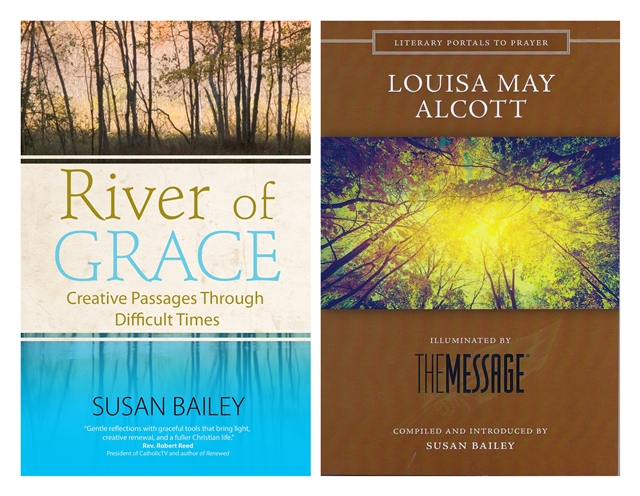
A dear friend from my Louisa May Alcott is My Passion blog wrote a wonderful review of River of Grace! This is a really comprehensive review; if you’re wondering what this book is about, Tarissa (the reviewer) summed it up beautifully! Here’s a portion of it:
Susan Bailey shares about the trials and triumphs in her life in her new book River of Grace. She tells how God’s mercy has shown her a greater kind of essence, once she let herself glide along with His unending grace.
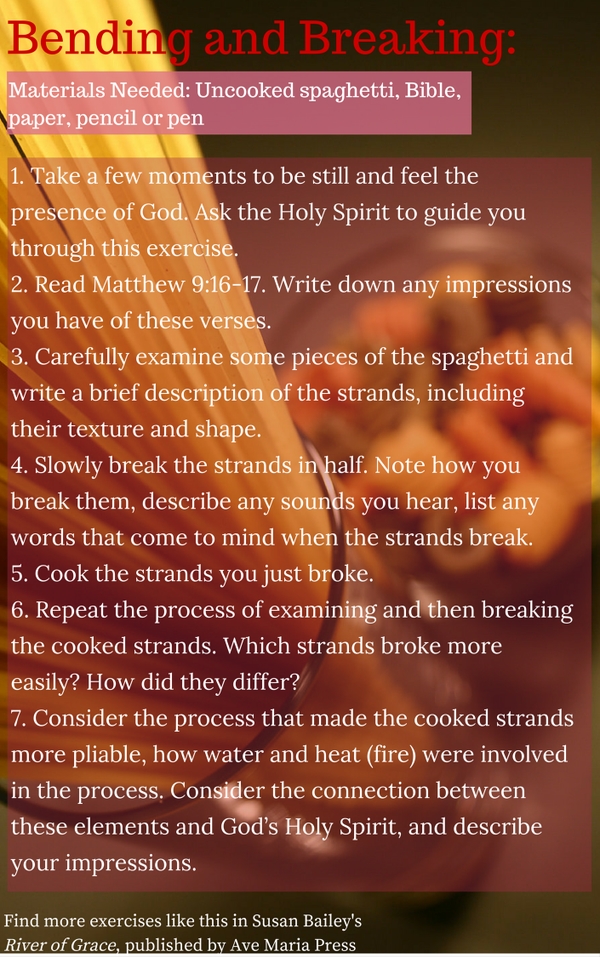
A running theme that you learn all throughout this book is how creativity and spirituality go together, hand in hand. Susan illustrates this time and again. Susan pauses to personalize the reading and ask you how you can create new life in your surroundings as you allow the river of grace to run through you. In each chapter, she takes time (and allows you to take time) to reflect and focus on your emotions, thoughts, and defining events in your own life. If you take a few moments to perform the suggested activities, and allow creativity to lead the way, you will be blessed with fresh insight and positivity.
For people struggling with grief, this book shows that there is a light at the end of the tunnel. Freely, the author doles out the pain she encountered on the deaths of her parents, and how greatly her life changed under those circumstances. She then dispenses the successful tools and mental thought process behind obtaining victory over death. Triumph is available to anyone! This is not a story of how to get over grief fast — but how to deal with it and give your afflictions to the Almighty. You will get through your time of sorrow, and when the grief cycle has ran its course, you will become a more complete person.









 Be as One