Reset Refreshed: Self-Care Activities That Help Kids Recenter Without Screens or Struggle

Guest post by Julie Morris
Image via Pexels

Kids absorb more tension than we notice, and without a way to release it, that energy turns inward. Their behavior isn’t random—it’s often a signal of overload. Resetting doesn’t always mean resting. It can mean moving, scribbling, sorting, or staring into space without demand. They don’t need fixing. They need frictionless ways to come back to themselves.

Get Outside: Let the World Be Quiet for a Minute

Nature offers something your house can’t: silence that moves. Kids don’t always need a parkour-style sprint to reset—they need trees that don’t need them, grass that sways on its own timeline. Researchers describe the fascination in green spaces as “soft,” not because it’s weak, but because it gently pulls attention outward. The effect isn’t instant, but give it 15 minutes. Sit under a tree. Don’t schedule it. Just let their senses track birds, wind, and uneven ground. A child who’s been sprinting mentally all day doesn’t need more tasks—they need frictionless wonder. And green space delivers that with no passwords and no parental performance pressure.

Save the Masterpieces Without the Clutter

Those finger paintings? The handprint turkeys? The drawing of your dog with six legs? They mean something. But they pile up fast. Instead of letting them vanish in the bottom of a junk drawer, consider archiving them. Saving artwork as a PDF creates a digital keepsake that can be shared with family or preserved for years without the physical clutter. You can check this one out — a free tool that lets you drag and drop scanned files, turning them into clean, easy-to-store digital copies.

Give Them a Journal

When kids put thoughts to paper—whether they’re writing, doodling, or scribbling emoji-style faces—they’re externalizing emotion, organizing inner noise, and making space for new thoughts to come in. You don’t have to read it. In fact, you probably shouldn’t. This is about ownership. One page a day. No rules, no grades, no “draw a rainbow with six colors” worksheets. Just paper and pen. Over time, they may write more. They may not. Either way, the practice of recording daily scraps of thought or image creates a self-care groove they’ll carry into teenhood. It’s simple and surprisingly effective: a journal provides emotional space when conversation feels too heavy or fuzzy.

Encourage Freeform, Unstructured Play
(and Walk Away)

Not all rest looks restful. Sometimes the reset comes from more movement—but only if they’re the one in charge. Let them build with couch cushions, dress dolls in winter hats, or turn the hallway into a dinosaur habitat. It might look chaotic to you, but this kind of child-led play gives their nervous system a chance to work through big feelings without adult framing. The key is that it’s theirs. No objectives. No prize. Just raw creation. When a child can invent, destroy, and rebuild their own world, they’re also processing the one around them.

Let Art Slow the Pulse

Paint. Markers. Stickers. And a table that doesn’t ask questions. Art isn’t just cute output—it’s often the first time a kid externalizes a tangled emotion they couldn’t name. When you invite mindful drawing—not “make a tree,” but “draw whatever your hand wants”—you’re giving their body permission to lead the mind. This isn’t about creativity; it’s about calming through sensation. Studies show that creative focus through art can steady breathing and attention span, especially in kids who struggle to articulate stress. Keep a small bin of materials in reach, but not on display. This should feel like relief, not an assignment.

Movement That Isn’t a Sport

Not every kid wants a team jersey. Some just need to stretch, roll, tumble, or march around the backyard with their arms out like helicopter blades. Movement shouldn’t always mean drills or lessons—it can be wiggly, weird, or quiet. A good physical reset meets a child’s energy exactly where it is, then helps it shift. If they’re sluggish, try a skipping game. If they’re buzzing, lead them in slow, deliberate stretches. It’s not a workout. It’s an exhale. Daily movement improves kids’ mental clarity and emotional regulation more than most parents realize. The trick? You have to let them move like themselves—not like tiny gym members.

Kids don’t reset on command. But they do respond to rhythm, sensory space, and moments where they aren’t being asked to perform. These resets aren’t tricks. They’re tools—honest, repeatable, and quiet enough to let their systems breathe. When they know how to return to stillness, they don’t just feel better. They grow steadier. And steadiness is the soil where everything else grows.

Discover a world of inspiration and self-care at Be as One, where you can explore resources to elevate your wellness journey and embrace a more connected, creative life.

Be sure to visit Julie’s website at juliemorris.org.
Susan Bailey, Author, Speaker, Musician on Facebook and Twitter
Read my other blog, Louisa May Alcott is My Passion
amazing grace album cover
NEW MUSIC!
Susan’s
new release, Amazing Grace” is now available!
Available on Amazon, Spotify, iTunes and YouTube
00 cover smalllouisa cover smallimaginary-heroes_cover
Purchase Susan’s books.

River of Grace Audio book with soundtrack music available now on Bandcamp.
Listen to the preface of the book, and all the songs.

On the journey to harmony–Thoreau, the Sound Map and opening up the inner eye

In my quest for a harmonious life I understand the need to be still. Certain tools help in that effort:

  • Reading, to organize my thoughts.
  • Praying, to tap into my soul, drawing me closer to God.
  • Time spent outdoors, especially in the Spring, to quiet myself.

Achieving mindfulness

The landscape is slowly coming to life here in New England and when I see signs of Spring, I think of Henry David Thoreau. His intimate knowledge of the outdoors came from a sense of mindfulness–no detail missed his watchful eye. He took the time to be still and observe. And in following that simple maxim, the world revealed itself to him.

roses-640

New book on Thoreau

I recently reviewed a book on my Louisa May Alcott blog by Corinne Hosfeld Smith (certified tour guide of the Thoreau birthplace and author of Westward I Go Free: Tracing Thoreau’s Last Journey) called Henry David Thoreau for Kids:

thoreau for kids

Demanding writer

I welcomed this book because while I have always appreciated Thoreau’s message, I find his his works difficult to get through. The writing is dense, demanding your full attention. Many of us suffered through high school and college English classes with his classic Walden. And yet, that message of a different way of living got through to me even though I could not begin to digest all the words.

Making Thoreau concrete

What I loved about Henry David Thoreau for Kids were the twenty-one activities geared for middle school students that help you live out his ideas. Many of these activities are just as engaging for adults.

I was intrigued by the exercise which encouraged the participant to sit outdoors for thirty minutes in total silence, waiting for wildlife to appear. Sure enough, after a few moments birds and other creatures come close for observation. I was eager to try this exercise in my quest to be still.

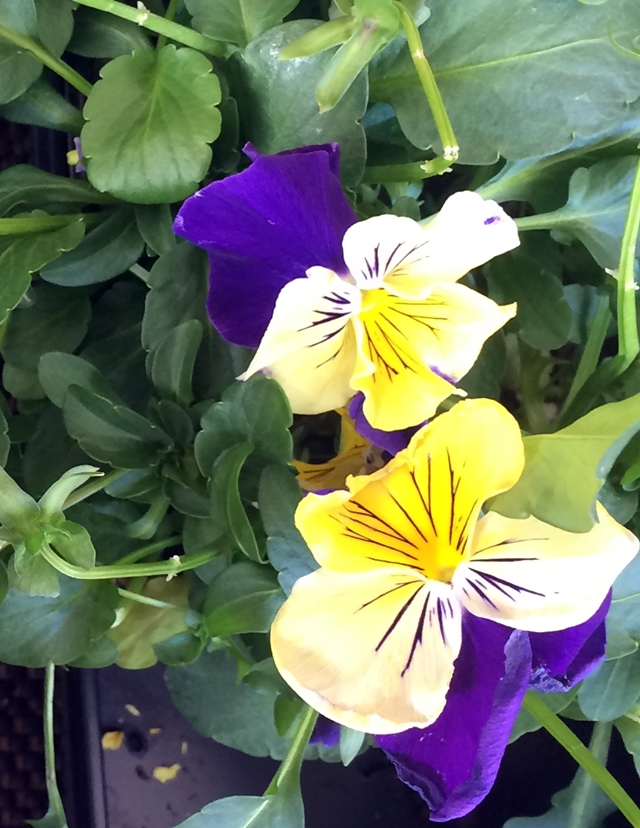
pansies-640

Helpful tool

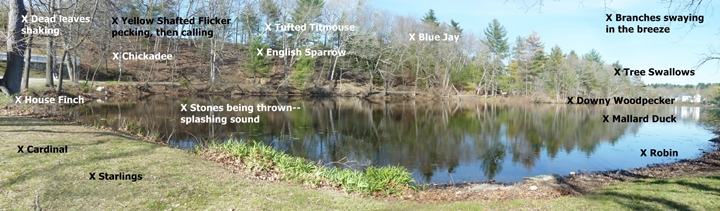
Stillness, however, does not come easily in this busy world so I was grateful that Smith recommended another exercise to help me focus–creating a sound map.

Sitting in my lawn chair, I sketched the area you see here in my notebook and every time I heard a sound from nature, I drew an “x” where I thought I heard it and wrote down what it was. As you can see, I heard quite a bit!

panoramic photo (uses first and third photo)2-720

From listening to observing

In the listening, I began to appreciate the visual imagery around me.

This slideshow requires JavaScript.

Stillness opens the inner eye

Stillness and mindfulness are hard to achieve in this high tech, multi-tasking, noisy world. Patience and due diligence are rewarded however with the opening of the inner eye, that which sees beauty and truth around us and eventually, within us. It’s a simple truth really: the wonder of life and how it was created, and how we are lucky to be alive despite all the challenges.

Houghton MS Am 1506 (4)-Cranch

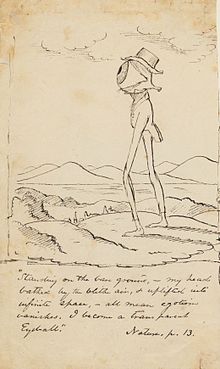
A compatriot of Thoreau’s, Ralph Waldo Emerson, once wrote of the transparent eyeball, an expression for which he was mocked. Wikipedia explains it this way:

 “The transparent eyeball is a philosophical metaphor originated by Ralph Waldo Emerson. The transparent eyeball is a representation of an eye that is absorbent rather than reflective, and therefore takes in all that nature has to offer.”

Emerson experienced an epiphany that day–the discovery of the ability to read between the lines in the world around him, and come to an understanding of a deeper existence within him.

Once that eye is opened …

… you never want it to close. All of a sudden, the smallest things become lovely, compelling, even exciting. Once I became mindful of what surrounded me in the natural world, I couldn’t get enough of it, especially when it came to bird watching and kayaking.

And once I made a commitment to pay attention to what was there inside of me, allowing myself to to be drawn closer to my Creator, I find I can’t get enough of that either.

Silence is becoming an elixir.

I understand from the great mystics that you can learn to be quiet and still even in the midst of noise and chaos. Wouldn’t that be something! Somehow I think a bunch of people with that kind of inner harmony could truly change the world for the good. Think about it.

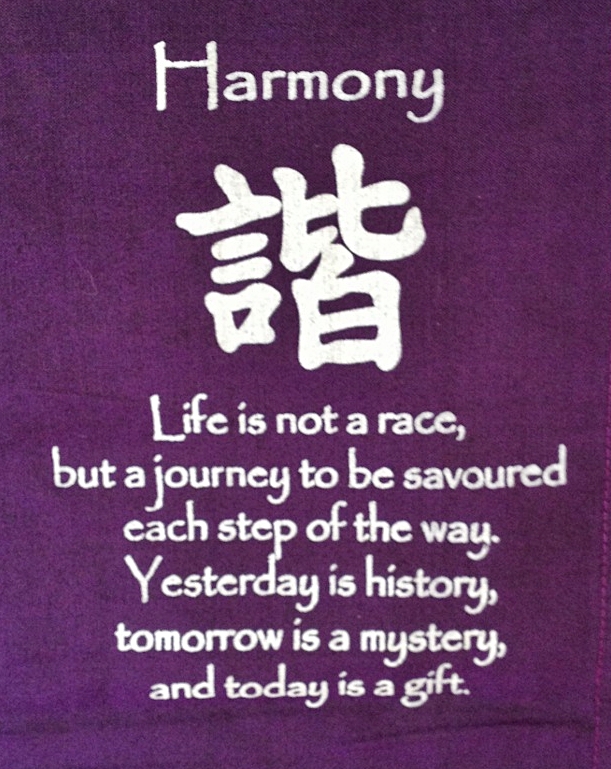
harmony1

Your time of stillness

Try spending thirty minutes in the woods, in a field or by a pond this Spring. Create your own sound map and share it here. Let’s compare notes and find out how we are doing on our journey to harmony.

You can find out more about Henry David Thoreau for Kids here, and read about the author, Corinne Hosfeld Smith, here.

Click to Tweet & ShareOn the journey to harmony–Thoreau, the Sound Map and opening up the inner eye http://wp.me/p2D9hg-1IH

em space


Many people find coloring to be a wonderful way to relax and experience harmony in their lives. Is that you? Join my Email List to subscribe to this blog and receive your free Harmony coloring book (and more).

Susan Bailey, Author, Speaker, Musician on Facebook and Twitter
Read my other blog, Louisa May Alcott is My Passion