There is no doubt that we are in the midst of a violent storm, in the world around us, and in our own private spheres.
We wake up to another terrorist attack or senseless shooting. We face a crisis of trust in our leaders.
Our faith is under siege. Believers face ridicule and rejection, and for some, martyrdom.
Sickness and death surround us. We witness children in poverty dying of starvation around the world. We encounter suffering, death and grief among our own families and friends.
In the midst of these storms,
do you find it difficult to pray?
We feel its power pushing us forward, carrying us as does a river’s current. It takes us many places both serene and chaotic. It molds and shapes us. Yet there’s nothing concrete to grasp onto. We cannot dip our hands into its waters nor physically feel that current.
The gospel reading for the first Sunday after Easter features the doubting Thomas as depicted in John 20:24–29. I have always been moved by his story. In my book, River of Grace, I wrote the following:
“When the others told him that they had ‘seen the Lord,’ he refused to believe. He treated their story with skepticism that bordered on rejection. He was provocative in his declaration that he would not believe unless he placed his hand in the side of Jesus and probed the wounds with his fingers. Thomas deliberately pushed away any semblance of hope that Jesus was alive. He did not dare to believe. Reading that passage I understood the bitterness in his demands and the refusal to face his pain. When Jesus appeared to all the apostles several days later, he invited Thomas to do as the others had done: touch his wounds.”
Death is a traumatic experience. In the case of Jesus, it came as a total shock to the disciples despite the fact that Jesus had warned them many times of his impending death. He also promised them hope in the aftermath. Yet as we have witnessed in the readings following Easter, even when Jesus was right in front of them, they could not believe. Continue reading “Hiding ourselves in the wounds of Christ – a post-Easter reflection”→
They are testing Jesus “so as to bring a charge against him.” They want to be rid of him.
If Jesus answers that the woman ought to be stoned to death, which was the penalty for adultery under Mosaic law, he would be challenging the Roman authorities. The Romans had banned executions without their authority or approval.
If Jesus answers that she not be punished under the penalties imposed by Mosaic law, then Jesus sets himself up in opposition to what Moses prescribed.
So it’s a trap.
But Jesus uses the trap to unmask the hypocrisy of these pious frauds.
These guys are using this woman as a pawn in their scheme to discredit Jesus.
They don’t care about her, or about justice or the even well-being of whatever marriage has been violated.
The leaders are using the woman as a chess-piece.
If they had even a modicum of interest in justice wouldn’t her male accomplice be under scrutiny too? (It did say, she was caught in the act of adultery, didn’t it? The law required the same penalty be meted out to both. But this guy is nowhere to be found. How convenient!)
So Jesus says, “Hey, put down your stones!” Start scrutinizing your own heart before you throw stones of condemnation at others. This whole situation you’re presenting is corrupt and rotten to the core.
The gospel tells us that the religious leaders went way, beginning with eldest.
(Maybe the older ones realized that with the accumulation of years, they had more “scrutinizing” and soul-searching to do.)
The woman is left alone with Jesus. He tells her to stop sinning. “Don’t do this again.”
Just as importantly he tells her: “Neither do I condemn you.” In doing so, he saves her life. And, he gives this woman a new lease on life.
Let’s pray that Jesus’ provocative and courageous actions would inspire us: and accept the simple truth that God, and only God, will be the ultimate judge of every life and of every heart.
In the meantime we can put down the stones of condemnation and redouble our efforts at healing and reconciling whatever is broken in our lives and the lives that cross our path each day.
The younger son asks for his inheritance and then wastes the money to the point of starvation. The Father compassionately welcomes him back. The “dutiful” stay-at-home elder son protests the welcome given to the younger son. At the end of the story, one wonders whether the older brother will be reconciled with the merciful Father.
Jesus addressed this parable to religious people who disliked Jesus’ table fellowship with “sinners.”
Here are some details about the story
that might help to hear it with ‘new ears”
this coming Sunday. *
In Jesus’ time, fathers were discouraged from distributing inheritance during their lifetime. But if he did , a father was still entitled to live off the proceeds while he lived. The younger son acts shamefully, effectively wishing the father were dead. That the father did not explode and discipline on the spot testifies to the depth of his love. The elder son is no better. Instead of protesting the inappropriate property division and refusing his share, he accepts it (v. 12). And he makes no effort to reconcile his father and brother as culture demanded he should. His behavior is equally shameful.
The younger brother sinks deeper into shame. Losing his money to non-Judeans through wasteful spending makes things worse. He begins to starve. He tries to leech on to a wealthy patron who assigns him a repulsive job of feeding pigs. (Remember, pigs are considered unclean animals in the Jewish tradition.)
Still he starves. The carob pods fed to the pigs were the wild variety with bitter berries, nauseating and insufficiently nourishing to humans.
Coming to his senses, the younger son resolves return home to become a “hired servant” of his father. He is willing to accept the shameful fact that the village will disown, reject and physically abuse him for taking his dad’s inheritance and before his death and then losing it to Gentiles. Nonetheless, the younger son judges this a small price to pay for life and food.
The father acts in a way that is shocking for the culture of the time. He runs (very inappropriate for an elder) the gauntlet the village has prepared for the returning wayward son. He publicly forgives the son by kissing him on the cheeks, and heals the broken relationship between them. The best robe is certainly the Father’s. It will guarantee the son’s acceptance by the community at the banquet. The signet ring indicates enormous trust. The sandals are a sign of being a free man in the house, not a servant. (Servants and slaves did not wear sandals.) Killing the calf means the entire village will be invited and prodded toward forgiveness. This size animal can feed over 100 people.
Instead of honoring his father by accepting his brother and playing his appropriate role as chief host at the meal, the elder son publicly insults and humiliates his father (vv. 28-30). The insults are jarring: he addresses his father without a respectful title; he speaks of himself as a “slave” and not a son (v29); he accuses the father of favoritism (him a calf, me not even a goat!); he refuses to acknowledge his brother (“this son of yours”; he invents the claim that his brother lived with prostitutes.
In effect, this elder son’s heart has always been elsewhere. He too wishes his Father were already dead.
Once again the father replies to the wayward son with love and acts of self-humiliation. He returns insult with an endearing “my child…” He assures him that his inheritance remains intact, and he invites the elder son to join the festivities.
Here the parable ends rather abruptly. What will the elder son do? That is the question the Pharisees and scribes and the modern believer must answer. This is really the story of two lost sons. One was lost, but found. The other… well, we just don’t know…
This Sunday is called LAETARE SUNDAY. It is the Fourth Sunday of Lent, we reach the mid-point of the Lenten season. The Mass vestments this Sunday are rose colored, rather than the usual Lenten purple.
The custom dates back to the Middle Ages when the Pope carried a single rose in his right hand when returning from Mass on this Sunday. At the time, the rose was a symbol of Christ due to both its being beautiful and yet being covered with thorns. The Pope’s carrying a rose was a visual reminder that the celebration of Christ’s Passion is not far off. Soon we will experience the beauty and the suffering (thorns) of Christ’s love for us.
While the Pope’s custom was abandoned, the symbolism continues through the rose colored vestments worn at Mass.
Holy Week and Easter are not far off. But it isn’t too late to make this Lenten season a time of personal renewal. Remember, the word “Lent” comes from the old English word for” springtime.” During this season, the liturgy invites us to experience a “springtime” from within, a new beginning within our souls. How will your spirit be renewed to embrace the joys and challenges of 2016?
For more aids to your Lenten journey, visit the Lenten Resources page for posts, podcasts, music and videos, plus a stay-at-home mini retreat.
Welcome to this Lenten Mini Retreat of self-examination and discovery:
“The Journey Within: Seeing Ourselves in the Eyes of God by Following the Path of Jesus”
This retreat consists of an hour-long presentation of word and song. It is broken up into sections and features several short videos. You do not need to do the entire retreat in one sitting. In fact, I recommend that you do a portion each day over several days so that the lessons really sink in.
You will need three additional items in order to participate in this retreat:
I present this retreat to show that by following our Lord’s example we find that the journey of self-discovery is not a self-indulgent act but one of love, towards ourselves and our Creator. It is an act of humility where we come face to face with the ugly truths and weaknesses in our lives and give them over to God. It is a fruitful action, empowering us with the confidence and vision to carry out the wonderful life plan that God has given to us.
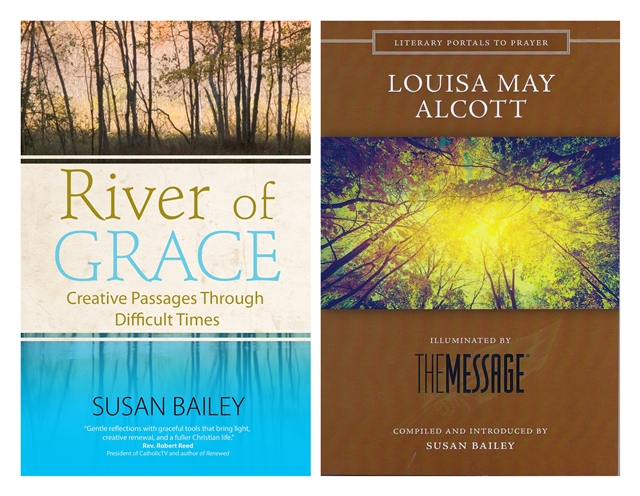
This presentation is drawn from chapter 6 my book, River of Grace. You will be led on a rich journey where you begin to see yourself as God’s beloved child, fearfully and wonderfully made with a glorious mission to fulfill.
Let’s begin.
Listen to Part One of this retreat–it is the longest segment, lasting approximately 34 minutes:
a. Watch the video:
2. Listen to Part Two (3 minutes, 55 seconds):
a. Watch the video:
3. Listen to Part Three (6 minutes, 35 seconds):
a. Watch the video and sing along:
4. Listen to Part Four (1 minute, 50 seconds):
a. Watch the video:
5. Listen to Part Five (1 minute, 41 seconds):
a. Watch the video and sing/pray along:
6. Listen to the last portion, Part Six (13 minutes, 1 second):
I hope you have enjoyed this mini retreat–perhaps it will lead to a lifelong habit of self-discovery. Remember always to keep your eyes fixed on Jesus and follow every footstep of his path.
Citations:
This retreat quotes extensively from Chapter 6 of River of Grace: Creative Passages Through Difficult Times by Susan Bailey and published by Ave Maria Press. Flow Lesson handouts also come from this book.
Copyright 2015 Susan W. Bailey
“Lead Me to the Wilderness” copyright 2016 Susan W. Bailey
“In His Eyes” sung by Mindy Jostyn; written by Mindy Jostyn and Jacob Brackman, available on the album In His Eyes. Song used by permission.
Share with your friends
Going on a retreat with a friend can make it extra special. You can easily share this retreat with your friends
on social media – just click on the links below:
I had a theology professor who would often say, “When preparing your Sunday homily, you should have the New York Times in one hand and your Bible in the other.” His point was that good preacher connects his message with what is happening in the world around us.
Good preaching addresses the issues that people are thinking and talking about.
This Sunday’s gospel is presents Jesus as an outstanding preacher (Luke 13:1-9). He uses recent events in the news to help illustrate his message about God.
Apparently there had been a deadly massacre near the temple in Jerusalem. Also, some workers at a construction project were killed when the tower they were building collapsed. (In today’s terms we might think of a mass shooting or of the recent crane collapse in New York City.)
Many people in the time of Jesus believed that disasters and tragedies were signs of God’s anger against sinful individuals or people. They thought that these terrible events were “punishments” sent by God.
“Nonsense!” Jesus says. Neither good fortune nor calamity are indicators of one’s favor or disfavor with God. In other words, good and bad things can happen to anyone. However, in the future, God will judge the hearts of every soul, regardless of their situation in life.
(Some people aren’t going like this Sunday’s gospel. People who like to believe that tragedies that befall individuals are “punishments” from heaven might get a bit uncomfortable. Jesus’ words will challenge their thinking. Hopefully they won’t walk out of Mass.)
Jesus then tells a story about a fig tree—a fig tree that doesn’t bear any fruit. Stubborn tree!
Nonetheless, the vinedresser patiently nurtures, waters and cares for the tree—patiently hoping that it will bear fruit.
The point of the story is that God is merciful. And God never stops planting, in our lives, opportunities to start over, to try again, to rework things, to move beyond our hurt and pain and make things right.
Lent is already well underway but perhaps you are still in need of ideas for your reflection. Click on any of the images below for blog posts, songs, videos podcast presentations and Flow Lesson exercises to enhance your Lenten experience:
[huge_it_slider id=”30″]
Do you have a particular spiritual practice that helps you draw closer to God? Please feel free to leave a comment and share–we can all use new suggestions!
And please–feel free to share on your social media:
This Sunday’s gospel tells us that Jesus led Peter, James and John up a high mountain (Luke 9:28-26) to pray. Apparently the three disciples got a bit sleepy, however. (Maybe all that mountain climbing was tiring.)
Nonetheless, we’re told that “becoming fully awake,” they got to see Jesus in a new light.
They “saw” him in a way they never before experienced. And, a voice beckoned them to “Listen, to my chosen Son.”
Words will never adequately describe what Peter, James and John experienced that day.
And while the gospel doesn’t give a quick “wake up” remedy, it does imply that opening our eyes will involve moving beyond our comfort zones—like the strenuous workout of a mountain climb.
–You need to get to the mountain top in order to appreciate the view and “take in” the vista. (Usually not much of a “view” at the comfy lodge at the foot of the mountain!)
“Seeing in a new way,” is the fruit of prayer. If prayer is stretching our hearts and minds to see things as God sees them, then prayer will push us beyond our ourselves and challenge us to look at the bigger picture of our lives and the world. Prayer will dare us to gaze even into the “beyond” of eternity.




 Be as One